
The theory of the elements or the 'Scholten method' is based on the periodic table: Jan Scholten has found a new approach for the safe application of mineral remedies. His method complements and greatly expands traditional homeopathy. It also casts new light on previous materia medica: many familiar symptoms become understandable that were previously only known as detailed facts and had to be learned apparently without connection. The new method is based on the natural order of the elements, the periodic table. It now allows medicines that were not previously tested to be prescribed in a comprehensible, convincing way. This has proven true for more than 20 years and has been independently confirmed worldwide by numerous cures.
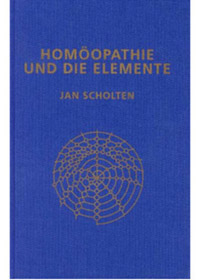
That the periodic table can also provide a new understanding of mineral remedies for homeopathy is self-evident, since this natural ordering of all substances was already used earlier to predict first the chemical and later the physical properties of the elements. As the most ingenious homeopath of our time, Scholten found the long-sought key. He called it “The Theory of the Elements”. A genuine breakthrough in medicine, a wonderful expansion of the healing arts, perhaps the greatest discovery of our time!
The periodic table is a natural order and did not arise from human arbitrariness: The elements develop according to a universal blueprint, the code of nature, which reflects a well-defined order of the cosmos. They can most simply be arranged in rows and columns, as was done from the start when Mendeleev first discovered this system by comparing the chemical properties of the then-known elements. He thus predicted the chemical properties of elements that had not yet been discovered. And it was correct, for soon the elements marked only by gaps—e.g. scandium—were found and behaved in terms of weight, size and chemical bonding exactly as he had asserted.
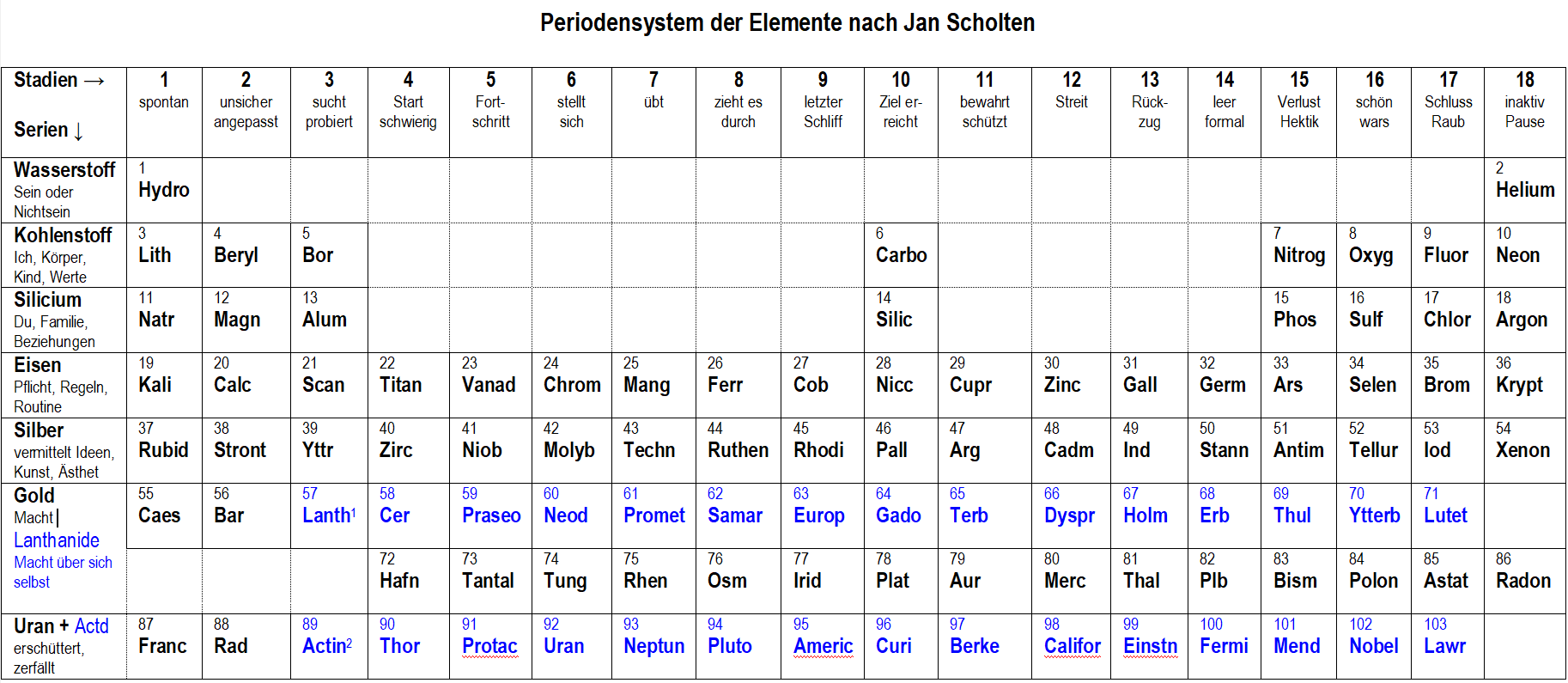
The properties of each element arise from its position in the periodic table: The seven rows and 18 columns of the periodic table were called by Scholten “series” and “stages”. Thus there are seven series and 18 stages. The series are the levels of mental and physical developmental stages from childhood to old age, and the stages are the steps through which these levels are traversed: from spontaneous beginnings (1) through a learning ascent (2–9) and success (10, 11) to the subsequent decline (12–17), in which one learns how to let go of what has been acquired and not cling to it. Thus the “carbon series” is the second row, the series of childish experience. It contains elements such as carbon, nitrogen and oxygen, the basic building materials of the body. They are also known in classical homeopathy as elements of physical vital functions. Carbo vegetabilis, the potentised vegetable charcoal, is a good breath booster in cases of poor oxygen supply. Only in recent years has nitrogen and oxygen as the combined molecule NO become known as a vasodilating physiological substance in circulatory regulation, but it had already been used in homeopathy as Nitrogenium oxydatum and its indications for vasodilation can be derived from the theory of the elements.
The remedies of the carbon series such as Graphites (potentised elemental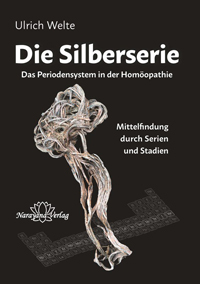 carbon), lithium or oxygenium have long been known in homeopathy in part. Their remedy pictures are mostly body-related and linked to relatively simple vital functions. Lithium is similar to natrium but much more childish, naive and completely bipolar; carbo mainly needs a lot of fresh air to breathe; and the electron-hungry, possessive oxygen grabs every passing electron of a positively ionised element it can get hold of and oxidises it: “you belong to me, body and soul” etc. By contrast, the elements of the gold series, the sixth row, are much heavier and more ponderous and occur far less frequently in the body and in nature than the elements of the simpler series. Physically they are built much more complexly with a larger mass of protons and neutrons in the nucleus and a correspondingly larger number of electrons in the shell, which race about the nucleus in different, also more complex layers or shells and behave more complicatedly in chemical bonding.
For example, lead, the homeopathic Plumbum, is an element of the gold series in stage 14 and thus a very different remedy from the much lighter and less complex sodium carbonate (Natrium carbonicum), which as a compound of an element of the third row with an element of the carbon series only possesses the properties of the latter. Sodium, as the first element of the third row (silica series in stage 1), primarily concerns spontaneous (St. 1) interpersonal relationships (Sili series) between two people; it is about spontaneous opening into affection or about closeness in aversion (he loves me – he loves me not), that is, about dyadic relationships that want to complement each other to form a family and have children, and this relationship must also remain physically stable (carbonicum, St.10 of the carbon series). Lead, on the other hand, is a heavy element in stage 14 of the sixth row, the gold series, and can therefore be healing primarily where it unfolds the traits typical of the gold series and stage 14: in elderly people who are paralysed after a stroke and have lost control over their nerves, or in sclerotic deposits of an aged circulatory system, especially in people who have already passed the zenith of their life (a stage beyond 10) and suffer from neurological disorders or brain diseases (a pathology of the gold series) and who must recognise the emptiness of their existence (St.14) as a former manager of a company or as a former mayor or rector (gold series) after younger people have moved them aside to a sideline (St.14), where they can only act formally or merely mediate diplomatically (St.14).
In short, those who already know homeopathy well and have then grasped and internalised the series and stages vividly can deduce the properties of mineral remedies to a certain degree and work therapeutically with them in a very lively way. It makes remedy selection more accurate, more flexible, simpler and more exciting; indeed, many therapists only came to properly understand and love homeopathy through this new approach.
Recommended reading: Those who want to know more beyond the first impulses are especially recommended the three main works by Jan Scholten: Homoeopathy and Minerals; Homeopathy and the Elements; and Secret Lanthanides. Those who want a simple yet profound introduction to the theory of the elements illustrated by case examples from homeopathic practice are recommended the book by Ulrich Welte: The Silver Series – The Periodic Table in Homeopathy. Those who want to know more about the further development of these ideas for a new systematisation of the plant kingdom are recommended the introductory book on Scholten’s plant theory by Martin Jakob How the Plant Theory Works! – all available through the Narayana Verlag in Kandern.
--------------------------------------------------------------------------------------------------------------
 |
Autor: Specialist in general medicine, |
Photo: 570894151 by Jason Winter
--------------------------------------------------------------------------------------------------------------


