
The Colours of the Hummingbird – Calypte anna, Part 3
A case of dysmenorrhoea with cyclothymia – flitting around, unsteady high mobility.
by Peter Tumminello
What happened so far: Part 1; Part 2.
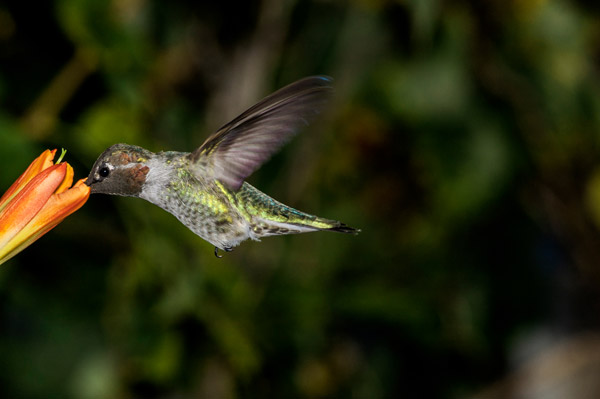
The third hummingbird case comes from Peter Tumminello and was the first to provide the basis for the colour preference of the remedy; Monica Rigney picked up the thread with her two cases, as we saw in Part 1.
Peter Tumminello writes:
A 23-year-old woman returns to me because she had benefited from a number of remedies previously.
She begins with the thought ‘there have been many changes, in the family, with friends and with myself’. Then she talks about many changing relationships with young men. She mentions three in particular and I see that these relationships constantly go back and forth; she seems boundlessly flexible in them.
 ‘When I broke up with Jim, a lot happened... after a month I met another, Ben, we were together for a month and it ended strangely. We split up because I liked someone else, James. I went to him in Queensland, and so Ben cancelled a planned big trip for me. But it wasn't over with Ben. We like each other, but I don't want a serious relationship with him again. I want to see him again, but I don't know whether he wants that too.’ Then a stranger helped her when her car broke down, and she immediately invited him for dinner.
I was quite puzzled by her changing affections and had the feeling as if a very lively, plump, jumpy little creature were flitting around in front of me, like in a zoo. She also says she dreams that her best friend's boyfriend would ‘hit on’ her. She concludes the account of her love life with: ‘in my relationships there are many losses and a constant back and forth’.
She has problems with her course completion: she does not read the required texts, fails an exam and only enrols at the very last minute to take it. Her moods change, at times elated, then deeply depressed; she is constantly out and about and socialises, but does not achieve much. For next week she plans a sailing trip, she wants to learn foreign languages and then she wants to go to Cuba! And then she is frustrated that the exams upset her plans.
Impression: She appears bright and light, with darting facial and body movements, and in her thoughts she races from one idea to the next, from one boy to the next, from place to place.
Physical complaints: In the last two cycles of her too-short period she had ‘shock pains’ lasting 2–3 days. Accompanying this is a strange sensation ‘as if my lower abdomen is rotting and wants to fall away’. This is worse during the period, and then she would most like someone to stand on her stomach.
She does a lot of sport: yoga, netball, running and swimming.
Analysis: My perception of her pronounced energetic presence was of an animal with quick and light movements, perhaps like a butterfly. I decided to focus on her unusual symptom of the ‘rotting lower abdomen’ and checked in my repertorisation programme whether any flying animal had produced such a proving symptom. I found four insects and three birds. The flea (Pulex irritans), the housefly (Musca domestica) and the cockroach (Blatta orientalis) did not match the feeling of her type of mobility, whereas the butterfly (Limenitis) was definitely a possibility. Among the birds the omnivorous Corvus corax and the large scavenger Cathartes aura did not suit her gentle, light and interactive manner. And then there was Calypte anna, the fast-flitting hummingbird, with its mobile lightness. A prover of the remedy had noted the symptom: foul-smelling flatus like a ‘rotting old skunk’.
I asked her about a colour preference, and without hesitation and confidently she chose a radiant blue, 15C. Although Calypte anna at that time was not yet listed under this colour, the remedy, with its quick mobility, the luminous plumage and the hummingbird's high energy level, matched her nature. It seemed to me that she was constantly flitting from one person to another, from one place to the next, and was only seeking the sweetness of many contacts. I prescribed three doses of Calypte anna M.
Course: She returned 5 weeks later and said that she felt ‘more grounded’, she was more present and did not need to be constantly among people. Her severe mood swings disappeared quickly. She had a confrontation with her best friend, took a clear stand for the first time and did not become as upset as usual, because she usually avoided conflict. She has become calmer and no longer constantly seeks contact with young men. My impression is that her former airiness and flightiness has completely changed; she has become remarkably more mature. She has become more self-confident and no longer needs to ‘believe in girl-friendships when, on meeting again, they don't even say hello to me’. She enjoys dancing and attends a live music performance weekly. Her menstrual complaints have improved drastically; she can now work during her period and no longer needs painkillers. Her bleeding has also normalised and now lasts 4–5 days.
Now about 8 years had passed when I rang her again for permission to publish. She still remembers the benefit of the remedy and says that it made the necessary changes in her life easier. Since then she has had no problems with her menses, lives happily married and has two children.
“I think and feel that colour is of comprehensive importance. It lies close to the source of perception; it forms the interface of a good case-taking with the true disturbance of the energy field. Every homoeopath can grasp it, it only has to be evident enough. It sharpens the attentiveness of the therapist and the patients alike.”
Peter Tumminello, 6.12.2019
------------------------------------------------------------------------------------------------------------------------------
Photo: Shutterstock_1222370080 , Copyright: Nick Pecker

