

Feeling emotionally free again and building a healthy sense of self-worth
Do you know this feeling? Phrases like – “I'm not good enough”, “I can't have everything”, “I don't deserve to be rich” – many people suffer from low self-worth. This lack of self-confidence shows up in what they consider to be possible in their lives. You have probably observed it at some point – a person who grew up in material abundance handles money in adulthood in a very different and self-evident way. People who grew up in more impoverished conditions may not have integrated that sense of abundance. From childhood they know phrases like: “We can't afford that.” or “That's too expensive right now.” Those very phrases that we unconditionally believe in childhood shape us as adults if we are not made aware of them. And so we often unconsciously create life realities by unreflectively keeping these imprints. Each of us has integrated beliefs and it is worth taking a closer look at them.
Challenging beliefs
If you want to become aware of these beliefs in your life, listen to yourself and notice the stories you tell yourself and others about yourself. How often do you say something negative about yourself? Becoming consciously aware of these negative beliefs is the first step to freeing yourself from them. Because once we are aware of them, we can also change them!
How this can work is the focus of the Emotional Freedom Technique, commonly called EFT, a method widely used in psychotherapy that combines the traditional principles of acupressure/acupuncture with affirmations. You can read more about it in this article.
Neuroplasticity: How our brain reacts to emotions and why EFT works
Every emotion and every belief shapes our brain. Depending on what we believe and what experiences or vulnerabilities we have, the brain organises itself via synaptic connections. Our brain forms according to our input: the things we love or hate most are emotionally charged most strongly and are therefore wired most firmly in us. [1] Our emotional state therefore shapes our neural mapping. [2]
“We create our neural patterns through repetition, exposure and emotional context.”
In summary: The brain has the potential to change – this is called neuroplasticity. [3]
How you can stimulate the neuroplasticity of your brain with EFT
Brain research has by now shown in many studies that the brain can be physically influenced by emotions [4]. By experiencing emotions and then acting on them, you imprint your brain in a certain way. Conversely, this also means: if you no longer follow your old patterns and the emotions associated with them and do not continuously repeat them in your actions, those neural pathways fade over time and new ones can form.
Most of our patterns are closely linked to emotions and often operate unconsciously or semi-consciously. As soon as these patterns surface into your awareness, you are no longer at the mercy of those repetitions – and thus no longer at the mercy of the associated emotion. By becoming aware, you can regain a certain freedom of choice about whether you really need to act out the emotion or not.
This is where the Emotional Freedom Technique comes in. Once you are aware of an emotion or a pattern, you can work with EFT and consciously choose a different emotion—one that better reflects you and your true nature. [5]
EFT can help to unlearn what no longer serves us and instead establish new behaviours, thoughts and feelings that we desire.
What you feel determines your reality
That EFT is not a pseudoscience but is supported by evidence is now shown by many scientific studies.
This was different in the last century. During the 20th century scientists believed that the adult human brain was fully developed and at the same time unchangeable in its neural circuits. [6]
In the late 1990s this dogma was exposed, and rigorous studies then demonstrated the profound plasticity of the human brain. The breakthrough had been paved by studies at the University of California under Merzenich [7], who showed reorganisation of the brain after nerve damage, and by the renowned neuroscientist Michael Kaplan. He was among the first, in the mid-1970s and early 1980s, to observe neurogenesis using an electron microscope and argued that nerve cells can form anew even in the adult brain. [8, 9]
This was finally scientifically confirmed by studies by Swedish neuroscientist Eriksson and colleagues in 1998, which showed that “the human hippocampus retains the ability to generate neurons throughout life.” [10]
Later it was discovered that not only our learning centre in the brain (the hippocampus) is plastic, but that these structural changes can also occur in deep layers of the brain. In particular, research into the effects of meditation on the brain showed how certain forms of meditation can create a kind of neuronal highway to the amygdala. The amygdala is the centre that governs fear and other emotions. It has even been shown that this centre physically changes with extensive meditation. [11]
“Your truth is what you feel within.
And that feeling stems from a neural pathway in your brain.”
The Emotional Freedom Technique was developed almost simultaneously with the dogma breakthrough in the 1990s by Gary Craig. He is considered the method's founder.
“To heal unwanted sensations and return to a feeling of normality, you must retrain your neural networks. This is something you can do with education, support and a methodical daily practice. Medications cannot change the neurons for you. Neither can your family members, doctors, physiotherapists, audiologists or psychologists. Only you can change your neural maps, and you can learn to do this in a step-by-step process. In short, you can use the healthy neurons in your brain and body to set damaged pathways out of action and create new neural patterns that feel normal again.”
Joey Remenyi
You can view these neural paths as roads to freedom, a way out of old patterns. Because you can influence these highways using the proven Emotional Freedom Technique (EFT).
What is EFT?
The Emotional Freedom Technique (EFT) is a method from cognitive psychology. It combines acupuncture points with affirmations and has been shown to be helpful for various psychological conditions such as stress, anxiety, fear, depression, phobias and post-traumatic stress disorder (PTSD). Physical symptoms such as pain, fibromyalgia and traumatic brain injuries can also be positively influenced. [12]
While EFT long fought for recognition, more than 100 studies have since confirmed the effectiveness of this method. In Korea, for example, EFT is approved as a new health technology and it is also successfully used in psychotherapy here. [13]
What can the Emotional Freedom Technique help with?
EFT has proven particularly effective for regulating negative emotions. Especially for emotions such as fear, sadness, anger, guilt or frustration, the technique can be a useful aid.
Above all, this method can help to reduce stress and promote general relaxation. EFT can be especially helpful for resolving blockages. But it can also be used if you suffer from phobias or irrational fears, such as fear of spiders or fear of heights. For many life problems, EFT can be a valuable tool in the self-help toolkit. [14]
“The problems you can apply EFT to are extremely diverse:
from anxieties, phobias, stuck thought patterns and behaviours
and addictions to physical problems
right up to performance enhancement at school or work.”
Effects of EFT at a glance
The effect of EFT is scientifically evidenced, for example, in the work of Dr David Feinstein, in which he cites dozens of specific studies and summarises their findings. Feinstein is a clinical psychologist and director of the Energy Medicine Institute. According to him, the Emotional Freedom Technique helps with:
- Phobias
- Fear of public speaking
- Exam anxiety
- Depression, general anxiety disorders and other psychological symptoms
- Pain and physical illnesses
- Weight control
- Sporting performance
- Post-traumatic stress disorder. [15]
EFT for lack of self-confidence and negative beliefs
Our self-worth is shaped by the way we think about ourselves. These convictions can be deeply rooted. Almost everyone knows the negative remarks made about themselves, such as:
- I'm not good enough.
- Life is unfair.
- Life is hard.
- I can't have everything.
- Only those who work hard deserve a lot of money.
With the help of EFT, these negative beliefs can be transformed into positive ones. The success is reflected in a changed attitude towards a particular problem. The change can be measured using a rating scale or a kinesiology muscle test. [16]
EFT affects the psyche and helps with stress
EFT shows great success especially for stress symptoms, because the technique can mitigate the negative effects on body and mind. [17] Even stress associated with post-traumatic stress disorder (PTSD) can be reduced with EFT, as studies have shown. [18] That EFT need not hide behind other therapy forms for treating stress-related symptoms is shown by a study comparing EFT with talk therapy and with a rest group. The result was remarkable: the primary stress hormone cortisol was significantly reduced in the EFT group. Psychological states perceived as burdensome such as anxiety or depression halved in the EFT group, but not in the other two groups. [19]
EFT for anxiety and depression
Anxious memories trigger stress signals in the brain – especially in the amygdala. Through repeated tapping of certain acupuncture points this can be counter-conditioned so that the anxiety decreases. [20]
Dr Feinstein explains this mechanism as follows: A trigger evokes a specific reaction in the amygdala. By stimulating the acupuncture points, the amygdala calms down. As a result, the hippocampus responds differently and assesses this information as safe. The neural pathways change: where there was previously a fearful reaction, the memory can be neutralised. [21]

EFT can be very supportive in letting go of distressing emotions and is therefore often used in psychotherapy in combination with other methods
EFT for trauma
EFT is frequently used to treat trauma. People often suffer from trauma after events such as military combat, natural disasters, sexual assault or the unexpected loss of a loved one; this is often referred to as post-traumatic stress disorder (PTSD). PTSD is characterised by flashbacks to the trauma, negative thoughts and anxiety, sleep disturbances or irritability – conditions that have a very debilitating effect on the affected person.
EFT can help in processing these distressing traumatic memories and improve the symptoms. The method has been trialled in various traumatic situations, such as after the 2004 tsunami in Thailand, the 2008 earthquake in Pakistan and with survivors of the Rwandan genocide. [22]
Leading trauma researchers now agree that treating trauma can take place not only through cognitive understanding but also in collaboration with the body. [23] For example, Dr Robert Scaer, author of The Body Bears the Burden, states: “If the amygdala in the brain is not freed from the freeze response, the devastating physical and emotional effects of the trauma will perpetuate themselves.” [24]
How does the Emotional Freedom Technique work?
The EFT technique is based on tapping certain acupuncture points. These are located on the energy meridians according to Traditional Chinese Medicine, giving you direct access to the body's various energy qualities. In Chinese medicine these energy qualities are associated with both an organ and an emotion. It is precisely through this link that emotions can be influenced via the acupuncture points.
Many people find it hard to imagine acupuncture points because they are not directly visible to the untrained eye. Acupuncture points are access points to different energy qualities of your body. They are often found in small depressions that can be felt. For example, if you form an L between your thumb and index finger and then slide the index finger of your other hand along between the fingers, you end up in a depression. Here is one of the most important acupoints for letting go – Large Intestine 4.
There are many acupuncture points you can choose for the EFT method. The tool-set of eight points is very suitable for self-help in everyday life.
- Point: Crown – at the crown of your head; tap only lightly, similar to gentle raindrops
- Point: Eyebrow – tap on both sides of the face where the eyebrow begins.
- Point: Side of the eye – you will find this point at the outer edge of the eye where the bone starts, on both sides.
- Point: Under the eye – tap this point on both sides beneath the eye where the bone begins.
- Point: Under the nose – work the point beneath the nose above the upper lip.
- Point: Chin point – you will find this point above the chin and below the lower lip.
- Point: Collarbone – this point is located just under the collarbone, where the breastbone and collarbone meet.
- Point: Under the arm – locate this point about 10 cm below the armpit.
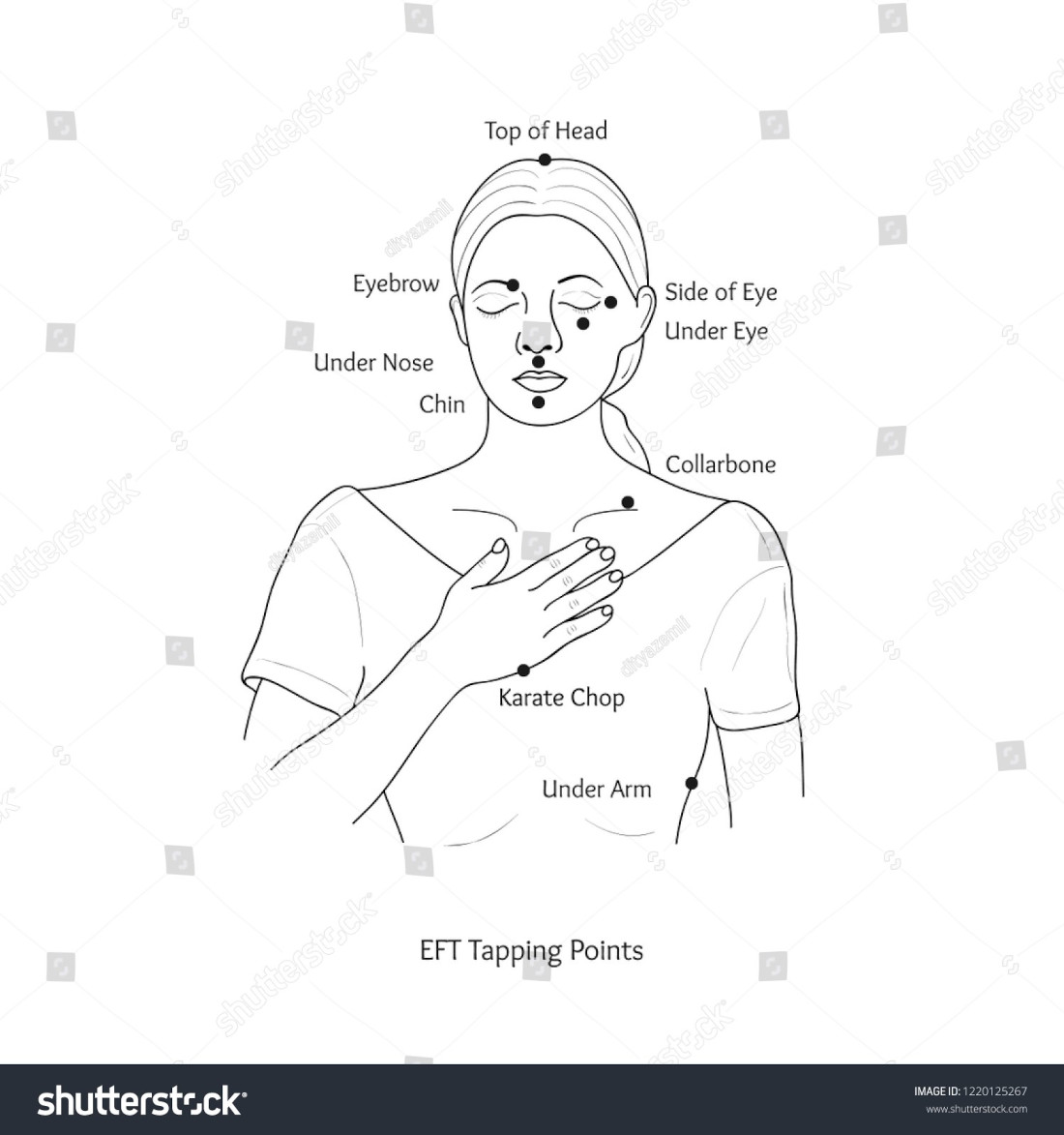
The most important EFT points for self-treatment
Short EFT guide: How to apply the Emotional Freedom Technique
Step: Problem assessment
You begin by internally rating your problem on a scale of 1–10, where 10 is the worst state and 1 the best.
Step: Determine an affirmation
Become aware of the problem and work with affirmations. An example of an affirmation is:
- “Even though I have problem X, I fully and completely accept myself.”
Step: Tapping + speak the affirmation
Now tap the sequence of acupuncture points with your index, ring finger and thumb pressed together. At each point speak the affirmation aloud.
Step: Reassessment
Feel your problem and rate it again on the 1–10 scale. If the problem persists, repeat the sequence again with a slightly modified affirmation.
- “Even though I still have problem X, I fully and completely accept myself.”
Use several rounds of the EFT technique to bring your result as close to “0” as possible. You can also add other points such as the Gamut point (a point on the back of the hand between the ring finger and little finger) if you are not satisfied with your result. [25]
The power of affirmations as an essential part of EFT
Most of our beliefs we either adopted from our parents or from our teachers or society and they became firmly anchored in us. With the help of affirmations – which then become the new beliefs – these old attitudes can be overwritten. This is also called “reprogramming”.
Examples of positive affirmations can be found, for example, from Dr Klinghardt, “Mental Field Techniques – very practical”. An affirmation should always be formulated positively and repeated frequently so that the brain learns it. It must always be expressed in the present tense. By repeating the affirmation over and over, e.g. 10 to 20 minutes daily, the newly programmed “neural highways” are established.
Recommended books:
Neuroplasticity and the effects of healthy synapses on the body:
- Joey Remenyi. Brain in Balance
Getting to know EFT as a self-help method:
- Susanne Marx. Klopfen befreit
Practical exercises and step-by-step tapping protocols:
- Fred P. Gallo. Klopfakupressur - Die Toolbox
Examples of positive affirmations and other valuable mental techniques:
- Dr Klinghardt. Mentalfeldtechniken - ganz praktisch
How to activate mental self-healing with findings from brain research:
- Marcus Täuber. Gedanken als Medizin
Disclaimer:
As individual as each person is, so unique are the suffering, pains and fears experienced. EFT is therefore never a panacea, but a tool that can support you in activating your own inner self-healing powers.
This article does not replace treatment by a qualified therapist. The basis of this article is studies and current literature. It must not be used for self-diagnosis or self-treatment. If in doubt, discuss any insights from this article with a therapist you trust.
Sources:
[1] https://link.springer.com/article/10.1017/S1745855209990330
[2] https://www.narayana-verlag.de/Brain-in-Balance-Joey-Remenyi/b28316
[3] https://www.verywellmind.com/what-is-brain-plasticity-2794886
[4] https://www.sciencedirect.com/science/article/abs/pii/S0028393297000705
[5] https://eftinternational.org/wp-content/uploads/2023/11/EFT-International-Free-Tapping-Manual.pdf
[6] https://anthrosource.onlinelibrary.wiley.com/doi/abs/10.1111/j.1548-1425.2010.01247.x
[7] https://www.annualreviews.org/content/journals/10.1146/annurev.ne.06.030183.001545
[8] https://pubmed.ncbi.nlm.nih.gov/11576677/
[9] https://en.wikipedia.org/wiki/Michael_Kaplan_(biologist)
[10] https://www.nature.com/articles/nm1198_1313
[11] https://books.google.de/books?id=DlnH-qadA08C&lpg=PA185&dq
[12] https://www.focusedhealthykids.com/wp-content/uploads/2016/07/College-Student-EFT-Study.pdf
[13] https://www.ncbi.nlm.nih.gov/pmc/articles/PMC10978442/#ref1
[14] https://eftinternational.org/wp-content/uploads/2023/11/EFT-International-Free-Tapping-Manual.pdf
[15] http://www.innersource.net/ep/images/stories/downloads/Acupoint_Stimulation_Research_Review.pdf
[16] https://www.narayana-verlag.de/Klopfen-befreit-Susanne-Marx/b23726
[17] https://www.focusedhealthykids.com/wp-content/uploads/2016/07/College-Student-EFT-Study.pdf
[18] https://www.focusedhealthykids.com/wp-content/uploads/2016/07/College-Student-EFT-Study.pdf
[20] https://www.focusedhealthykids.com/wp-content/uploads/2016/07/College-Student-EFT-Study.pdf
[21] https://www.innersource.net/ep/images/stories/downloads/Acupoint_Stimulation_Research_Review.pdf
[22] https://www.liebertpub.com/doi/full/10.1089/jicm.2022.0561
[23] https://eftinternational.org/wp-content/uploads/2023/11/EFT-International-Free-Tapping-Manual.pdf
[24] https://eftinternational.org/wp-content/uploads/2023/11/EFT-International-Free-Tapping-Manual.pdf
[25] https://eftinternational.org/wp-content/uploads/2023/11/EFT-International-Free-Tapping-Manual.pdf

