
The traditional 12 mineral salts and how they are used
Whether for digestive complaints, skin rashes or as part of a course of treatment – the range of applications of the Schuessler salts has proven effective for many symptoms and is extremely varied. The mineral salts discovered by Dr Wilhelm Heinrich Schuessler in the 19th century are based on a simple principle: disturbances in the mineral balance of the body’s cells are causative for imbalances in the body and, consequently, for illnesses. [1]
However, it is not the quantity taken that determines the effect of the Schuessler salts; rather, the so‑called potentiation ensures that they can be better absorbed by the body. Through the principle of dilution and dynamisation the body can “understand” the minerals more easily. This principle goes back to Samuel Hahnemann, the founding father of homeopathy. In Schuessler salts, the potencies D6 and D12 are mainly used because Schuessler found that these dilution levels are sufficient to activate the cells to better absorb the minerals.
How often do patients take calcium, zinc or selenium in isolation and the body cannot metabolise them? The information delivered to the body by the Schuessler salts stimulates the cells to restructure. They can detoxify better and absorb and transport nutrients more effectively. [2]
Which are the basic salts defined by Schuessler and what are they used for?
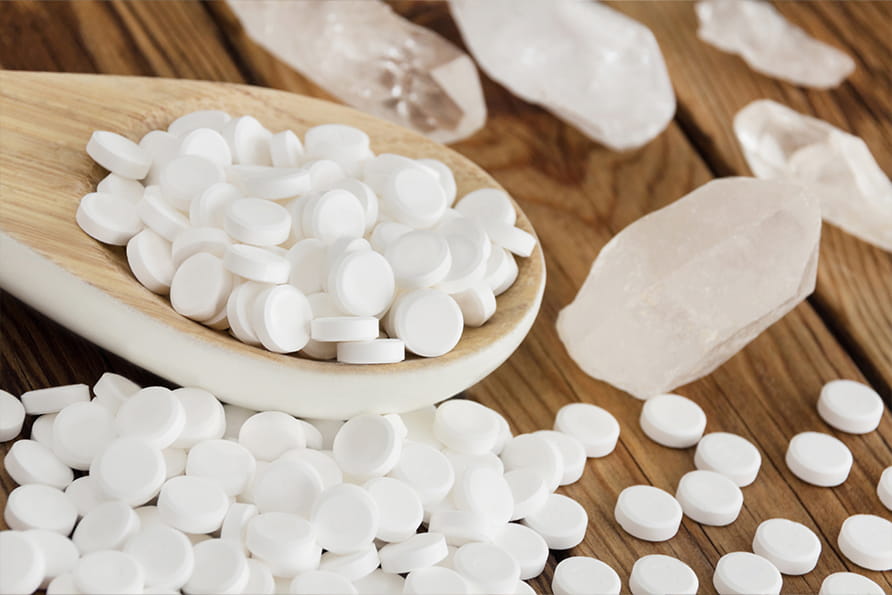
Figure 1:
Schuessler salts are mineral salts in homeopathic dosage (potentiation).
An overview of the physical aspects of the 12 basic Schuessler salts
No. 1: Calcium fluoratum – the salt of connective tissue, joints and skin
The first Schuessler salt is Calcium fluoratum, in German: calcium fluoride (fluorspar). It is the mineral salt responsible for the elasticity of tissues and bones. It strengthens tooth enamel and can also be used for depressive moods. This life salt is important for elasticity – whether in connective tissue, tendons, ligaments or bones. Wherever something has become too rigid, Schuessler salt No. 1 can be helpful. But not only for hardened structures; it is also indicated where something is too elastic and needs more firmness. Calcium fluoratum is closely connected to the body’s structural proteins collagen and elastin, so it is also capable of building supportive tissue in the body. [3]
| Areas of application: | Facial signatures: |
|
|
No. 2: Calcium phosphoricum – the salt for bones and teeth
Calcium phosphoricum, or in German calcium phosphate (phosphoric lime), is the Schuessler salt that can build up the body’s energy supply, calm muscles and nerves and support bone stability. It is considered the most important rebuilding remedy in biochemistry because it is responsible for bone strength. No. 2 is also of interest in cases of hyperacidity, as it balances the acid‑base equilibrium. Since it relaxes muscles and nerves, the salt has a calming and soporific effect.
Calcium phosphoricum was originally described by Schuessler as "a functional remedy for anaemic conditions and a restorative for tissues after the course of acute diseases". Calcium phosphate supports the formation of red blood cells so that the cells are better supplied with oxygen again. [4]
| Areas of application: | Facial signatures: |
|
|
No. 3: Ferrum phosphoricum – the salt of the immune system
Ferrum phosphoricum, or iron phosphate, is one of the first‑aid remedies for acute and inflammatory conditions. This life salt improves the oxygen supply to the cells and makes one mentally and physically fit.
Ferrum phosphoricum is often used in the initial stage of acute illnesses. Especially in the first phase of an inflammation it is considered an outstanding supporting fever remedy (up to 38.5 °C). It is therefore commonly used for flu and colds to boost immune defence. Similar to Schuessler salt No. 2, Ferrum phosphoricum is regarded as a good restorative remedy.
| Areas of application: | Facial signatures: |
|
|
Ferrum phosphoricum can be taken very frequently as a supportive therapy in acute conditions such as fever, pain or inflammation – every 5–10 minutes 10–12 tablets.
After sport, 20–30 tablets can be dissolved in 1 litre of water and drunk.
For prevention and strengthening the following are recommended per day:
- Adults: 4–6 tablets
- Children 6–12 years: 3–4 tablets
- Children up to 6 years: 1–2 tablets
No. 4: Kalium chloratum – the salt of the mucous membranes
The fourth Schuessler salt is Kalium chloratum. It is considered the mineral salt of the second inflammatory phase after Ferrum phosphoricum and supports the immune system, water balance, the airways and the mucous membranes.
Kalium chloratum has a detoxifying influence on the body. It can bind and eliminate pathogens and toxins. That is why it is so useful in the second phase of an acute cold, which is often experienced as very burdensome – roughly around the third or fourth day. [5]
As a potassium supplier, Kalium chloratum is an important salt for connective tissue, glands and immune defence.
Beauty tip: For women who want to tackle cellulite, Kalium chloratum is recommended because of its decongestant effect.
| Areas of application: | Facial signatures: |
|
|
No. 5: Kalium phosphoricum – the salt for nerves and psyche
Kalium phosphoricum, also known as potassium phosphate, could be described as a psychological salt. It supports mental health and strengthens the nerves. At the same time Schuessler salt No. 5 provides energy in the muscles and cells. Kalium phosphoricum can be helpful in high fever and also has a detoxifying effect on the body.
Potassium phosphate is found mainly in brain and nerve cells, but also in the blood and muscles. The potassium proportion is particularly important for nerve cells because potassium controls the transmission of impulses from cell to cell.
| Areas of application: | Facial signatures: |
|
|

Figure 2:
Kalium phosphoricum can strengthen nerves and psyche and thus help, for example, with depression or anxiety disorders.
No. 6: Kalium sulfuricum – the salt of detoxification
Kalium sulfuricum, potassium sulfate, is essential for cell renewal and can therefore be very supportive in regenerating skin and mucous membranes. It is helpful for acne and psoriasis. At the same time it is an important salt for detoxifying the body. It is particularly the sulfur component in Kalium sulfuricum that stimulates the excretion of pathogens via skin and mucous membranes. This prevents them from being deposited in the connective tissue. Sulfur is also an essential building block for the joints – connective tissue, cartilage and the bones themselves need sulfur.
| Areas of application: | Facial signatures: |
|
|
No. 7: Magnesium phosphoricum – the salt of muscles and nerves
Magnesium phosphoricum, in English magnesium phosphate, is responsible for calming and strengthening the musculature. In short: it makes nerves like wire ropes and ensures that complaints whose cause is stress come back into balance.
Magnesium phosphoricum relaxes by relieving cramps, which is why No. 7 is the biochemical remedy for any muscle cramps and muscle tension.
Moreover, Magnesium phosphoricum has a calming effect on heart and circulation. It can also act as a balancing agent in cases of hyperacidity, as it is a very important alkali‑forming remedy. It is very supportive in thrombosis, allergies and elevated cholesterol levels.
More than 300 enzymes are activated by magnesium. That is why Magnesium phosphoricum is so important for energy metabolism.
| Areas of application: | Facial signatures: |
|
|
Magnesium phosphoricum is also known as the "Hot 7". This refers to a special application of the 7th Schuessler salt, in which Magnesium phosphoricum is dissolved in hot water and drunk. This method is often used for rapid relief of acute complaints, particularly cramps such as menstrual pain and other pains.

Figure 3:
Magnesium phosphoricum supports, for example, in muscle cramps and nerve inflammations.
No. 8: Natrium chloratum – the salt for the fluid balance
Natrium chloratum is probably better known to many as table salt. Schuessler salt No. 8 is primarily responsible for regulating the body’s water balance. Natrium chloratum detoxifies the body and is also referred to in biochemistry as the “water remedy”. It is mainly found in the extracellular fluid, binds toxins there and supports their excretion. Wherever nutrient supply does not occur via the blood, Natrium chloratum is responsible for nutrient transport. This includes tendons, intervertebral discs or cartilage.
From a bioenergetic perspective, Natrium chloratum is also an interesting counterplayer to today’s overabundance of table salt.
| Areas of application: | Facial signatures: |
|
|
No. 9: Natrium phosphoricum – metabolism and hyperacidity
Schuessler salt No. 9 is Natrium phosphoricum, also known as sodium phosphate. It is found in every cell of the body and in all tissues and is the mineral used in chronic or latent hyperacidity. This alkaline salt causes deacidification in the body. It binds excess acids and supports their elimination so that the metabolism is stimulated again. That is why Natrium phosphoricum is known as the salt of metabolism and as a deacidifying agent.
It is also frequently used prophylactically to reduce the risk of kidney, bladder and gallstones, gout and many civilisation diseases such as type 2 diabetes, high blood pressure or obesity.
| Areas of application: | Facial signatures: |
|
|
No. 10: Natrium sulfuricum – the salt of internal cleansing
Schuessler salt No. 10 is Natrium sulfuricum, also known as Glauber’s salt. This mineral salt supports detoxification and decongestion in the body by dissolving fluid accumulations. It is a great aider of the excretory functions of skin, liver, gall bladder, bladder, intestine and kidneys.
Schuessler salt No. 10 ensures that excess fluid is eliminated from the cells via the kidneys and the skin. Natrium sulfuricum is also able to stimulate bile flow and intestinal peristalsis, thereby promoting detoxification and excretion.
| Areas of application: | Facial signatures: |
|
|
With Natrium sulfuricum the time of administration plays a major role:
- If this Schuessler salt is taken between 10:00 and 11:00, it influences urine excretion on the same day.
- At midday it tends to influence the liver,
- in the evening it supports bowel activity the next morning.
For diuresis, Schuessler salt No. 10 can be taken three to five times daily with 5 tablets each time.
No. 11: Silicea – the salt for hair, skin and connective tissue
Silicea is also known under the term silicic acid. The 11th Schuessler salt is considered a beauty and even a “rejuvenation salt” in biochemistry because it ensures the firmness of skin, hair, nails, bones and connective tissue.
It supports increased moisture retention in the tissues so that their elasticity and firmness can improve.
Silicea has also proven useful for nourishing bones and joints.
| Areas of application: | Facial signatures: |
|
|

Figure 4:
Silicea is also called the salt for skin, hair and nails and is used, for example, in hair loss.
No. 12: Calcium sulfuricum – the salt for the joints
Calcium sulfuricum, or calcium sulphate (gypsum), is primarily considered a cleansing and regenerating remedy. On the one hand it has a cleansing effect on skin and mucous membranes; on the other hand it stimulates detoxification processes in the liver.
Calcium sulfuricum is mainly found in the liver, bile, but also in brain, spleen and muscles. It supports the formation of connective tissue. Due to its sulphate content, Calcium sulfuricum is helpful in inflammations and all purulent processes.
| Areas of application: | Facial signatures: |
|
|
The descriptions chosen for the Schuessler salts are excerpts from a much larger range of applications. A standard work on the Schuessler salts that helps to better understand and apply the great healing potential of these twelve salts is the book by the Indian physician Dr Shankar Raghunath Phatak “The Great Schuessler Repertory.”
Book recommendations
- The Schuessler Therapy with 36 Mineral Salts. Rosina Sonnenschmidt
- The New Schuessler Home Pharmacy. Rosina Sonnenschmidt
- The Great Schuessler Repertory. S. R. Phatak
- Tongue Diagnosis and Schuessler Salts. Sigrid Molineus
- Facial Diagnostics according to Dr Schuessler. Peter Emmrich
- Schuessler – concise and to the point. Thomas Feichtinger, Susana Niedan‑Feichtinger
Further articles on the topic:
Disclaimer
Treatment with Schuessler salts should always be embedded in a holistic therapy concept so that the life salts can fully develop their optimal effect.
This article does not replace treatment by a qualified therapist. The basis of this article is studies and current literature. It must not be used for self‑diagnosis or self‑treatment. If necessary, discuss any inspirations from this article with a therapist you trust.
Sources
[1] https://www.narayana-verlag.de/spektrum-homoeopathie/schuessler-salze
[2] https://www.narayana-verlag.de/Die-Schuessler-Therapie-mit-36-Mineralsalzen-Rosina-Sonnenschmidt/b9462
[3] https://www.narayana-verlag.de/Praxis-der-Biochemie-nach-Dr-Schuessler-Thomas-Feichtinger-Susana-Niedan-Feichtinger/b7698
[4] https://www.narayana-verlag.de/Schuessler-kurz-buendig-Thomas-Feichtinger-Susana-Niedan-Feichtinger/b24100
[5] https://www.narayana-verlag.de/Zungendiagnose-und-Schuessler-Salze-Sigrid-Molineus/b13380
Figure 1: PhotoSGH/Shutterstock.com; Figure 2: oatawa/Shutterstock.com; Figure 3: GBJSTOCK/Shutterstock.com; Figure 4: Kmpzzz/Shutterstock.com

