
A professionally successful fifty-year-old man came to my practice for treatment after undergoing a nephrectomy for kidney cancer. Apart from the surgical removal of the affected kidney, his doctors had no other treatment to offer. His wife sent him to my practice to prevent a recurrence of the cancer and to find a solution for any acute situation that might arise. Her concern was partly because her husband tended to ignore and downplay his symptoms. His malignant kidney disease had repeatedly caused blood in the urine and pain. At one point he could no longer bear the pain, but by then the tumour had already grown to eight centimetres. An earlier treatment would not have fit his outlook, because he was tough.
Just cut it out!
Patient (P): "I want to explain it with a sporting metaphor: If we as a sports team hadn’t shown stamina, we would have lost quite a few games. Or if you’re an emergency doctor, you always have to ask what matters now, and that requires enormous strength. We do things to achieve something in the end and not to give up too early. You have to know you can achieve something if you put your foot on the accelerator, without help from outside and only with your own body."
He described himself as an optimistic, tough bloke who never needed painkillers; even at the dentist he didn’t use procaine. You’re not manly if you moan. Falling down is no shame, but staying down is. "I don’t need a safety net. I should have become a firefighter. When the going gets tough, I put my foot down and it will be fine. That’s my way of living. When there’s a lot going on, I react by working well, hard and fast."
Internal bleeding
When he learned of his diagnosis, he said: "Bring me the tools and cut the thing out." During the operation a small vein in his abdominal wall was injured and he almost bled to death. He needed ten litres of blood and had to spend quite a while in intensive care. He said: "When everyone else loses their nerve, my time will come."
He always wanted to build a house for his family, with a solid roof, tight windows and a fence around it. He is a "cave-builder". That way he would be safe from life's uncertainties. The family needs a secure place to fend off uncertainty and be less vulnerable.
P: "I do things only out of fear of being hurt. Friends know how to hurt me; thoughtlessness hurts me psychologically, but I pretend it doesn’t bother me. Only with my wife can I show vulnerability; there my whole apparatus doesn’t work so well. I make fun of myself first to prevent others from making fun of me and thereby hurting me."
Hard and vulnerable
"Yes," says his wife, "he has a very vulnerable emotional side that is incredibly soft and often touched. His father, an extreme sportsman, died at forty-eight from a stroke; he was dead within an hour." The patient was ten years old at the time and never mourned his father's death. "You have to cope with the new situation and make the best of it."
His medical history includes a massive herniated disc that had paralysed his entire abdominal wall. "That brought me to the edge of my pain tolerance and I had to take painkillers; otherwise I couldn’t bear it."
Analysis
This case was about vulnerability and the compensation on a physical and psychological level. This is the theme of the plant family Asteraceae. I then looked for a remedy from this family that meets injuries with a "toolbox mentality", as my patient called it, and at the same time has a strong tendency to bleed. It was striking and unusual that the patient nearly bled to death from a small injury to a small vein.
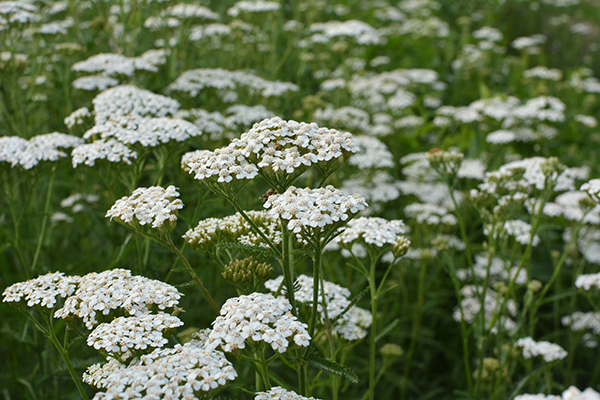
According to Sankaran's miasm theory, this fits the typhus miasm, in which it is decisive to perform at the highest level in a crisis. Both Chamomilla and Millefolium fit this miasm. The appropriate remedy was "Achillea millefolium". The name of this remedy is derived from Achilles, the hero of the Trojan War, who is said to have used Millefolium to heal his wounds.
Important rubrics
Mental: numbness
Mental: fearless
Urethra: discharge - bloody
Generalities: bleeding - cancer; in
Generalities: bleeding – injury; from
Generalities: injuries – operation – complaints from
Generalities: injuries – ruptures, tears – blood vessels; of the
Prescription: Millefolium C200, two doses given over a long period. Later 1M was given, four times over four years, always for treating an acute infection. He always responded promptly. Each time he was well again after just one day. His creatinine values, which were initially high after his nephrectomy (1.4 mg/dl), normalised (0.9 mg/dl). All subsequent tests were normal.
Systemic family constellations in addition to homeopathy
I later referred him for a family constellation therapy because I suspected his illness might have something to do with the lack of mourning for his father's early death. Surprisingly, this was not the case at all. Instead there was a strong connection to his maternal grandfather, who had been severely wounded in the war. After the therapy the patient returned to report: "You know, my remedy Millefolium is colloquially also known as 'soldier's herb'. Millefolium was often used in antiquity to stop bleeding from war wounds. My grandfather was a war correspondent who was in Russian captivity until 1955 and was therefore one of the last to be released. He died a few months later from the consequences of the privations he had suffered. The representative for my grandfather in the family constellation reported that he had only survived so long thanks to a plant that stopped the bleeding. Could it be that Millefolium was that plant?"
Patients who need a remedy from the Asteraceae family are often "tough guys" who are unable to respond adequately to injuries, who take a lot and do not allow themselves to feel pain. They respond to both physical and emotional pain with a numbing reaction. The healing process can begin when this blockage dissolves and the patient allows injuries and pain to be felt, as happened with this patient. During a follow-up the patient was able to cry and face the pain he had long suppressed. He visited his grandfather’s grave several times and felt at peace with him. Even on long walks in nature he feels his grandfather’s presence and finds him comforting. "He is there and that is good."
He has been receiving homeopathic treatment with Millefolium for six years and is symptom-free.
Note: Millefolium was classified into the typhus miasm by Dr Willi Neuhold from Graz, Austria.
Key terms: kidney cancer; vulnerability; fearlessness; tough; numbing reaction to pain; need to protect the family
Source: http://www.interhomeopathy.org/toughing-it-out-a-case-of-millefolium

