
The Colours of the Hummingbird – Calypte anna, Part 2
Fructose intolerance
An article by Ulrich Welte, Monica Rigney and Peter Tumminello, in three parts
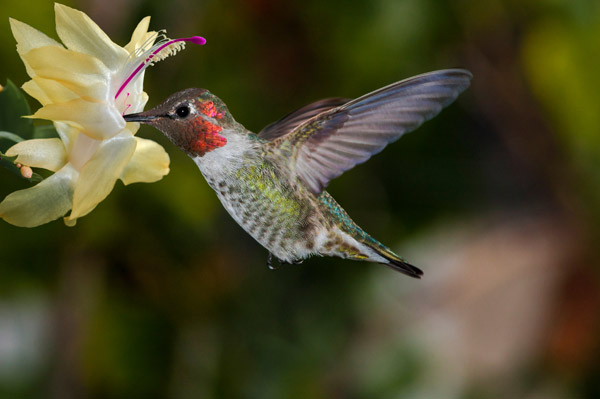
This observation comes from our practice in Kandern. The patient did not choose a blue like the patients from Part 1 of the article, but clearly Yellow 3C. Thus it is listed as single-valued under this colour, as no second case has been reported to date. Yellow is likely to be the remedy's secondary colour.
A relatively small woman of middle age presented with a diagnostically confirmed fructose intolerance. First impression: very slim, light, cheerful, humorous, always ready for a bright laugh, upright, agile and pleasant in manner; speaks quickly and purposefully. She can no longer tolerate a wide variety of foods and for two years has increasingly often had abdominal pain after eating, almost continuously for half a year, and she now has almost exclusively watery diarrhoeal stools. She can only eat small amounts and then she is finished. If she eats slightly too much, it lies like a stone in her stomach. Small frequent meals are best—the more often and the smaller the better. She really likes fine chocolates, pralines, but always only one and then stop, otherwise she feels nauseous. Best is a single Ferrero Küsschen and then nothing more.
She was thin even as a child, wanted to be a boy, was a fidgety child, always liked running around outside and being active. She often had dreams of flying “like a bird, it was very easy and pure pleasure.”
Analysis and course: Could it be a bird remedy? Flight dreams, lightweight build, lively and agile; so why not? – well: which birds does she love? Small ones, especially swallows and swifts, so agile and light.
In the comparative hand test, in which patients hold the little bottles one after the other in their hand for a while without knowing what they contain, she chose the hummingbird among the four tested (swift, swallow, hummingbird and buzzard). It makes sense to me, since the hummingbird is extremely sensitive to minute amounts of fruit sugar, which she cannot tolerate. I had just read the proving of Calyp-a and thought that the remedy might help in fructose intolerance. Her colour choice is clearly yellow 3C, second colour inconclusive 18B or 17C.
She received Calypte anna C30, by the plussing method. The first three days she felt nauseous and was extremely tired. Over the next two days everything improved. The stools improved, and especially the abdominal pain was much better in the following week, after 10 days almost gone. Bowel sounds that had been absent for 10 years returned. She had a dream: a bird sits on a branch and looks at her very intently. Its plumage is bright yellow to slightly orange and a little turquoise. Its gaze is full of compassion. – She also feels generally better and says the remedy is doing her good. Plan: Calypte anna C200, one dose every two weeks. After a further four weeks the stools became firmer after each dose and are now formed. The feeling of fullness is hardly present any more.
She remained symptom-free for three years. She laughs delightedly on the phone, her old bright cheerful laugh, when I ask her about the course. She says she is well and that I may gladly report on it. She can eat what and as much as she likes.
Remedy sketch of Calypte anna, the Anna hummingbird
(Excerpt from the proving by Cynthia Shepard with the addition of the cases published here for the first time):
CLINICAL: flickering, atrial fibrillation, palpitations. Fructose intolerance. Agitated. ADHD with a cheerful nature. Cyclothymia. Absences. Hypoglycaemia. Dysmenorrhoea.
From the proving: Deeply immersed in daydreams, from which she suddenly startles. Over-excitability and dullness alternating
The absent-minded professor; not very masculine, though brilliant and ingenious, but helpless and awkward in everyday life, impractical
Quick and spontaneous; quickly alarmed; exaggerated excitement, extreme mood swings – Phase 1
Often hums to herself; sings and trills; always on top; cheerful, in a good mood, great, hyper, feels on top of the world <–> dull, confused, absent, dazed. ‘Heavenly jubilant – miserably dejected’
Flu-like
Hungry, small amount satisfies; weight loss
Likes fine pralines, exquisite sweets. Likes salty, sour, olives
Sensation: lightness, as if detached; light <-> heavy.
Throbbing, pounding.
Stiff, as if frozen, rigid
Feeling as if she balances her head like a ball on a sharp stick (balancing my head on my neck like a ball on a stick) – Stage 10
SIGNATURE: can fly forwards, backwards and hover on the spot, darts from one blossom to the next
Fastest metabolic turnover and very rapid heartbeat; dependent on frequent food intake, but picky about food, seeks nectar, fructose, very sensitive to minute amounts
Territories with high nectar content are fiercely contested.
“Humming” bird: hums and buzzes in flight
DD: Coffea: both are in a good mood, have palpitations, an excited state -> Difference: Coffea likes yellow-green 23C, Calyp-a prefers pure blue 15–16C and yolk yellow 3C. Fructose intolerance and craving for sweets with small meals are more specific for Calyp-a
DD Lithium: both are lightweights with strong and rapid mood swings, but with Lithium these are more psychotic and point more towards bipolar disorders than the milder mood swings of cyclothymia in Calyp-a.
------------------------------------------------------------------------------------------------------------------------------
Photo: Shutterstock_1258093495, Copyright: Nick Pecker

