“Be careful with the stick, or you'll poke your eye out!” Has a sentence like this ever slipped out of your mouth?
Of course, we are all guilty as charged, right? Unfortunately, we mothers tend to paint the devil on the wall in many situations.
How about this one: “Don't squint with your eyes, or they'll stay crooked!”
Okay, okay. If you overdo the squinting, it might indeed happen that the eye muscles get tired at some point, but I've never heard of eyes actually becoming permanently “stuck” in a squint.
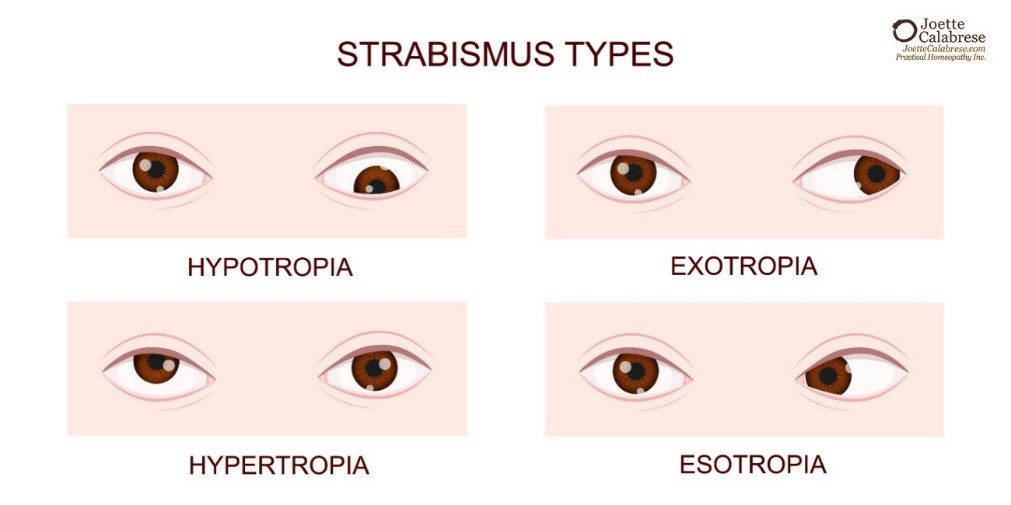
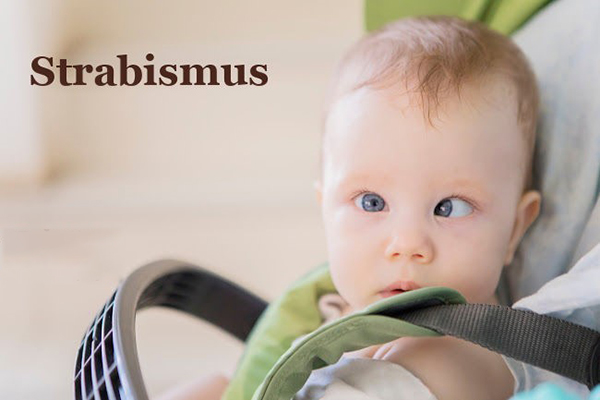
There is, however, a misalignment of the eyes that is medically called strabismus. Colloquially people also refer to it as “squint”. But squinting actually covers a whole range of misalignments.
[Forms of strabismus: From top left clockwise: hypotropia, exotropia, hypertropia, esotropia]
Strabismus in children
It is estimated that around 5% of preschool-aged children squint to some degree. The squint itself can be subtle or very marked; in the latter case the affected person has to squint to see properly. In instances where the coordination of the two eyes does not work correctly, binocular vision – 3D vision – can be limited or even entirely absent.
Strabismus can occur as a result of injuries, synthetic medications or muscle weakness, or it can be a symptom of another disease. So – as always – it is important to obtain a diagnosis. However there is no need to panic out of fear that surgery will necessarily be required.
There are several homeopathic remedies that we can use to treat strabismus, either alone or as an adjunct to surgery. Naturally it would go beyond the scope of this blog to explain all options, so at this point I would like to present two remedies and my thoughts on them.
Today I want to explain how to choose the right homeopathic remedy when you must distinguish between several possibilities. Specific details of the remedy picture are therefore not given here.
Argentum nitricum or Cuprum metallicum?
The first remedy one might consider is Argentum nitricum. Considering that this remedy is generally very good for the eyes, we should at least have thought of it. We're essentially talking about a more or less general treatment protocol for the eyes.
In the homeopathic method we strive to keep the list of potential remedies as short as possible by considering other pathologies that might influence our choice of remedy. For this we consult a homeopathic repertory and our materia medica. If we can find an additional clue (it does not necessarily have to be related to the eyes, but could be an emotional or general symptom) that completes the overall picture, that is another step toward the best-matching remedy for the specific condition called strabismus.
For example, does the person also suffer from anxiety or muscle spasms?
These pathologies, which “seem” unrelated to squinting, can provide valuable hints as to which strabismus remedy best fits.
If, for example, I find that the person also has severe anxieties, then Argentum nitricum could fit particularly well, because it treats both the strabismus and the anxieties – it bundles the two conditions into a neat package!
If the eyes flutter or twitch, that would be a bullseye for my second favourite remedy for strabismus: Cuprum metallicum. And why? Because Cuprum also helps with muscle cramps!
Even if the patient suffers from muscle cramps in other areas of the body (such as calf cramps or twitching), in that case I would favour Cuprum over Argentum, because the overall picture fits better.
Also in a strabismus following a head injury I would tend towards Cuprum, because the remedy has proven particularly useful in treating such injuries.
Homeopathy works gently and without unwanted side effects
See how it works? We strive to tie the package as neatly and cleanly as possible. We choose a remedy that not only heals the primary pathology but also addresses all the secondary complaints.
Ophthalmologists warn that untreated strabismus can trigger so-called amblyopia (the medical term for a lazy eye), which leads to loss of vision. As always it is important to work closely with a medical professional who cares about your health.
However there is no reason to panic. Homeopathy has proven effective in this and other conditions many times over and all without unwanted side effects.
Please remember to spread the good news – because homeopathy works! We can and should not keep this knowledge to ourselves. You owe it to your family, your friends and your community. Pass it on!
Warm regards,
Yours,
.png)