
Illustration: Light influences our metabolism – a key to regulating hormones and vital processes.
The effect of light on human metabolism is a fascinating and complex topic that is increasingly covered in the scientific literature. Especially interesting is exposure to different light sources, whether during the day or at night, and across different light spectra. Various studies have shown significant effects on a range of metabolic processes, including the regulation of hormones such as insulin, leptin and ghrelin.
To what extent does sunlight directly affect our physical state and, in particular, our metabolism? Which light spectra are responsible for which processes in our body?
In this article you will learn
- why our body needs light,
- how light concretely affects our body,
- what types of light exist, and
- how different light wavelengths affect our body.
What light does to our body – what the science says
“For the rest of my life I want to think about what light is.”
(Albert Einstein, 1916)
Recent scientific investigations have deepened the understanding of how light affects the human body and why it is so important for our health. After all, light is involved in controlling and organising various cellular processes, metabolic processes and brain function. The following findings are particularly noteworthy:
1. Light affects the circadian rhythm
The circadian rhythm, also called the sleep–wake cycle, is our "internal clock". Over a period of roughly 24 hours it controls numerous biological processes – not only sleep and wake phases, but also body temperature, hormone production, blood pressure and even metabolism.[1]
Light plays a key role in the sleep–wake cycle: it helps to synchronise this rhythm – especially natural morning sunlight, which signals to the body that it is time to wake up and be active. In the evening, darkness triggers the release of the sleep hormone melatonin.
The circadian rhythm is regulated by melatonin. The hormone released by the pineal gland is highly light-sensitive. It is suppressed during the day and released in the evening when it gets dark to prepare the body for the upcoming sleep phase.[2] A study from the Stanford Center on Longevity emphasises that morning sunlight in particular helps to stabilise our biological rhythm and improve sleep quality.[3]
Another important factor is the hormone serotonin, which acts as a precursor to melatonin. Serotonin production is increased under the influence of sunlight and boosts general well-being.
2. Light influences cognitive functions and mood
Daylight, especially in the blue spectrum, enhances attention, memory and mood. Research shows that morning light exposure stimulates the release of serotonin, which leads to an improved mood.[4]
3. Light and vitamin D synthesis
Vitamin D3 is one of the most important forms of vitamin D – the biologically more active variant that our body can produce itself through sunlight (UV-B radiation). Vitamin D3 is extremely important as it contributes, among other things, to the normal function of the immune system, to the maintenance of normal bones and teeth, and to the maintenance of normal muscle function. Many people in Germany suffer from vitamin D deficiency with the resulting symptoms.[5]
Ultraviolet B radiation (UVB, 280–320 nm) is the only part of the solar spectrum that induces vitamin D formation in the skin, and it is believed that this light provides more than 90% of the required vitamin D. UVB radiation first enables the conversion of provitamin D3 in the skin to previtamin D3. In the second step, previtamin isomerises to the actual vitamin D3 (cholecalciferol). This is further metabolised in the body to form biologically active forms.[6]
UVB rays – unlike UVA rays or artificial light – are therefore relevant for vitamin D3 production. Unfortunately, they cannot penetrate window glass, which means that vitamin D synthesis cannot occur indoors. The result: if we spend the whole day inside, UVB rays cannot reach us. Therefore, even short stays in the sun (e.g. 10–20 minutes for fair skin) are sufficient to stimulate vitamin D production.[7]
4. Light and metabolic activation
Daylight – especially the natural blue light in the morning – has a direct effect on our cellular powerhouses, the mitochondria. Studies show that light stimuli can activate certain signalling pathways that increase mitochondrial performance. This provides more energy at the cellular level, metabolism works more efficiently and physical and mental performance increases. But red and infrared light (e.g. at sunset or deliberately via red-light devices) can also improve the function of the enzyme cytochrome c oxidase, which increases ATP production and thereby improves cellular energy generation.[8] This process is called photobiomodulation.[9]
5. Light and weight regulation
Studies show that regular exposure to natural daylight not only regulates the circadian rhythm but can also support fat burning. Researchers at the University of Alberta found that human fat cells under the skin are light-sensitive. Via a light-dependent signalling pathway, especially short-wavelength (blue) light can have direct effects on fat metabolism. This could explain why natural light has a positive influence on fat deposition and breakdown.[10] At the same time, the risk of overweight and obesity increases when artificial light sources are left on during sleep.
6. Light and mental health
Lack of light is associated with depression and seasonal affective disorder (SAD). Light therapies using blue or white light have proven effective in reducing depressive symptoms and increasing motivation.
Particularly interesting is that bright light exposure shortly after waking can be used as an effective treatment for people with seasonal depression (SAD) and winter depression. This can speed up a delayed circadian rhythm and thus alleviate adverse metabolic conditions.[11]
7. Light, hormones and metabolism

Illustration: Light affects blood sugar, insulin and fat metabolism – a natural key to better insulin sensitivity and more efficient fat burning.
Light has a direct effect on blood sugar and insulin levels. A 2019 study showed that people who were exposed to more daylight in the morning had better insulin sensitivity than those living in darker environments. Stable blood sugar helps reduce cravings, particularly for sugary foods. This can prevent weight gain and contribute to a healthier energy balance in the long term. Higher insulin sensitivity means that cells respond better to insulin and use glucose more efficiently.
Light also affects fat metabolism on several levels: morning blue light increases metabolic rate and can boost fat burning. Red light in the evening promotes regenerative processes and the formation of mitochondria. UVB rays support vitamin D production, which in turn is involved in the regulation of fat storage and breakdown.
Light also influences several hormones that are essential for metabolism:
|
Cortisol |
Is stimulated by light in the morning and stimulates metabolism. |
|
Melatonin
|
Is released in darkness and regulates regenerative processes. |
|
Insulin
|
Light can improve insulin sensitivity and regulate blood sugar. |
|
Serotonin
|
Daylight increases serotonin production, which promotes well-being. |
Light also influences leptin and ghrelin – the two hormones that regulate hunger and satiety. Research shows that people exposed to less daylight tend to eat more and have a higher risk of overweight and diabetes.
Which light is beneficial? The effects of different light sources on the body
Even if we feel that the sun is a homogeneous light source, sunlight actually consists of different spectra. These spectra have different wavelengths, each of which has specific biological effects on our body.
The light spectrum spans various wavelengths between ultraviolet light and the infrared region. The human eye can perceive wavelengths between 380 and 780 nm.
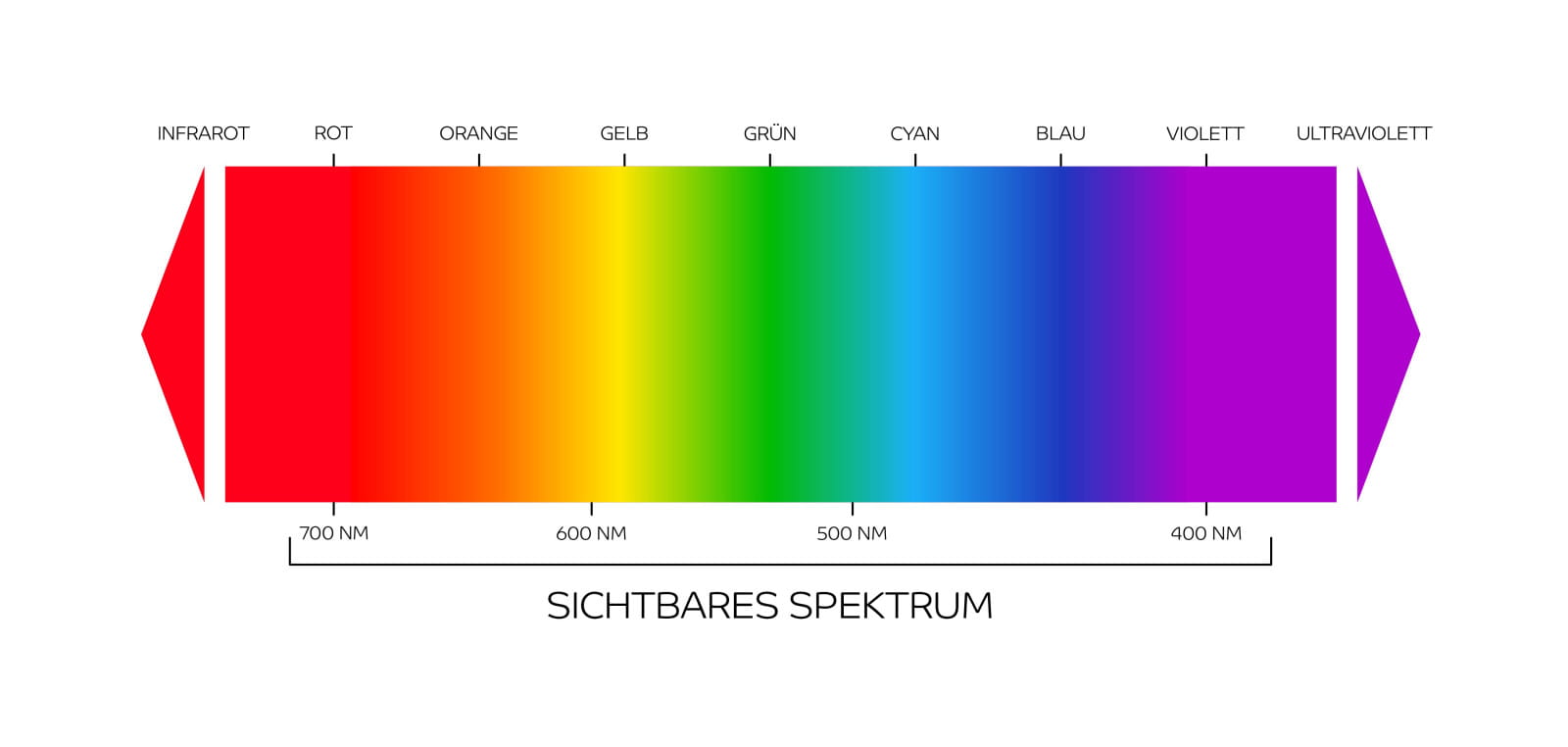
Illustration: The human eye is tuned to a specific light spectrum.
- Blue light (400–500 nm):
It has a strongly activating effect and suppresses melatonin production. As a result, it increases alertness and can influence blood sugar. However, too much artificial blue light in the evening can disturb the sleep–wake rhythm and negatively affect metabolism in the long term. - Red and near-infrared light (600–900 nm):
These types of light penetrate deep into tissues and promote cellular regeneration. Research on photobiomodulation shows that red light improves mitochondrial function and reduces inflammatory responses, which has a positive effect on metabolism. - UV light (280–400 nm):
UV light is ultraviolet sunlight that regulates germs, mites, mould, bacteria and viruses.[12] UVB rays are, among other things, responsible for vitamin D synthesis. An adequate vitamin D level is essential for calcium metabolism, the immune system and insulin sensitivity. Vitamin D deficiency has been associated with an increased risk of type 2 diabetes. - Infrared light (over 900 nm):
Infrared light can promote blood circulation, cause muscle relaxation and activate metabolic processes. It is increasingly used in therapy to support cellular regeneration and metabolic disorders.
Even the bestselling author Andreas Moritz describes the positive effects of different light spectra in Heal Yourself with Sunlight. According to Moritz, UV light, for example, is capable of lowering blood pressure and cholesterol, balancing blood sugar, and improving energy, endurance and muscle strength. Andreas Moritz emphasises the positive effects of natural sunlight on a range of illnesses and how important daily sun exposure is for everyone. According to Andreas Moritz, diet has a major influence on individual sensitivity to sunlight. The author suggests that sunbathing becomes dangerous when a strongly acid-forming diet with highly processed foods, refined fats and the like is preferred.
The effects of artificial light sources
Recent research has also deepened the understanding of how artificial light affects the human body. A study published in the Proceedings of the National Academy of Sciences in October 2024 analysed data from about 89,000 people, each over 40 years of age.
The results showed that people who were exposed to bright light during the night hours and absorbed less daylight were at a higher risk of premature mortality.[13] And a report published in National Geographic highlights that light pollution is associated with an increased risk of certain cancers, including breast cancer.[14]
Additionally, artificial light has been linked to various health problems such as sleep disorders, depression and anxiety.[15] Artificial light at night can also disrupt the natural sleep–wake rhythm, which is associated with an increased risk of obesity, depression and diabetes.[16]
Light and modern lifestyle – challenges and solutions
Our modern lifestyle has led to us spending the majority of the day indoors, often under artificial light. Artificial light, especially with a high proportion of blue light (e.g. from screens), can disturb our natural rhythm. To counteract this, the following measures can be helpful:[16]
Daily exposure to sunlight:
At least 30 minutes of daylight in the morning help to stabilise the circadian rhythm.
Reduce blue light in the evening:
Avoiding screens and LED lights with a high blue component can promote melatonin formation and improve sleep.
Red light therapy:
Applications with red or near-infrared light can promote cellular health and have anti-inflammatory effects.
Monitor vitamin D levels:
Especially in winter months, supplementation with vitamin D can be sensible.
Use light showers and daylight lamps:
These are a good alternative to natural sunlight, particularly in regions with little light.
Conclusion
Light is far more than just brightness – it is an essential control mechanism for our metabolism. The right amount and quality of light can regulate our hormones, increase energy production and promote general well-being. Studies show that light therapy, targeted sun exposure and avoiding artificial blue light are crucial measures for keeping metabolism healthy. Therefore it is important to regularly expose yourself to natural daylight and to use artificial light consciously to maximise the positive effects on metabolism.
Disclaimer
This article does not replace treatment by a qualified therapist. This article is based on studies and current literature. It should not be used for self-diagnosis or self-treatment. If necessary, discuss any ideas from this article with a therapist you trust.
Biographical
Jannyn Sass is a freelance medical journalist, graduate in communications, author and mother of three children. She worked as a communications expert in design and software agencies and for a tech investor in Berlin.
Since her youth she has been fascinated by the larger contexts that can lead to illness or health in a person’s life. Jannyn studied business communication to discover systemic connections and the facets of interpersonal communication. During her studies and an intensive experience in Australia, she realised that there must be more to life.
She began studying alternative medical approaches, spent three years learning Traditional Chinese Medicine in Berlin and trained as a health coach. Her main interest is researching the effects of consciousness techniques and natural substances on the bodies, minds and souls of humans, animals and plants. She is particularly engaged with meditation therapy.
Privat liebt sie es, die Berge und Täler zu durchqueren, in kalten Flüssen zu baden und die Magie der Natur zu entdecken.
[1] https://pmc.ncbi.nlm.nih.gov/articles/PMC10056135/
[2] https://pmc.ncbi.nlm.nih.gov/articles/PMC10056135/
[3] https://longevity.stanford.edu/lifestyle/2023/08/17/more-sunlight-exposure-may-improve-sleep/
[4] https://medericenter.org/resources/dr-michael-hummel-blog/into-the-darkness-how-light-cycles-affect-our-health.html
[5] https://www.bfr.bund.de/cm/343/ausgewaehlte-fragen-und-antworten-zu-vitamin-d.pdf
[6] https://www.tandfonline.com/doi/full/10.4161/derm.24494
[7] https://www.tandfonline.com/doi/full/10.3109/00365513.2012.681929#abstract
[8] https://www.researchgate.net/publication/317346378_Mechanisms_and_applications_of_the_anti-inflammatory_effects_of_photobiomodulation
[9] https://onlinelibrary.wiley.com/doi/full/10.1002/jbio.202300521
[10] https://www.ncbi.nlm.nih.gov/pmc/articles/PMC5703708/
[11] https://pmc.ncbi.nlm.nih.gov/articles/PMC10056135/
[12] https://www.narayana-verlag.de/Zeitlose-Geheimnisse-der-Gesundheit-Verjuengung-Gesamtausgabe-Andreas-Moritz/b21532
[13] https://www.pnas.org/doi/10.1073/pnas.2405924121
[14] https://www.nationalgeographic.com/science/article/light-pollution-health-cancer-insomnia
[15] https://darksky.org/resources/what-is-light-pollution/effects/human-health/
[16] https://darksky.org/resources/what-is-light-pollution/effects/human-health/
Figure 1: madorf/shutterstock.com ; Figure 2: zhukovvvlad/shutterstock.com ; Figure 3: Elena Pimukova/shutterstock.com
17.04.2025

