Review of the seminar by Jan Scholten
Periodic Table and Plant Systematics |
|
|
|
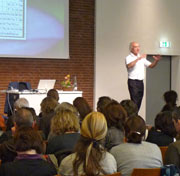
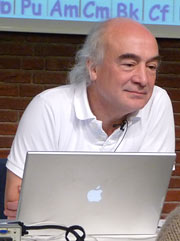
“I like to give bad seminars,” Jan Scholten said at the beginning to his roughly two hundred listeners. |
|
Of course Scholten first once again explained the basics of his method: the understanding of the periodic table and the concept of series and stages. |
|
|
|
The method is simple and beautiful in itself - in practice its application can, however, be tricky, as the discussion of the video cases showed. Among the participants there were often quite different views. Jan Scholten always explained his choice convincingly and one could easily follow his train of thought - but would one have arrived at it oneself? Incidentally, Scholten sometimes needs ten years and even more remedies to finally find the right one - to err is human and even the best homeopaths make mistakes. |
|
On the first day Jan Scholten spoke about the periodic table and, using video cases, presented some lanthanide salts; on the second day he explained his ideas on the plant kingdom. Scholten's plant systematics are recent and not yet published in books. For most participants the ideas were therefore “unheard of” and the remedies new - who, after all, knows the essence of bellflower, guelder rose and chrysanthemum? |
|
|
|
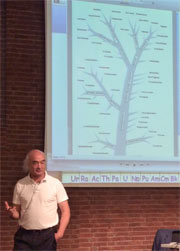
Scholten starts from the botanical classification of plants into families and arranges these families in a “taxonomic tree” according to their degree of development. For the individual families he identifies themes - similar to the series of the periodic table. In the seminar he explained the themes of Araliaceae, Campanulaceae, Caprifoliaceae and Compositae. Members of these four families are considered highly differentiated and thus stand in the crown of the “taxonomic tree”. And indeed we find aspects of the likewise complex lanthanides again: autonomy, freedom, control and sensitivity! |
|
The idea of stages can also be applied in the plant kingdom to determine a plant's position within the family. (The decision for a stage is based on knowledge gained from cured cases and also from provings.) Scholten is known as an important theoretician, but he does not hesitate to discard theories if they are of no use in practice - however well established they may be. This became clear several times during the seminar, for example when the subject of “potencies” came up: someone wanted to know why he almost always gives a C1000 in monthly repetition. Scholten replied spontaneously: “Why not? It works wonderfully!” Chutzpah and humour of this kind contributed greatly to the cheerful atmosphere of the weekend. |
|
|
..................................................................................................................... Author: Dörte Müller. Further impressions from the congress |
|