Homeopathy as a substitute for antibiotics
|
|
| by I. Camerlink (1), L. Ellinger (2), E.J. Bakker (3) and E.A. Lantinga (1) | |
|
|
Background
The use of antibiotics in livestock is increasing to such an extent that negative consequences for animal health, human health and the environment are looming. In the Netherlands the annual total use of antibiotics in livestock rose from 322,000 to 590,000 kg between 1999 and 2007. |
|
In organic livestock farming the amount of antibiotics that may be used is restricted. Treatment with homeopathic remedies has the significant advantage that there are no residues in animal products, and homeopathy also does not produce resistance. The European Committee for Homeopathy states: Homeopathy aims to activate the body's self-healing mechanisms. Therefore the healing process can take more time; determining the correct remedy also requires precise homeopathic knowledge. Ignorance and lack of understanding of the homeopathic therapeutic method are probably the main reasons for the limited use of homeopathy in livestock farming. However, homeopathy can be a realistic alternative to antibiotic treatment in livestock farming. |
|
|
|
Methods
To ensure that any differences between the two groups could not be due to a placebo effect or to different treatment of the animals by their caregivers during or after the treatment, a randomised, observer-blind, placebo-controlled trial design was chosen. |
|
The study was carried out on a commercial pig farm where approximately 300 pigs (large, white, Dutch landrace pigs) were kept. Neonatal piglet mortality in 2008 was 12%, largely due to Escherichia coli-caused neonatal diarrhoea. Fifty-two healthy sows in the final months of pregnancy were selected; they had never been vaccinated against E. coli. Twenty-six sows were randomly assigned to the group receiving the homeopathic treatment, the remaining twenty-six received a placebo. In total 525 newborn piglets born to these sows were included in the investigation. (Piglets that died because they were not viable or because they were crushed by the sow were excluded from the experiment.) |
|
|
|
The placebo group comprised 265 piglets, the homeopathy-treated group 260. The newborn piglets were allowed to suckle colostrum from the sows. They received no supplementary feed and no milk replacer. Both groups were housed in the same barn. All animals were cared for according to the usual guidelines.
|
| The homeopathic agent Coli 30K(4) is a nosode made from various strains of E. coli bacteria. The homeopathic preparation "Coli 30K" consisted of 99.85% demineralised water, 0.1% pure alcohol and 0.05% lactose sprayed with the homeopathic potency of E. coli.
The placebo had exactly the same contents—apart from the homeopathic preparation of E. coli. Homeopathic substances are well absorbed into the blood via the mucous membranes, e.g. through the mouth, nose, vulva. For practical reasons the homeopathic remedy was atomised into the vulva of the sows. This treatment was performed for all sows twice weekly during the last four weeks before farrowing. |
|
| Clinical assessments
Neonatal E. coli diarrhoea in piglets is generally observed between 12 hours and 5 days after birth. Therefore assessments were continued up to one week postpartum. The faeces of all piglets were examined daily for consistency. Normal consistency was marked with -, watery consistency (diarrhoea) with +. Faecal samples were analysed by the Animal Health Service laboratory for E. coli and Salmonella. During the total observation period 73 piglets suffered from E. coli diarrhoea, 452 piglets remained without diarrhoea. The duration of diarrhoeal illness was calculated from first onset until return to normal faecal consistency or death. Only two piglets died from their disease. The mean duration of illness was 1.86 days in the placebo group, longer than in the Coli 30K group (1.3 days). Even a reduction of illness duration by only half a day is significant when one considers that each day of illness corresponds to an average weight loss of 8 g (study Johansen et al.). |
|
| Results
Of the 265 piglets in the placebo group, 63 animals (23.8%) developed diarrhoea, whereas of the 260 piglets in the homeopathy group only 10 (3.8%) did! In the placebo group diarrhoea occurred throughout the observation period, i.e. on all days in the week after birth, with peaks on day 0 (within 24 h after birth) and on day 1 (24–48 h after birth). In 70% of all cases piglets from the same litter became ill on the same day. The mean duration of illness was 1.86 days in the placebo group, markedly longer than in the Coli 30K group (1.3 days). |
|
| Summary
Piglets in the placebo group contracted E. coli diarrhoea just over six times more frequently than piglets whose mothers received the homeopathic treatment with Coli 30K, i.e. the piglets of the homeopathically treated group developed E. coli diarrhoea significantly less often than the piglets of the placebo group. Piglets from first-parity sows especially responded well to treatment with Coli 30K. In this group the difference between the placebo piglets and the homeopathy piglets was even more pronounced. The litters of the homeopathically treated sows were apparently better protected against E. coli diarrhoea by being less easily infected by one another, whereas the piglets in the placebo group rapidly infected each other. |
|
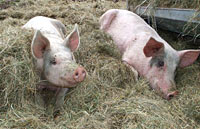 © carullamuehr /PIXELIO |
The owner of the farm where the study took place was initially very sceptical about homeopathic treatment. After the successful course of the study he decided to treat all his pigs with the E. coli nosode. Since then E. coli diarrhoea has virtually disappeared from his farm. |
|
..................................................................................................................... (1) Biological Farming Systems Group, Wageningen University, Droevendaalsesteeg 1, 6708 PB Wageningen, Holland (4) Apparently the Korsakovian method of potency preparation was used here Link to the original article |
|
 ©RainerSturm/