Healing and the Diversity of Methods |
|
| By Harald Knauss | |
|
|
|
|
|
About 25 years ago, when I began a course in classical homeopathy alongside my music studies, it was a core tenet of Samuel Hahnemann that set me on that path. Hahnemann said that illness stems from an inner upset of the person, indeed that such an upset is the actual cause of disease. As a musician I could understand that immediately. If a musician’s emotions are not in balance, it takes far more effort to tune his instrument properly than when he is in a state of inner equilibrium. Prompted by this, I began training with a classical homeopath to find out how such tuning could be achieved or maintained. It was an exciting time of experience that greatly enriched my life. Music became my profession, but homeopathy was always present. |
|
In recent years that core idea of Hahnemann’s recurred strongly in my life, albeit in a very different way. I reconnected with the "scene" of homeopathy and was pleased at how many new, creative colours homeopathy had acquired. But that pleasure soon gave way to a certain disquiet when I noticed how some representatives and supporters of the different schools denigrate one another. Bitter trench warfare rages, fought by all means. Slanders are spread or simply repeated without verification. So the world of rumour-mongering exists in homeopathy too. What sometimes seems to unite all schools is a common enemy: conventional medicine. Otherwise, fierce feuds appear to prevail. Surely it should be obvious to everyone that there cannot be only one truth in the world—no matter how certain circles have tried for two thousand years to hammer such a view into us. Anyone who defends such one-sidedness lives in a world of illusion. |
|
|
|
There are few circumstances that bring us down to the ground of reality more than illness; whether it is our own sickness or the healing process in dealing with it. Reading the recovery reports of many people makes abundantly clear that there is no royal road to healing and cannot be one, but that each person must find their own path to recovery. Therapists and healers can be possible companions on such a path. So at least one of the great pioneers of holistic therapy, Paracelsus, put it: it is always the "inner physician" who effects healing, not the external one. The outer physician only comes in when the inner physician is weak and prostrate. He must be helped to his feet so that he can resume his work, namely healing. |
|
There are many paths to healing. Some of them may even seem absurd to our thinking. A friend told me about a naturopath he had visited in Asia for some time. This man leapt round and danced around his patients with a bamboo pole, somewhat like a pole vaulter. According to my friend, his healing successes were breathtaking. Tell me that is not a valid path to healing! Healing paths are as colourful as the peoples, cultures and individuals who walk them. We must always take two things into account in healing: the person who is the healer and their chosen means and techniques. In holistic healing the healer is the central figure, because a great deal depends on their presence. Anyone who believes that it is the mere right remedy that heals—even if it is a homeopathic one—is in complete agreement with allopathy. And just the word "right" reminds us of the misery the struggle for the "one true belief" has caused in human history. Hahnemann spoke of vibrations and being in tune, and I am sure he meant the therapist or healer as well. |
|
|
|
I am firmly convinced that every holistic healer needs one essential quality: humility. Humility in the face of the overwhelming strength of suffering and humility in the face of the greatness, breadth and wonder-working power of healing. Every healer and therapist who has been ill themselves knows how illness teaches grounding and humility. I have met healers and therapists who spent their lives vehemently denouncing conventional medicine and, when they themselves developed cancer, immediately entered conventional treatment. |
|
Such a step is perfectly acceptable if a person in an emergency makes different decisions than they would when healthy or decides differently today than ten years ago. But what an expenditure of energy beforehand, how many negative emotions to struggle against something, and what a loss of self-confidence it is when one then has to ask the "enemy" for help. I also know the reverse case: a doctor who specialises in cancer and its conventional treatment. When asked what he would do if he himself were to suffer from this disease, he replied that his first step would probably be to go to a good spiritual healer. |
|
| The world is full of contradictions, and contradictions are part of life. Life is a path and means eternal change. Meaning arises from going, not from standing still. So said the Chinese sage Lao Tse. Only what forever changes remains alive. We need not be personally good at everything nor approve of everything. Positions are important in life. But a genuine stance need not consolidate itself by destroying or rejecting everything else. A genuine stance does not express itself through bad manners. A genuine stance arises from inner, spiritual maturity. It is what really is within, and it radiates that, allowing everything else to exist alongside it. Whoever values themselves inwardly grants others the dignity due to them. Some homeopaths might say at this point that someone has a healthy stance when they are in their inner power. Powerlessness must fight because it is about survival. A genuine stance is precisely that which is stable and yet always able to move with life, remaining adaptable. On this subject I recommend the wonderful book "Hara" by Karlfried Graf Dürckheim. | |
|
Things should be discussed. We can struggle over matters so that mutual fertilisation and development become possible. But the conversion of a personal opinion or insight into a crystalline, fanatical system of belief and values, from which the world is then to be healed, is anything but wholesome and holistic. I find any traditional practitioner of conventional medicine who is opposed to all naturopathy more acceptable, because he cannot think otherwise from within his frame of reference. But most therapists working in naturopathy, including many who count themselves as homeopaths, define themselves and their work through spiritual, holistic approaches. It is surprising, then, what rough tones are sometimes used between them. I would like to call to them a line from Hermann Hesse: "Friends, not these tones..." And that brings us back to being in tune. When such disharmonies prevail, then, according to Hahnemann, disease reigns. Is homeopathy therefore sick? |
|
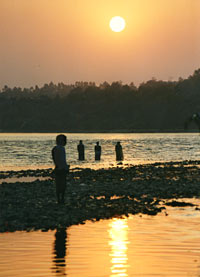 India/Ganges |
Perhaps it is good to ask this question. Perhaps it would also be good, instead of debating theories and approaches, to look at the whole and move from thinking and willing to experiencing. How do we experience ourselves and how do others experience us? Do we behave as we proclaim on our banners? Are we, personally, as a group, as an association, as in harmony, holistic and spiritual as we like to imagine? Are we capable of dealing holistically with one another, or do we behave as is common in many ordinary clubs or societies? These are indeed weighty questions that one must repeatedly face on the path of life. It is not easy to measure ourselves by our own resolutions, especially when they are defined by high parameters such as ethical, spiritual, cosmic, holistic. |
|
Once an audience member asked the well-known English spiritual healer Tom Johanson how one should begin if one wanted to become a spiritual healer. He answered: "First heal your own spirit before you try to heal others." One can imagine the astonishment of the questioner. To another listener he replied, when asked what it takes to become a healer: compassion full of devotion ("compassion"). Yet another asked what is needed first for spiritual healing. Tom Johanson answered: "A patient!" That last sentence should awaken us as healers and therapists. Our profession, which we hope is also our vocation, lives from the fact that others suffer, that they are unwell. Imagine there were a miracle cure and all beings were completely healthy—what would happen to our vocation then? What would we strive for and toil at? Was the tradition of Chinese medicine perhaps much wiser in demanding that the doctor receive payment only when his patients are healthy, while receiving no fee for his work if they remain ill? The aim was to maintain health, not to "repair". Provided, of course, that every person does their part for their own health and is aware of their personal responsibility. That would be a real paradigm shift in German health policy. I do not wish to tire you with such digressions of my thinking, but I want to bring us all—myself included—closer to what is really important in the healing vocation and where we invest our energies. Do we expend our energies defending abstract ideas, doctrines and theories to the last drop? Do we use our strength in constant distancing from the "other", perhaps what seems strange? Do we waste the power of our attunement by quarrelling with others, perhaps envying their success and feeding the shadows? And if we do such things, can we then be convinced that healing power and light flow from us into the world? |
|
|
I once told a physician friend about someone who constantly criticised and grumbled. When he met that person in person, he later said to me that he was not surprised that the person was like that. "Look at the joie de vivre he spreads in his surroundings!", so was his perception. What we think and feel is also what we are on the outside. Vibration carries on. What a waste of time and energy where there is so much more important work to do, especially on the healing path. |
|
|
|
It was an inner concern of mine to put down my perceptions. Perhaps I will thereby prompt reflection on where we invest our energy. The challenges of the future will not become easier and again and again there are attempts by certain moneyed circles to have all "natural healing" banned. Today's illnesses demand ever more commitment and strength from the therapist. Would it not be better to focus energies on what really matters? We should build bridges and work together on the common great task: a tolerant medicine and equal recognition of the diversity of life. |
|
|
|
|
|
|