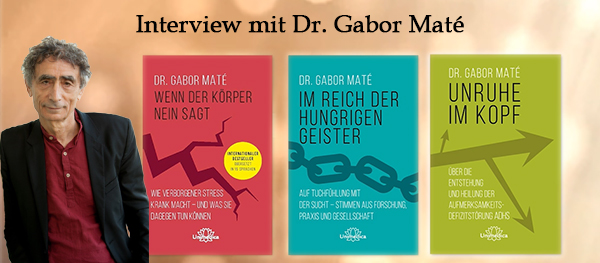
Bestselling author Dr Gabor Maté in interview
When the Body Says No offers an opportunity to steer hidden trauma towards healing. Narayana Verlag secured Dr Gabor Maté, the internationally leading trauma expert, for a personal interview in which he talks with us about the consequences of psychological and physical experiences for our whole lives. Whether certain personality traits favour the development of cancer, ADHD causes inner turmoil as described in Scattered Minds, or addiction seeks its victims as in In the Realm of Hungry Ghosts – the key to healing lies within ourselves. Shaped by his own biography and with deep empathy for the fate of others, the physician and author Gabor Maté shows us how we can find paths out of crisis.
Part 1 of 3 (21 min.)

“Nothing in nature can grow without vulnerability.”
When the Body Says No is one of Gabor Maté’s outstanding titles. In it he outlines the effects that stress and trauma can have on us, how they can affect our immune system and hormonal balance and even cause serious illnesses such as cancer, Alzheimer’s or heart disease. Maté grounds this in the “mind–body unity” that we need to learn to understand afresh. In the conversation he explains how this works, addresses the separated consideration of body and mind in the Western world as opposed to traditional medical knowledge, and emphasises the importance of vulnerability using the example of his own extraordinary life story.
Part 2 of 3 (12 min.)

“The more we become our authentic selves, the healthier our body will be.”
“We have the potential for wholeness and health, but the conditions must be right,” says Gabor Maté. In this part of the interview he explores whether all people are affected by adverse childhood experiences, whether there is a “cancer personality” and explains that genetically determined diseases are extremely rare. After all, illness is ultimately the body’s language in which it says no.
Part 3 of 3 (16 min.)

“When we diagnose a child with ADHD, we should not treat the child, we should take a closer look at the environment.”
In this part of the conversation Gabor Maté makes clear that ADHD is not a genetically determined disease but a developmental disorder of the brain and ultimately the result of a stressed society. “When we diagnose a child with ADHD, we should not treat the child, we should take a closer look at the environment.” He stresses that it is often not recognised that many people diagnosed with ADHD are actually highly sensitive children who require special care. And: we can protect ourselves by learning to be completely ourselves.
All books by Dr Gabor Maté
|