
Current update on the flu wave December 2022
Second update 7 February 2019
Update: Arsenicum album and Calcium arsenicosum for nocturnal restlessness
by Ulrich Welte
The seasonal influenza-like infections are now entering their third week and are already visible on the RKI maps https://influenza.rki.de/MapArchive.aspx
Since the 1st update we have treated a further 19 infected patients in 4 working days, 10 of them with Calcium carb. In 5 cases we gave Arsenicum album C30 or C200 with good success, which yesterday led us to try Calcium arsenicosum D12 in 2 children, both with pleasing success. All patients given Ars or Calc-ars were restless and anxious at night.
Two case examples of Calcium arsenicosum
-
11-year-old slim dark-haired girl, nervous, refined, withdrawn, takes everything very precisely, had many fears in the past. For 5 days an influenza-like illness with fever up to 40 °C, severe dry cough, sore throat. The infection began at night and improved after one day, only to return with renewed severity (this two-peaked course has been observed in our patients more often, estimated in about one third of cases). In the afternoons to evenings 3 x 5 globules of Calc-ars D12. The night was calm, in the morning she was without fever and generally fit again, feels healthy again, no more sore throat, cough is easing, wants to go back to school.
-
Three-month-old infant with 40 °C fever since last night (several siblings have the seasonal infection). The mother gave Belladonna, the fever reduced somewhat, but the general condition did not. The little boy was also very restless on the second night, constantly tossing about. Red cheeks, whiny, fretting, very restless. Dry cough. With Calc-ars D12 he was brought down in temperature within one night, he slept through again, the whining stopped, the restlessness too, he was brighter, already after the first dose.
Update of 31 January 2019
Update: Calcium carbonicum confirmed
After a week Calcium carb has proven to be the best remedy. Those who responded best were patients who already had the unusually strong sensation of cold, usually from the outset. Gastrointestinal symptoms were present in only about half of the cases, so they are not a leading symptom as initially suspected. Also, the alternation of cold and heat is not obligatory; mostly it is rather the cold which simply decreases after the fever rises, without heat or sweating necessarily following. The sensation of cold is not just general but especially in the hands or feet.
Up to today, Thursday, we have observed 33 patients who received Calc, mostly as C30, but also C200 or D12.
Of these 33 patients only 4 did not respond, while 26 experienced a positive effect. Among the patients who responded to Calc were 5 improved, 16 clearly and rapidly improved or cured within 1–2 days, and 5 particularly good responders who improved markedly within hours and were well again after 1 day or, in severe courses, in about 2–3 days. 2 patients had received the remedy prophylactically, so were not ill, and for one patient there was no feedback.
So, according to current observations, one can expect improvement with Calc in almost 9 out of 10 patients in these ongoing influenza-like infections, which speaks for a high similarity between the remedy and the acute clinical picture.
Update of 24 January 2019
Current: epidemic febrile infection with severe chills, vomiting and diarrhoea: Calcium carbonicum as an epidemic remedy?
by Ulrich Welte
In the last weeks around the turn of the year there were only sporadic respiratory infections, mostly with hoarseness and dry cough, but no remedy presenting with an epidemic character was found.
Only since the 3rd week of January have some uniform infection pictures been seen in the practice which also seem to respond to a single remedy: Calcium carbonicum. These are clinical pictures with an unusual sensation of cold (“I have never been so cold in my life”), fever around 39 °C, severe malaise, cold alternating with heat and sweating with gastrointestinal symptoms, vomiting and diarrhoea. Respiratory symptoms (hoarseness, sore throat) may also be present.
The first hint towards the remedy came at the end of last week, 6 days ago. Markus Kuntosch treated an acute patient in our Kandern practice with Calcium carbonicum. The remedy acted so convincingly quickly, rapidly and comprehensively that we have given it since the beginning of the week to all patients with similar symptoms, all four with the same clear and rapid result. Therefore we are issuing this early information now, albeit with reservation due to the early phase of observation.
The first indicative case:
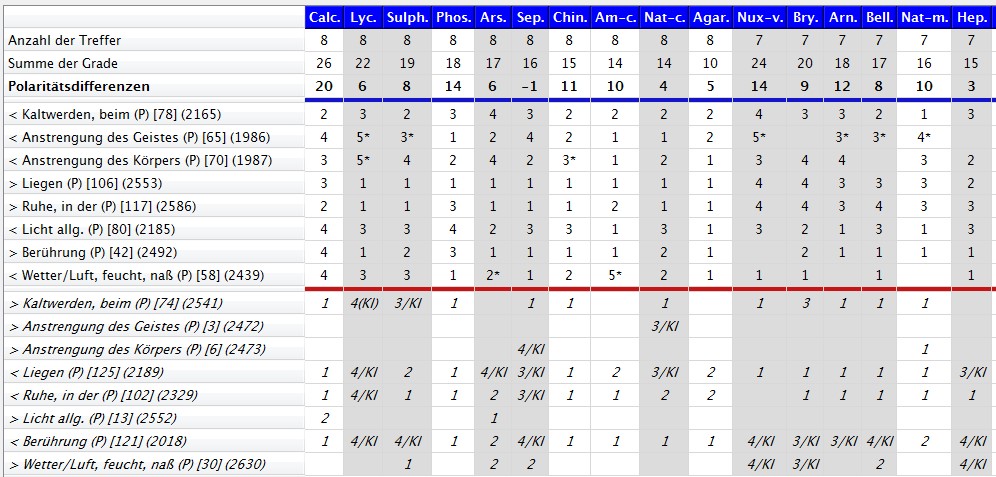
A 25-year-old patient has been ill for 4 days with chills, night sweats, fever around 39.5 °C, hoarseness, limb and throat pain. He prefers to lie down and rest. Any physical exertion worsens his condition. Even reading a newspaper strains him too much. He is simply exhausted. A polarity analysis (Bönninghausen method according to Heiner Frei) of the following symptoms results in Calcium carbonicum in first place with a very pronounced leading polarity difference of 20 points. Calcium carbonicum C200 dissolved in water and given a teaspoon every 2 hours brings rapid improvement. Already the next morning he is fever-free, the nose discharges a lot of clear secretion, limb and throat pains decrease markedly and he feels fitter.
Further confirming cases:
A robust, slightly overweight man in his late 50s has been freezing massively for several days, he has rarely felt so cold. The cold alternates with heat and sweating. His nose runs, he has cough and non-purulent sputum. Since yesterday he has had abdominal pain and also had diarrhoea twice. In the rubric “fever alternating with a sensation of cold” Calcium carbonicum is present at degree 3. Because of the first-mentioned case and his constitutional similarity to Calc (strong, heavy body build with tendency to sweating and lax tissue) Calcium carb C30 was given using the plussing procedure. After a few hours he felt generally better, by the evening the abdominal pain was gone, the temperature returned to 37 °C, and the night was much better than the whole previous week. The next morning he felt fresh again, no diarrhoea, no cold, no more sweating. He needed sick leave for only one more day that week because he felt well again.
Furthermore we treated three more patients with Calcium carb C30 with the same rapid success. They all had a strong sensation of cold, felt truly ill with fever and gastrointestinal complaints with nausea and vomiting. One patient said he had never been so cold in his life. After Calc carb C30 in the plussing procedure the malaise was much better after half a day, the vomiting and diarrhoea stopped the same day and all three felt healthy again the next day and went to work or school.
Plussing procedure:
This method of administration originates from the Indian physician Dr A.U. Ramakrishnan. He originally used it in cancer patients, but it has also proven effective for simple acute infections in our practice. A few globules are dissolved (the quantity is of secondary importance, 5–10) in a half-litre bottle of water and the bottle is shaken vigorously 20 times. Then the bottle is drunk empty in small portions over the first day. In the evening leave about one centimetre of liquid at the bottom and top up with fresh water the next morning (do not fill completely, leave some air). This dilution is shaken vigorously 20 times again and drunk over the day. Repeat the same procedure the next day. If necessary, a fresh dose of globules can be repeated on the 4th day.
Older flu courses 2018–2015:
Update of 12 October 2018
Update on the flu wave
by Paul Herscu
It is almost a tradition that Paul Herscu sends updates on epidemically occurring illnesses to share the latest findings with other homeopaths as soon as the current situation demands it and a Genius epidemicus is known.
Paul Herscu writes in his current newsletter:
“As many of you have noticed in the clinic or at home in the family, we are in the midst of a fairly early-appearing viral infection that is spreading among children and adults. We have observed the following so far:
In very small children the chronic constitutional remedy is indicated as long as the (new) symptoms are covered by it. But there are also children who become irritable, moody and clingy in the course of this wave. In these children Chamomilla helps, even if the symptoms are not as extreme as we know from Chamomilla. As soon as the symptoms develop in this direction, it is the indicated remedy.
For adults the indicated main remedies are Nux vomica and Phosphoricum acidum. As with the flu wave some years ago, Nux vomica helps with a sensation of cold and cough. It is interesting that Phosphoricum acidum helps very well when profound tiredness and exhaustion are predominant. The picture somewhat resembles Gelsemium, which however did not help our patients; therefore please always also consider Phosphoricum acidum. ”
Source: http://www.nesh.com/
Update of 04 April 2018.
Genius epidemicus for the barking, irritating cough during/after the flu
By Gabriele Spooren-Bunzel
After one of the most severe influenza epidemics (highest sickness absence in over 20 years) patients have been developing a sudden barking, asthma-like irritative cough during or after the flu/influenza for over 5 months, partly with fever, great weakness and swollen lymph nodes (many patients also showed activated mononucleosis). This violent irritating cough resembles whooping cough, as it frequently causes gagging/vomiting by day and night. The following rubrics were selected:
Cough — barking
Cough — barking — rumbling from high in the chest downwards; audible, loud
General — mononucleosis
Chest — pain — cough — sore, painful
Chest — pain — burning
The remedy of choice in over 150 patients was each time Muriaticum acidum C200 administered over 3 days, 3 times daily. It sometimes had to be repeated after a 3-day pause. When Muriaticum acidum C200 was given immediately at the start of the irritative cough it could often be halted.
>> Feedback on the article can be found in the comments
Update of 13 March 2018.
Flu courses sometimes more severe than initially expected: at least 358 patients have died in Germany so far as a result
Contrary to our initial assumption, the danger of the epidemic is greater than expected. We did not see life-threatening courses except initially one severe pneumonia. But now the media are reporting more and more deaths. The Robert Koch Institute states that up to last week 358 people in Germany had died as a result of seasonal flu. However this number only includes laboratory-confirmed cases. The number of deaths diagnosed clinically without lab confirmation is likely to be considerably higher. BILD ("Three-shift operation in the crematorium") describes a dramatic rise in deaths in Saxony, which were not always diagnosed as Influenza A or B but mostly recorded as pneumonia or heart failure associated with flu.
https://www.bild.de/regional/dresden/grippe/totenstau-im-krematorium-55077310.bild.html
In our practice the frequency of infections does not decrease; day by day fresh infections continue to appear. The beneficial effect of Nux-v 200 remains convincing, and we are certain that wide dissemination of this information would be helpful, as the numerous positive comments on our blog show. We have little difficulty in treatment because the majority of patients have no complications and recover quickly. Even in occasional relapses the remedy helps again as expected. Colleagues who doubt whether homeopathic remedies are effective could easily test them here and use the remedy alongside their usual therapy; we are convinced they would see better courses than otherwise.
>> Feedback on the article can be found in the comments
Update of 9 March 2018.
Germany comprehensively affected by flu: Nux-v remains leading
The RKI flu map shows Germany entirely in red, an outbreak of seasonal flu not seen for 10 years: https://influenza.rki.de/MapArchive.aspx. The courses do not seem generally as severe as two years ago, only the nationwide spread is impressive. In our practice the number of treated patients is now well over 100, and the epidemic remedy remains Nux vomica.
Nux vomica in C200 is the best remedy. An exemplary course, as we often see it here, is described by a reader of the flu blog from Bavaria (see in the comment sectionBryonia, but when it did not help after a week he found Nux vomica on our blog. The C30 helped after a few days, but residual symptoms remained. He then took the C200 a week later and was symptom-free after 3 days. The illness lasted over 3 weeks, and only after the C200 did he feel fully better.
If the remedy is taken in good time it can significantly shorten the course or even abort it, as happened a few days ago with a colleague in our practice. Markus Kuntosch was the one who found the epidemic remedy right at the start because a child treated with it was well again after a few hours and we then gave Nux vomica experimentally in other cases with success. He was able to reap the rewards of his homeopathic discovery himself. After a long day at work he was confident at the end of the day that the flu had finally caught up with him: chills, rapid alternation of hot and cold, severe headaches, nausea, pronounced malaise, very worn out — the typical current flu feeling. He took Nux vomica C200, went to bed, slept very long and deeply and awoke healthy and cheerful the next morning. Thank you Nux vomica, thank you dear homeopathy!
>> Feedback on the article can be found in the comments
Update of 26 February 2018.
Nux vomica effective in Hungary for seasonal flu as well.
Nux vomica remains at the forefront as the epidemic remedy. In our practice the proportion in which Nux-v. acted convincingly remained at about 80%, although we no longer recorded all cases individually because we were almost overwhelmed by external patients from closed colleague practices. Their number is now probably over 80.
In the meantime a Hungarian colleague, who had independently arrived at the remedy and given it successfully, has also confirmed Nux vomica as an epidemic remedy. See the link to the comments.
Are there follow-up remedies if Nux-v. does not help?
In about 20% a follow-up remedy was necessary. However, no clear second-line remedies emerged. Perhaps Bryonia for an intermittent course or Phytolacca for prominent throat pain with red tonsils or Gelsemium for the “head flu” or Ipecacuanha for severe gagging with cough or Eupatorium for particularly pronounced bruised exhaustion may be somewhat more often indicated, but with 2–3 cases per follow-up remedy our limited observations do not indicate a clear clustering. In one case, with a severe pneumonia, an antibiotic plus Ferrum phos C30 was lifesaving, though the latter was chosen on purely individual grounds.
Which potency?
The effective potencies still range from low to high, with the remedy seeming to act more emphatically from C30 upwards. However, there is also a certain relapse rate where a multi-day symptom-free interval does not yet represent a cure and a further dose is necessary, preferably in a higher potency than before. Furthermore, frequent repetition is often very useful. Thus, at the beginning over the first days a 200 may be given hourly and then less often, depending on the effect. As prophylaxis C30 seems sufficient, perhaps once a week with ongoing exposure. With very rapid administration, if the flu sets in suddenly, a single high potency may suffice once the symptoms first appear. At least the following two cases suggest this.
What are particularly typical symptoms for Nux-v?
In two colleagues who were threatened with illness themselves the 200 and 1000 were very quickly helpful and aborted the course at the outset. Both had the particularly typical signs for the current epidemic remedy: sudden onset with severe malaise at night or early morning, with headache and nausea. Both took Nux vomica immediately, one as 200 and the other as 1000, and there was no outbreak of the infection, after 1–2 hours it was over.
Does the indicated remedy change with each epidemic?
The centuries-old observation that epidemics with the same diagnosis often require a different epidemic remedy can also be seen in our observations of the seasonal flu. There is no “homeopathic remedy for flu” — one must search for the appropriate remedy for each flu wave by observation of effect. Initially one searches by the usual repertorisation of symptoms and gives the resulting remedies until one finds one that helps particularly convincingly and quickly. Thus, for example, the remedy Squilla or Scilla maritima, which was excellently effective in spring 2015, was rather ineffective this year, as we saw in some patients who still had that remedy at home and took it first because of its previously convincing effect, but without comparable benefit.
>> Feedback on the article can be found in the comments
Update of 15 February 2018.
Nux vomica confirmed as the epidemic remedy for seasonal flu.
A contribution from the Kandern practice of Ulrich Welte and Markus Kuntosch
Meanwhile Nux vomica has established itself as the epidemic remedy in our practice. It was given to over 30 patients with various influenza-like symptoms and was effective in about 80% of cases. In about 20% of the well-responding patients a follow-up remedy was necessary, often Ipecacuanha or a personal remedy. It was also notable that Bryonia often seemed indicated. Several patients took it without marked improvement until Nux-v. brought the turn. Also Eupatorium rarely acted despite good indication.
The RKI flu maps show a clear infection peak in southern Germany and especially in the southwest, which persists this week as well, as we also see in our practice. The epidemic Nux vomica has greatly eased our daily work. We now prefer to give the C200 rather than the lower potency, because it has proved more reliable. Dissolved in water, a teaspoon hourly. We also like to give it prophylactically in families when one member is ill. Then as a single dose of C30.
>> Feedback on the article can be found in the comments
Update on the flu wave
Nux vomica as the epidemic remedy for seasonal flu in February 2018?
A contribution from the Kandern practice of Ulrich Welte and Markus Kuntosch
Since the beginning of the year we have seen a slight cluster of flu cases, which, however, did not have an epidemic character, as the RKI maps also showed. Nevertheless we remained alert and constantly on the lookout for an epidemic remedy, but found none. There were nevertheless severe courses, very persistent cough, some severe and one very severe pneumonia case, and also prolonged courses with superadded problem organisms such as Staph. aureus and Prevotella species. Furthermore, the conditions for a problematic flu wave are present because since early 2018 an H3N2 seasonal influenza has been prevalent and spreading in the USA and especially Australia. This virus type is the most troublesome among the seasonal strains. Older data show that epidemics with a high H3N2 proportion result on average in almost three times as many, especially elderly, people dying from influenza and its consequences as in normal years.
Until a few days ago we saw no clustering of homeopathic remedies among our patients and no striking healing courses to warrant mention. But just in the last days we have surprisingly seen rapid recoveries within 2–3 hours in children with severe flu symptoms. The remedy was every time Nux vomica, mostly as C200, dissolved in water, a teaspoon hourly; in one case also as D6, almost equally effective. We present this observation for verification.
>> Feedback on the article can be found in the comments
Gelsemium for the currently circulating "head flu"
by Ulrich Welte - dated 20 October 2017
11 cases observed
Since mid-September in the Kandern practice we have increasingly used the homeopathic remedy Gelsemium for acute viral infections. The remedy was successful in various potencies (D6, C30 and C200) in 11 observed cases during the last 2 weeks, especially when symptoms resembled a “head flu”, i.e. headache, dizziness, a bruised feeling behind the eyeballs, light sensitivity. Often also sore throat, stabbing, in the larynx; sore feeling in the pharynx and on the tonsils; hoarseness, weakness of voice. Fever below 39 °C often occurs with dizziness. Bronchitic symptoms are rather rare.
Notably all patients had complaints in the head: pressing headaches, a dazed feeling, pressure on the upper eyelids with the sensation that the eyes are hard to keep open (a typical symptom of Gelsemium), wooziness, dizzy, stunned, paralysing (Gels), and here the remedy helps most clearly. Few limb pains, little mucus. Further indications for the remedy also came from repertorised symptoms such as ‘gagging in the morning on waking’ (in Radar only 4 remedies, including Gelsemium). One patient responded quickly and convincingly to Gelsemium, the headache disappeared immediately, then the gagging, and she was well the next day.
The main effect after intake is usually a clearing in the head within hours, a freer feeling in the head, clearer thoughts. The dazed pressure in the head goes away quickly after Gelsemium and thus shows the main direction of the remedy, which is also the main complaint of the current “cold”.
Genius epidemicus: Gelsemium
Since we did not initially know whether a Genius epidemicus might be spreading, we tried, following the proven Rademacher approach, the once-successful remedy on all patients who came to the practice with acute head symptoms — headache, dizziness, sore throat, etc. It quickly became apparent that Gelsemium currently has an epidemic quality in our area (South Baden). Within 3–4 weeks there was a quite appreciable number of about 15–18 “hits” before we began collecting cases. These are therefore not large numbers, rather a mild epidemic. In the last 2 weeks there are now at least 11 collected cases that responded to Gelsemium, so we present our observation here for verification.
Despite Robert Koch Institute flu maps, increased infection numbers
The RKI flu maps only show respiratory infections with the typical flu viruses. At present they show hardly increased activity here and nationwide, all nicely blue and healthy. Nevertheless we have noticeably increased infection numbers in the practice, but with different symptomatology than the respiratory flu courses recorded there, so probably a different virus type than the one captured by those maps.
Link to earlier contributions differentiating various flu remedies
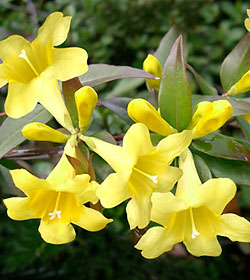
Gelsemium sempervirens
---------------------------------------------------------------------------------------------------------------------------------------
Category: Cases
Keywords: Gelsemium sempervirens, head flu
Remedy: Gelsemium sempervirens.
Photos: Shutterstock 365422418 Gelsemium, Copyright Manfred Ruckzio
Shutterstock 619892681 Headache Copyright Africa Studio

