Some joints are easy to ignore — until they start causing problems. What holds true for plumbing definitely applies to our bodies as well.
How often do you, for example, think about your elbow? I admit — you might still have your mother’s quiet voice in your head, scolding you to take your elbow off the table!
But if you bang your elbow, I guarantee you won’t be able to think of anything else. (I hope you remember my blog post about the funny bone — that’s where the fun stops.)
Considering the elbow is one of the most heavily used joints in our body, it’s no surprise it’s particularly prone to overuse injuries.
Tennis elbow even without tennis
Mike was a busy plumber in a lively community. One day he suddenly felt a burning pain on the outside of his elbow. For Mike it was a completely new sensation. Until then he had only associated joints with pipes and sinks!
But now he couldn’t stop thinking about the unbearable pain in his elbow joint. He could hardly hold his wrench and grimaced every time he tried to tighten a tap. Eventually it got so bad he could barely turn a door handle. Each day it became harder and it was a real challenge for his work.
At that point his wife persuaded him to see a doctor for a diagnosis.
Mike wasn’t the sporty type. On the contrary — he often compared himself to his wife’s cat, which lazed about all day. You can imagine his surprise when the doctor told him he had a tennis elbow!
“Tennis elbow? I don’t even watch tennis on TV!” he protested.
Symphytum officinale for tennis elbow
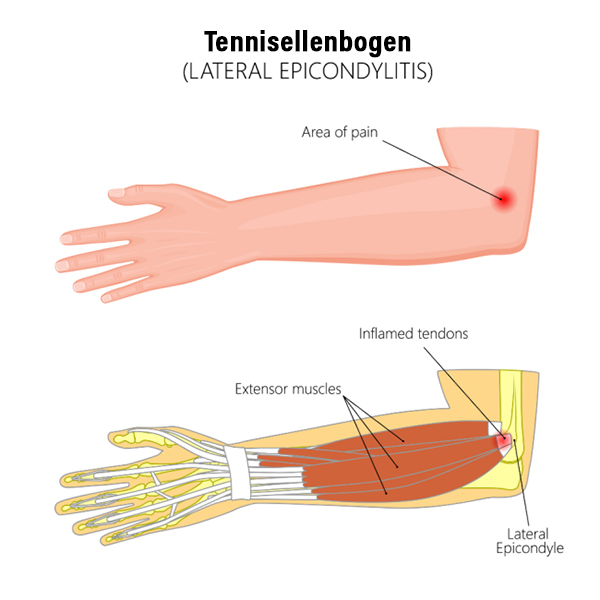
I can assure you you don’t have to step onto a tennis court to get tennis elbow. The term is simply the colloquial name for lateral epicondylitis (tiny tears with inflammation of the tendons that attach to the bony prominence on the outside of the elbow). Tennis elbow is a fairly common condition, especially in people whose work repeatedly strains the forearm.
Plumbers are particularly susceptible, as are butchers, manicurists, mechanics, housewives, gardeners, dentists, construction workers and people who spend all day at a computer (especially if they use a mouse).
Fortunately Mike’s wife was well versed in homeopathy and she began treating him twice daily with Symphytum officinale 200. More information on dosing and potencies can be found here. Symphytum is a very helpful remedy for injuries to bones, tendons, ligaments and joints. It therefore fits this condition of the elbow tendon perfectly.
Acute remedy Hypericum
And instead of burdening her husband’s sensitive stomach with the painkiller ibuprofen (as the doctor had suggested), Mike’s wife popped a small tube of Hypericum perforatum 200 into his work bag. Whenever the pain worsened during the day, Mike didn’t reach for ibuprofen but took Hypericum as an emergency remedy as needed. And boy, did that work well!
Mike was amazed that his “plumber’s arm” (he refused to call it tennis elbow) gradually eased.
Whenever the symptoms now reappear after a particularly strenuous plumbing job, Mike simply takes the homeopathic pellets and the discomfort subsides again within a short time. And whenever the pain improves, he stops the medicine. That’s how homeopathy works! But more importantly: no synthetic drugs, no surgery, no pain, and over time with homeopathic treatment (only as needed) fewer and fewer pellets will be necessary and the pain will diminish.
That’s what I mean when I say homeopathy addresses things at the root. It may take time, but why not? My personal goal is to get by as long as possible without conventional drugs. That was also his wife’s intention.
Golfer’s elbow
But what if the pain had been on the inside of the elbow instead of the outside? Well, there’s a name for that too… golfer’s elbow, or medial epicondylitis. (Remember: in medical terminology ‘lateral’ refers to anything away from the midline of the body and ‘medial’ to anything towards the midline.)
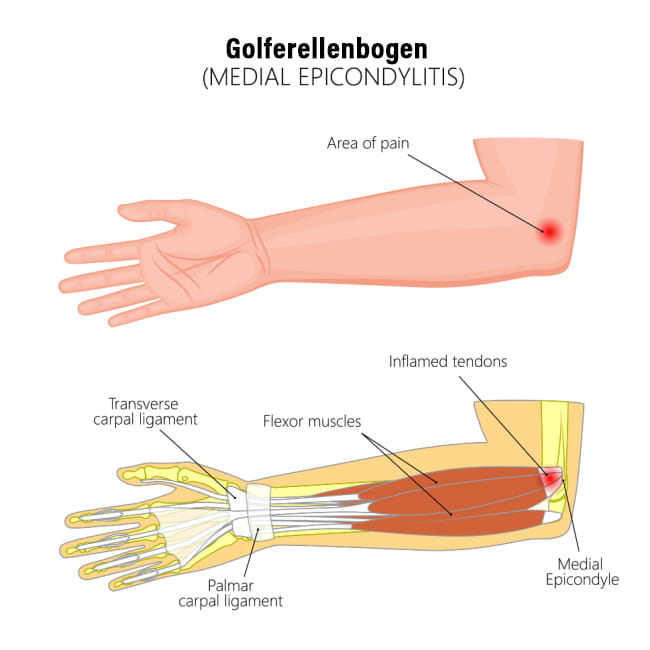
The pain with golfer’s elbow is similar, except it occurs where the tendon attaches to the bony bump on the inside of the elbow. And as with tennis elbow, you don’t need to be a golfer to get it. The cause seems to be repetitive movements of the fingers and wrists, especially when weight and high force are involved.
Since both conditions affect the tendons, the homeopathic remedies remain the same.
Whether you’re a tennis player, golfer, plumber or manicurist — homeopathy is excellent for treating elbow pain. The next time you see someone wince and grab their elbow, don’t hesitate to share the good news. Homeopathy helps — spread the word!
Warm regards,
Yours
.png)