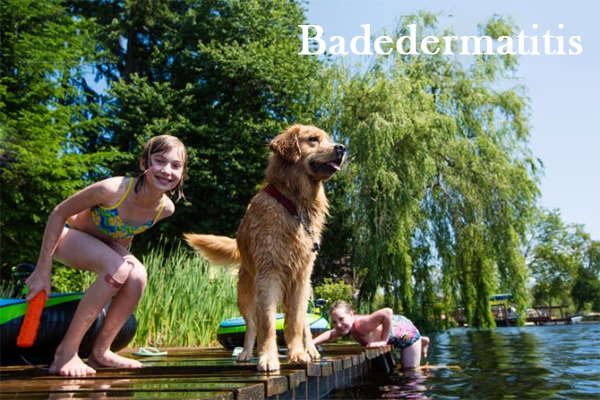
It's summer! It's hot! VERY hot!
I raised three boys. I know that children are drawn to water in hot weather – any water at all. It doesn't matter whether it's an overcrowded swimming pool, a sea covered in algal bloom or a polluted, murky river. Even puddles of mud exert a magical attraction on children when the temperatures outside are sweltering.
But even if a body of water looks very inviting, microscopic parasites can be thriving there (they're carried there by land animals, snails and birds) and can cause allergic itching in sensitive swimmers. The medical term for this condition is cercarial dermatitis. You'll probably encounter the colloquial name 'swimmer's dermatitis' more often.
And it's no fun.
Jenny and the Itch
I know a girl – she's 16 and her name is Jenny – who went swimming with her family at an artificially created lake in the summer. (It was a reservoir whose water is used in winter to make snow). The day was perfect for splashing around and playing in the cool water. Then Jenny's itching started.
Although the whole family had been in the water, only Jenny began to itch. Poor girl.
When her mother realised what she'd picked up, the thought of parasites in the water terrified her so much that the family didn't return to the lake that summer.
Avoidance can certainly be a precaution. It just didn't do much for Jenny's future plans. She had to scratch almost compulsively; it was driving her mad.
Swimmer's dermatitis can be a very broad category. As I mentioned, the medical term refers to skin irritation caused by tiny parasites in the water. However, some people use the term more generally to mean anything to do with skin irritation associated with water – from a sensitivity to salt or chlorine to dry skin caused by constant evaporation when getting in and out of the water.
But we don't necessarily need to know the exact cause. After all, we know which remedies are generally indicated for itching and rashes, don't we?
Antimonium crudum
And I'm not referring to the cortisone-containing creams that are advertised on medical websites. Cortisone creams only bring short-term relief, not a lasting solution. Besides, they can have terrible side effects. It's like using a sledgehammer to crack a nut! Sure, it may help temporarily, but at what cost?
Homeopaths would simply reach for Antimonium crudum 6, to be taken twice daily until a marked improvement occurs. Information on dosage and potentisation of homeopathic remedies can be found here. If the itching is unbearable, the remedy can also be taken every three or four hours. Once improvement is evident, the dose should be reduced to twice daily.
Perhaps you remember that a few years ago I wrote about Ant crud in this article. I want to stress again that Antimonium crudum is an excellent remedy for itching and has helped many of my students and clients to rid themselves of troublesome skin complaints. In the past I also frequently used other homeopathic remedies that proved effective in many cases of itchy rashes. Thanks to the doctors Drs Banerji I now also have this wonderful remedy in my repertoire and it has made a significant difference in my practice. Many cases have been cured with it.
Enjoy swimming without regret
This remedy should be in every home medicine cabinet… precisely because you never know when swimmer's dermatitis (or something else) might send you or one of your loved ones up the wall.
So—plunge into the fun and jump into the pool or lake without a care. Cool off and enjoy yourself! And if a tiny nuisance in the water does lurk and makes life difficult for you afterwards, you'll be well prepared with your homeopathic medicine. Homeopathic remedies give your body the natural support it needs – without the risks and side effects of cortisone creams and other corticosteroids.
Homeopathy helps – spread the word!
Warmly,
Yours
.png)

