|
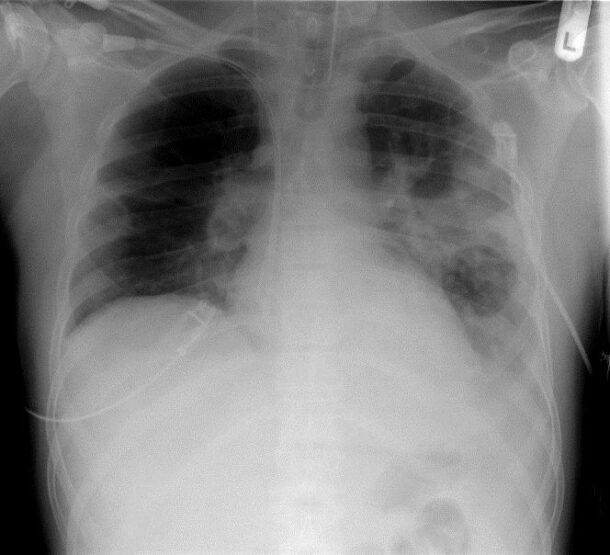
This year many people have told me about cases of pneumonia. In some it began as flu that developed into pneumonia; others reported a cough that got progressively worse. There were also cases where a mild cough wouldn’t go away and pneumonia was eventually diagnosed.
Pneumonia can be viral or bacterial. Typically the affected person suffers from a cough with rust-coloured sputum, chest pain, fever, weakness, chills and even nausea and vomiting. In milder forms however there may only be a persistent cough. Conventional treatments usually include antibiotics, but for over 200 years homeopathy has also been able to cure such cases successfully, quickly and completely.
Homeopathic successes in pneumonia
At the beginning of the 20th century homeopaths cured their pneumonia patients much more successfully than their allopathic colleagues and achieved a far higher recovery rate. Just read the following quote from a document of the National Center for Homeopathy about pneumonia:
"In the same year – 1928 – Doctors Alfred and Dayton Pulford of Toledo, Ohio, wrote in their monograph on pneumonia: 'It has already been stated, and we have every reason to follow this belief, that 80 percent of all cases of pneumonia recover without any medical interference and with proper nursing, so that any system or medical method that cannot reduce the mortality rate to less than 20 percent must be regarded as more of a menace than a blessing for patients with pneumonia.
Having treated 242 cases of pneumonia of all kinds and degrees of severity, some of which came to us directly from allopaths and others diagnosed by allopathic colleagues, with only three deaths, a percentage of only 1.4 percent, we can hardly understand the fixed minimum mortality rate of 25 percent, let alone a maximum mortality rate of 95 percent in a disease that responds so readily to the right remedy as pneumonia does. The mortality rate under administration of the homeopathic simillimum should at no time exceed five percent; a higher rate would rather call our ability into question.'"
Antimonium tartaricum
When Monica developed pneumonia she had just recovered from the flu and her fever had gone, but a cough remained. She kept assuring her family that she was fine, "just a little cough", so it seemed unnecessary to give her a remedy. Then she noticed that her chest felt as if it had been stuffed with cotton wool. It was the persistent weakness that worried her family most. Monica’s sister, who had attended a homeopathy course, finally gave her Antimonium tartaricum C30 twice daily. Within a few days her voice grew stronger. For the first time in weeks Monica was able to cough up phlegm. After a week of repeated doses she was almost back to herself. No antibiotics, no side effects, a complete recovery, and all with an inexpensive pack of Antimonium tartaricum C30. (Further information on dosage and potency of the remedy can be found here.)
Kali carbonicum
The Banerji protocol for pneumonia relies primarily on the remedy Kali carbonicum 200, to be taken twice daily. For a cough with gagging, Ipecac 200, to be taken every three hours, may also be used.
There are many other remedies that match particular forms of pneumonia, but as our homeopathic colleagues of earlier times taught us, the real question of whether homeopathy can cure pneumonia depends on the skills of the prescriber. The right remedy must be used, and when it is, the cure is fast, gentle and complete. It's best to always have a small home medicine kit on hand.
Homeopathy helps – spread the word!
Warmly,
Yours,
.png)
Source: https://joettecalabrese.com/blog/pneumonia-homeopathy-pneumonia/
|


