
The word ‚fungus‘ need not always carry a negative connotation. I can assure you on my honour as an Italian cook that there are also good fungi – just think of fine edible mushrooms and truffles!
When some of you recently raised the subject of fungi with me, I realised immediately that you weren't looking for a recipe for Fettuccine al Tartufo from me.
The human body hosts many different fungi within its microbiome. Problems arise when this delicate balance is disturbed. The question is what exactly can upset this sensitive equilibrium. Environmental influences and hygiene products certainly play a role, but over‑the‑counter medicines also make their contribution.
A dysbiosis caused by fungi can produce a variety of complaints in and on our bodies. Although treating a fungal disease generally requires a specific approach, I can assure you that fungal infections can be treated successfully and sustainably with homeopathy.
Fungal infections and homeopathy
I have written elsewhere about fungal infections: on Candida albicans, Sepia and here about oral thrush, which is also a fungal infection.
So, as mentioned, when the fungi in and on the body seem to shoot up like mushrooms from the ground (pardon the pun), the individual sites of infection are generally treated with different medications. But why is that? In homeopathy we do not act against specific microorganisms; instead we look closely at the affected organ.
So let's take a closer look at another common fungal disease – the highly contagious fungus Tinea pedis. Sounds rather exotic and mysterious, doesn't it? But don't be too impressed by the Latin technical term. Colloquially the pathogen is known as athlete's foot.
Arnica in dilution
Moist conditions, such as those typically found in changing rooms, provide an ideal breeding ground for this particular fungus. It shows itself through itchy, burning, scaly and cracked patches of skin. Not very attractive.
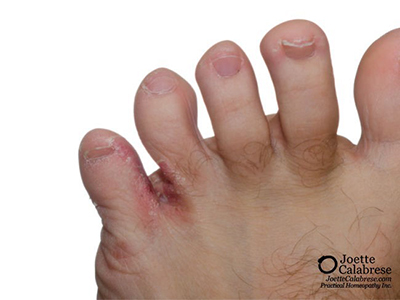
Recently I learned the treatment method of my colleague Joe De Livera. Joe uses Arnica 30 for athlete's foot in an aqueous solution that is sprayed directly onto the affected skin areas. Further information on potency and dosage can be found here. The method is fundamentally different from anything I have used in the past, but it is very effective.
Making aqueous extracts yourself
Lately I have experimented myself and prepared aqueous extracts with Arnica 30. For this a pipette (approx. 10 to 20 drops) of Arnica dilution (liquid form prepared either with water or alcohol) is dissolved in half a litre of water. If the dilution is not available to you, you can also make the spray using globules. Ten to twenty globules per 500 ml of water are usually sufficient.
Before each application I shake the bottle ten times. Unlike the more precise dosing protocol we must observe with the oral administration of globules, the spray can be applied to the skin as needed and as often as required. It should, however, be used at least twice a day. Please make sure the skin is well dried before you put your socks back on – we know that a damp environment promotes fungal colonisation.
And when the fungus has gone, you may be proud of your success. Homeopathy helps – pass it on.
Warmly,
Yours
.png)