Homeopathy in Japan Dr. Rosina Sonnenschmidt - Seminar in Japan 2009 |
||
Arrival in Japan |
Normally a lecturer in Japan is not invited automatically a second time. Seminar participants usually wait to see whether the seminar content and live work with patients bear fruit in their own practice. Japanese homeopaths are intensively trained and are also taught to observe carefully and to sense whether the lecturer lives what they teach. That Rosina Sonnenschmidt was invited again attests to her authenticity, her excellent work and manner of presentation, as well as to her holistic application of homeopathy. |
|
 |
 |
Rosina Sonnenschmidt was appointed the first foreign honorary member of the Imperial Homeopathy Society. |
| Certificate establishing the honorary membership | Certificate of regular membership | |
Contact between Rosina Sonnenschmidt and Torako Yui was established some years ago. After Hahnemann’s foundational works on homeopathy had all been translated into Japanese, Dr Yui wanted a worldwide network of Japanese homeopaths to search for literature that met the standards of holistic thinking and treatment. A German-speaking colleague discovered the book “Homoeopathic Cancer Repertory” by Rosina Sonnenschmidt, and with its holistic approach to cancer therapy it precisely met the needs of the Japanese. The decision to translate the book into Japanese was made quickly. |
||
Dr. Torako Yui
|
The book Liver and Gallbladder – Acquired Authority from the series Organ-Conflict – Healing by Rosina Sonnenschmidt has been available in English since November 2009 and was presented by Dr Yui at the beginning of the seminar. The entire series “Organ-Conflict – Healing” will be translated into English and into Japanese over the coming years. |
|
Homeopathy in Japan has only existed for 17 years and was founded by Dr Torako Yui. After her own serious illness, from which Torako Yui, then living in England, was completely cured by homeopathy, she developed the desire to establish homeopathy in Japan. To obtain a house for training, money for investments, permits for the import of mother tinctures and for distribution in pharmacies, etc., Dr Yui invited people from government, business and medicine. She presented her ideas and demanded that all who wanted to support her project gain their own experience with homeopathy. The invitees took her up on the offer and experienced that the globules had effects on them. Symptoms disappeared, psychological condition improved. They met again after half a year. Representatives of the imperial household together with politicians and businesspeople listened with interest when Dr Yui spoke of the enormous potential savings in the health system. Within one year laws were changed and financial subsidies provided. The courageous woman ensured that the introduction of homeopathy was a success and not merely an alternative idea to conventional medicine. |
||
Much has happened since: More than 1,000 homeopaths have been trained and have formed working groups throughout Japan, practices have been opened, the national law on compulsory vaccination was abolished and the term “Classical Homeopathy” was replaced by “Holistic Homeopathy”. Torako Yui will also speak at the Children's Homeopathy Congress from 12–14 March 2010 in Badenweiler. |
||
Organic farming
|
At the centre of the concept of “Holistic Homeopathy” in Japan is homeopathy. It is accompanied by various therapeutic measures:
|
|
Japan is an island state. Homeopathy centres as well as practices are spread across various islands and it is often not possible for patients to consult a homeopath directly. To be able to treat successfully over large distances, however, two basic prerequisites must be met:
Constitutional homeopathy also requires creative solutions, training homeopaths to draw diagnostic conclusions from the patient’s appearance, movement, voice and expression. Here intuition, observational skills and knowledge of remedies are required. |
||
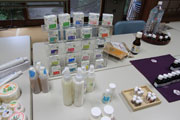
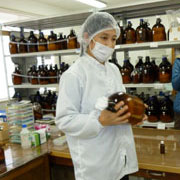
Preparation of homeopathic remedies
|
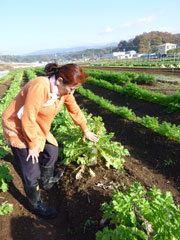
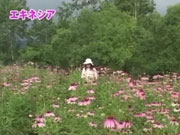
How consistently and comprehensively homeopathy is taught and applied is also shown by the fact that every homeopath works in the cultivation fields of medicinal plants on the island of Hokkaido. In this way all steps between soil preparation, planting, harvest, production of mother tinctures, spagyrics, essences and tinctures are experienced holistically.
|
|
|
Dr Torako Yui explains the planting method and the layout of the flower fields ~video(Torako_Blumenfeld.flv;Dr. Torako Yui)~
Japanese homeopaths harvesting the planted flowers ~video(Torako_Blumenfeld2.flv; Harvest)~
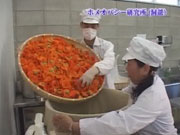
Dr Yui explains the further processing of the flowers into homeopathic remedies ~video(TorakoVerarbeitung.flv; Processing)~ |
|
|
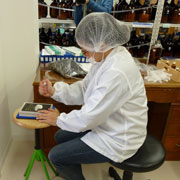
Homeopaths in Japan can independently produce homeopathic remedies and are not dependent on foreign suppliers. The desire to place homeopathy within a holistic view of people and the world is fulfilled throughout. |
|
For the Japanese, Dr Yui explains, it is of central importance that they are no longer a dying people. We cannot imagine here the consequences of the two atomic bombs: countless types of cancer, miscarriages, stillbirths, malformed offspring and the trauma of human experimentation and the loss of human dignity. Dr Yui stated everywhere she spoke in the media, at congresses and at lectures nationwide: “Sixty years after the atomic human experiment neither pharmaceutical medicine, chemotherapy and radiotherapy nor the vaccine mania can point to any success in healing. On the contrary. Therefore it is time to change our consciousness, to trust our native culture and folk medicine, to rely on our spiritual roots in Shintoism and Buddhism and to integrate homeopathy into our culture.” |
||
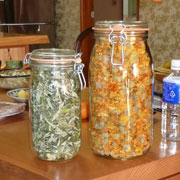
Herbal blends from organic farming
|
Japanese homeopaths are up to date in research into holistic cancer therapy and are leading in the production of fermented mushrooms and cereals. Dr Yui has since produced many cancer nosodes and supports cancer treatment with a fermented buckwheat drink, which is also available to all homeopaths to strengthen immunity. The work of Dr Heinrich Kremer “The Silent Revolution of Cancer and AIDS Therapy” (Ehlers Verlag), as well as the teachings of Dr Geerd Ryke Hamer on archaic conflicts and their representations in the brain, are studied, as are all miasm models of past and present. |
|
|
||
The result is a pragmatic, simple treatment concept for complicated diseases and a spiritual and creative approach to chronically ill people. |
||
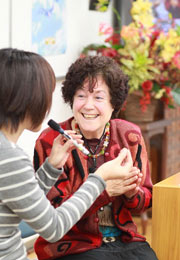
Live case-taking
|
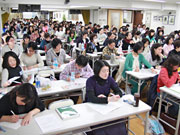
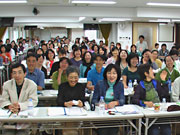
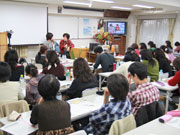
Rosina Sonnenschmidt’s presentation of her miasmatic work and her explanations of the cancer conflicts, as well as the live case-taking with Japanese patients and the teaching of simple rhythmic breathing exercises during the seminar, were enthusiastically incorporated into the holistic concept. The great success led Dr Yui to decide that every day at 9am and 3pm homeopaths throughout the country should pause for half an hour, meditate, then recite and perform the rhythmic breathing exercises taught by Ms Sonnenschmidt. “Let us always start with ourselves first, then we will know what is good for our patients!” |
|
Impressions of the Japan trip |
||
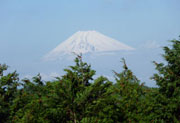
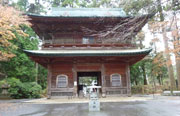
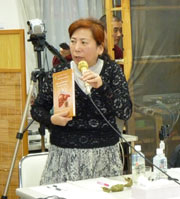

 |
 |
 |
 |
 |
 |
 |
 |
 |
 |
 |
 |
Link to the Imperial Society for Homeopathy

