Everyday Miracles in the Maternity WardA midwife's stories of healing with homeopathyby midwife Susan Vaughen | |
© melti / PIXELIO |
During my more than forty years as a midwife I have attended many thousands of births. Each one has deepened my appreciation of the boundless miracle of natural birth and strengthened my commitment to affirming the self-healing capacity of my patients. I discovered homeopathy relatively late in my career, but today I rely on it completely, because it can perform both everyday miracles and extraordinary, astonishing things.
|
As a midwife in a medical practice I have many medical resources at my disposal, yet there are situations in which only a homeopathic remedy can help. The right remedy can change the entire dynamic in the delivery room. Countless times homeopathy has helped women avoid a caesarean section by advancing labour or calming the woman so she could gather herself and actively participate in the meaningful experience of birth; it has ensured the baby's wellbeing by supporting the progress of labour. The nurses on the ward tease me because they panic — and not me — when a labouring mother develops problems and the baby's heart rate weakens: "Susan says: ‘Relax and let the homeopathy work!’"
|
|
Everyday Miracles |
|
|
Aconite has eased many a birth and calmed numerous anxious expectant mothers so that labour could proceed naturally. |
|
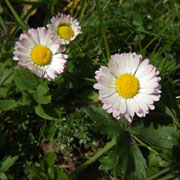
Bellis perennis was often particularly helpful after birth when a woman had been pushing for a long time and her hips and back ached and her tailbone hurt so much that she could hardly sit. |
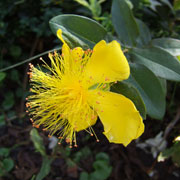 |
Hypericum, with its affinity for nerve injuries, can be especially useful after a caesarean section because there are so many nerve endings in the pelvis that can be affected. I have often used it to speed healing, ease the typical sharp pain of nerve damage and relieve numbness after a caesarean. |
|
In two cases I observed that Staphysagria calmed mothers who were in tears after a caesarean. The need for this remedy showed itself in their obvious anger at feeling "violated and hurt" by the procedure. I found that it sometimes heals nerve pain better than Hypericum when there is an emotional dimension of humiliation and outrage. |
| Occasionally I need to use remedies that are otherwise less commonly used during labour, or I give a familiar remedy under unusual circumstances. In a maternity ward anything is possible. | |
Sudden Rage |
|
Twenty-eight-year-old Charlotte has fair skin, dark hair and deep blue eyes. She dresses in bright colours and favours a flamboyant style. Her partner often accompanied her to antenatal appointments, and she expressed her needs to him decisively but cheerfully. |
|
 |
I realised I had a perfect picture of Belladonna before me. The violent outbursts, the rage and intense agony, the sudden fever, the throbbing headaches, the red face and bright eyes, the pain at every touch and her screaming — all pointed to Belladonna. We often associate Belladonna with lack of thirst; in fact Belladonna also appears in many thirst rubrics in the homeopathic repertory, including "thirst; extreme" and "unquenchable thirst." I gave Charlotte a dose of Belladonna C200 and waited. |
| Forty-five minutes later the fever had subsided. She looked calmer and worked better with the contractions. She still did not want to be touched or to get up, but as her symptoms had improved I continued to wait. Another forty-five minutes later she again complained of pressure in the pelvis and began to bear down spontaneously. This time she immediately agreed to an examination and showed no discomfort. Her cervix was fully dilated and she was ready to give birth. One or two pushing contractions and she delivered her eight-pound son, who was even crying strongly before he was fully out. When I looked at Charlotte's notes I wondered whether Belladonna was her constitutional remedy. During labour women usually need a first-aid remedy related to the presenting circumstances, but sometimes they also display an intensified picture of their constitutional remedy. Whenever I had seen Charlotte before, she had seemed very "lively" and closely attached to her husband, and she was always in a good mood. Hahnemann described people who need Belladonna thus: "Unrestrained and exuberantly cheerful; they tend to scold for no reason and to offend others laughingly." Unfortunately I had no opportunity to follow Charlotte's further progress; I hope, however, that Belladonna helped her in every respect. |
|
Rescue from the Brink |
|
Christine was a 30-year-old woman with a placenta praevia. She believed the placenta was obstructing the cervix and that she would need a caesarean. We had told her that she needed immediate care if she began to bleed because it could be life-threatening. At 37 weeks' gestation (pregnancy usually lasts 40 weeks) she arrived at the emergency department with bright red bleeding. She said she had bled a little at home. We began to prepare her for theatre but did not rush because the bleeding was only trickling and did not indicate immediate danger for her or the baby. |
|
Painful Back Labour |
|
Wendy was a healthy 26-year-old second-time mother. At 38 weeks she called me at midnight to say labour had started with a nagging pain in her lower back that worsened with each contraction. When I arrived at the hospital she was leaning against the wall and her husband was pressing firmly on her back. The stronger the contractions, the more she wanted him to press on her back. |
|
Potassium chloride |
I gave her a dose of Kali carbonicum C200, and within five minutes Wendy felt the pain ease as the baby moved away from her back. The baby had rotated into the typical head-down position, and with a surprised look Wendy exclaimed: "Wow! I'm ready!" In fact the baby's head was already visible, and with the next contraction Wendy easily delivered her over-4-kilo daughter. |
Feeling Unable to Cope |
|
Twenty-nine-year-old Tracy, pregnant with her fourth child, wanted a different kind of birth from her previous ones. Previously she had always been given an epidural, her labours had been induced with drugs, and she had been generally disappointed by her birth experiences. At antenatal consultations Tracy expressed the wish to retain control of this birth and avoid unnecessary interventions. |
|
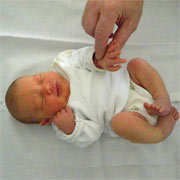 |
Tracy's body was clearly ready for birth, but her fear seemed to be standing in the way. Because she felt unable to cope with the task ahead, I gave her a dose of Gelsemium C200, which is a main remedy for anticipatory anxiety about an impending event, especially when the patient is weak and trembling. Tracy had a good lunch and then took a nap. She awoke more rested and relaxed than she had felt in weeks. |
She read her children a bedtime story, and at 10:30 pm her waters broke and she went into labour. By about 11:30 pm the contractions were regular and strong. Tracy arrived at the clinic around midnight, and her healthy baby was already born by 12 noon! At the three-day postnatal check-up Tracy could not say enough about her wonderful and satisfying birth experience. Gelsemium had helped her over the "stage-fright" and enabled her to shape the birth of her child according to her wishes. |
|
The Benefits of Homeopathic Treatment |
|
Homeopathy changes the way I approach midwifery, even when I do not give a remedy. One of the most important lessons I took from the Academy of Classical Homeopathy in Florida was the patient history, which is much more comprehensive than anything I had learned in midwifery school. To select an appropriate homeopathic remedy the homeopath needs information that conventional medicine regards as secondary but which in reality lie at the core of personality. My homeopathy training has increased my ability as a midwife to understand my patients and to give them the best possible care.
|
|
 |
Susan Vaughen, a certified midwife and nurse, has helped women bring their babies into the world for decades; she has worked as a childbirth educator and is a La Leche League leader. Since 2002 she has been a registered nurse and midwife. She is a graduate of the Academy of Classical Homeopathy/Florida and currently works as a midwife in Florida. |
--------------------------------------------------------------------------------------------------- |
|
|
|