Homeopathy for Depression
Q-potencies for moderate to severe depression compared with fluoxetine: Double‑blind study
By U. C. Adler, N. M. P. Paiva, A. T. Cesar, M. S. Adler, A. Molina, A. E. Padula and H. M. Calil from the Medical Faculty, Sao Paulo, Brazil. |

Globules versus tablets
|
Overview
Homeopathy is used in medicine both as an adjunctive and as an integrative therapy in the treatment of depression. The aim of this study was to investigate the non‑inferiority and tolerability of individually prescribed homeopathic remedies in Q‑potencies for acute depression; fluoxetine was used as the active control.
91 outpatients with moderate to severe depression were instructed to take an individually prescribed homeopathic remedy or fluoxetine 20 mg daily (up to 40 mg daily) for the duration of the prospective, eight‑week, single‑centre, randomised, double‑blind, double‑dummy trial.
|
The primary efficacy outcome was the change in the mean score on the Montgomery‑Åsberg Depression Rating Scale (MADRS).
Secondary efficacy outcomes were response to treatment and remission of depression. The study demonstrated non‑inferiority of homeopathy. There were no significant differences between the treatment groups in response rates or remission of depression.
Tolerability: There were no significant differences in the frequency of adverse effects, although a higher percentage of patients treated with fluoxetine reported bothersome side effects; furthermore, there was a trend towards higher discontinuation due to adverse effects in the fluoxetine group.
This study illustrates the feasibility of randomised controlled double‑blind trials with homeopathic remedies in the treatment of depression and shows the non‑inferiority of individually prescribed homeopathic Q‑potencies compared with fluoxetine in the acute treatment of outpatients with moderate to severe depression.
|

|
Introduction
According to the Brazilian World Health Survey 2003, depression, at 19.2%, was the most common chronic disease among those covered by the survey, including asthma, arthritis, angina and diabetes.
There remain many shortcomings in the treatment of depression with antidepressants, concerning efficacy, side effects, non‑adherence or delayed response.
|
Unmet needs that conventional treatment could not satisfy may contribute to patients seeking alternatives: depression is one of the main reasons for the use of complementary and integrative medicine (CIM) in the USA, although the efficacy of CIM for this condition has not yet been definitively established.
Homeopathy is an integrative therapeutic approach that is also used in the treatment of depression, and in Brazil it is recognised as a medical therapeutic discipline. Classical homeopathic treatment is individualised to the patient. The homeopathic remedy is selected according to its similarity to the patient’s signs and symptoms. Homeopathic therapy aims to stabilise the organism against the physical and mental impairments caused by the illness.
The minimal doses used in homeopathy are said to influence bodily processes through Hahnemann’s method of potentisation, even in terms of physics: thermoluminescence emitted by ultra‑high dilutions (potencies) of lithium chloride and sodium chloride remains specific to the initially dissolved salts despite dilution below Avogadro’s number.
With potentised homeopathic remedies in unusually small doses, Hahnemann aimed for a rapid, gentle and lasting restoration of health; he believed this could be more easily achieved with his final potentisation method, the fifty‑thousandfold dilution (Q‑ or LM‑potencies), in which the substance is diluted 50,000‑fold at each step. Hahnemann’s instructions for the preparation and use of these potencies are part of a posthumous publication (6th edition of the Organon) and were, until recent decades, even unknown to many homeopaths.
There are no controlled studies on the use of homeopathic Q‑potencies in depression. Therefore, despite homeopathy’s reported effects in depression treatment, its use has been limited by the lack of high‑quality clinical trials. Recently, however, Q‑potencies have been tested in controlled, randomised trials and their therapeutic effects have been demonstrated versus placebo in fibromyalgia and attention‑deficit/hyperactivity disorder (ADHD).
The present study is a further step in this direction and aimed to evaluate the non‑inferiority and tolerability of individually prescribed homeopathic Q‑potencies in adults with acute depressive episodes compared with fluoxetine in a prospective, randomised, double‑blind/double‑dummy trial. |

Hospital in Jundiai |
The patients
Patients were referred to the Outpatient Clinic for Homeopathy and Depression of Jundiai (São Paulo, Brazil) that matched their form of depression (single or recurrent depressive episodes) and were enrolled in the study after a clinical consultation. The ability and willingness to cooperate were also prerequisites.
|
Exclusion criteria were: psychosis, mania, hypomania or other disorders such as panic attacks, personality disorders, alcohol or drug abuse within one year prior to screening, use of antidepressants within 30 days prior to screening, pregnancy or breastfeeding, age <18 years, MADRS <15, suicide attempts (although these are depressive symptoms, they are also standard exclusion criteria in clinical depression trials).
The 91 patients were recruited between February 2006 and September 2008.
Ethics
Each participant was informed about the study and gave written consent. The study was approved by the ethics committees of FMJ and UNIFESP.
Study design, blinding and randomisation
The study was a prospective, randomised, double‑blind, double‑dummy trial with fluoxetine as the active control medication. The double‑dummy method was used because it was not possible to make the homeopathic remedy (medicinal globules) and the fluoxetine capsules look the same; therefore a placebo was manufactured for each medication.
Patients underwent a homeopathic case-taking by the principal investigator and received a prescription for an individual homeopathic remedy as well as for fluoxetine. The pharmacist dispensed either homeopathy and placebo or fluoxetine and placebo in random order.
Only one of the authors and the pharmacist had access to the code of this randomised sequence during the study. After each patient completed the eight‑week trial, the pharmacist informed the PI whether the patient had received homeopathy or fluoxetine (and the corresponding placebo), without revealing the code.
Medications used in the study
Patients received one of the following medications:
i. one drop of the prescribed Q‑potency, three times per week (Mondays, Wednesdays and Fridays), in the morning before breakfast, or
ii. a hard white gelatin capsule containing 20 mg fluoxetine hydrochloride, taken daily in the morning after breakfast.
in addition they took their placebos.
The homeopathic Q‑potencies were produced by HN‑CRISTIANO Pharma, Pinheiros, São Paulo. They were supplied in 30 ml bottles with one bead of the prescribed remedy in the Q‑potency in 20 ml of a 30% alcohol solution. Patients started the study at Q2 and progressed to higher potencies: Q3, Q4, etc., according to their clinical indication. The placebo bottles contained the same amount of 30% alcohol.
The fluoxetine capsules were provided by High Cost‑Pharma of Jundiai. Because these capsules supplied by the local health system were yellow‑green, the medication was re‑encapsulated by another pharmacist into white capsules to match the placebo, which was supplied in white capsules and contained cellulose, kaolin and talc.
If there was no response after four weeks of treatment, the patient was blinded to receive:
i. 40 mg of fluoxetine daily or two placebo capsules and
ii. a new homeopathic prescription or placebo solution. The homeopath was allowed to change remedy, potency or dosing instructions.
The principal investigator is a homeopathic physician with 20 years’ experience in the use of Q‑potencies as described by Hahnemann in the 6th edition of the Organon. |
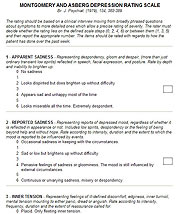
Montgomery‑Åsberg Depression Rating Scale |
Measurements
Improvements were assessed with the Montgomery‑Åsberg Depression Rating Scale (MADRS), which was administered by an assessor blinded to treatment allocation and outcomes.
The unit of measure was the change in mean scores from baseline to weeks 4 and 8 of treatment. Response and remission were measured for this period.
Tolerability was assessed with the adverse effects scale of the Scandinavian Society for Psychopharmacology; the evaluation was also performed blinded.
|
The study comprised patients with moderate to severe depression. Initially 284 individuals were screened, 105 met entry criteria, 14 of whom did not attend the first appointment. Ninety‑one patients participated in the study, and 55 completed the eight‑week study period.
Almost all participants were female (98%). One male patient was randomised to each group. Marital status (married, single, widowed, divorced) appeared not to be relevant.
Twenty remedies were used to treat the 48 patients randomised to homeopathic therapy: Alumina, Anacardium orientale, Arsenicum album, Aurum foliatum, Barium carbonicum, Calcium carbonicum, Carbo animalis, Causticum, Graphites, Hepar sulphuris, Kalium carbonicum, Lycopodium clavatum, Natrum carbonicum, Natrum muriaticum, Mezereum, Phosphorus, Sepia succus, Silicea, Sulphur and Zincum. These remedies were selected according to Hahnemann’s instructions, i.e. characteristic symptoms, the rule of similars, etc.
In the fluoxetine group three patients took clonazepam (1–2.5 mg), and two took diazepam (5–10 mg). One patient in the homeopathy group took clonazepam at study entry, and another took diazepam. None of the study participants were in psychotherapy.
Efficacy analysis
Fluoxetine and homeopathy showed similar response rates at week 4 (63.9% and 65.8%) and week 8 (84.6% and 82.8%). Regarding remission, there were also no major differences between the two treatments (47.2% and 55.3% at week 4, and 76.9% and 72.4% at week 8).
Tolerability
There were also no significant differences regarding adverse effects, although a higher percentage of patients treated with fluoxetine (21.4%) than homeopathy patients (10.7%) reported side effects. |

|
Discussion
In this study outpatients with depression were randomised in a double‑blind trial to receive either individually prescribed homeopathic Q‑potencies or fluoxetine. Analysis showed that the homeopathic Q‑potencies were not inferior to fluoxetine.
This is the first controlled, randomised double‑blind trial with a sufficient number of patients to allow, to the best of our knowledge, conclusions regarding the homeopathic treatment of depression.
|
Previously there appear to have been only two other studies that investigated homeopathy for depression, one of low methodological quality (not blinded) and another with too few participants: eleven patients were enrolled and only three completed the study.
The present study was not recruited by advertisements, nor was it designed by proponents of alternative medicine; the participants were help‑seeking patients of the Clinic for Homeopathy and Depression of Jundiaí. The predominance of female participants is explained by the relatively low use of health services by Brazilian men.
The need for individualised prescriptions in classical homeopathy has been regarded by experienced researchers as an obstacle to double‑blind trials. In fact, such a trial not only demonstrates the effect of homeopathy but also the skill of the homeopath in selecting and managing remedies.
There were also no significant differences between response or remission in the two treatment groups; however, it can be hypothesised that the homeopathic consultation itself is a positive therapeutic intervention that may act independently or synergistically with the prescribed remedy.
Fluoxetine and homeopathy patients showed differences in tolerability which—although not statistically significant—are of interest: the fluoxetine group had a higher tendency to discontinue treatment because of unpleasant side effects. On the other hand, more homeopathy patients discontinued due to worsening of depressive symptoms. A possible explanation might be random differences in small samples, or that homeopathy was not sufficiently effective in stressful situations.
There are no data on the effect of homeopathy in preventing depressive relapses, but it is known that stressful life events can cause recurrence of depression even in conventionally treated patients.
The present study has certain limitations such as dependence on a single homeopathic physician, a relatively small sample and a short treatment duration—the acute phase of depression.
Nevertheless, despite these limitations, the study demonstrates the feasibility of randomised controlled double‑blind trials with homeopathic remedies for depression and shows the non‑inferiority of individually prescribed homeopathic Q‑potencies compared with fluoxetine in the acute treatment of outpatients with moderate to severe depression. Further studies are required to corroborate these findings; longer‑term trials and follow‑up studies on depression treatment with homeopathy are also needed.
|
Correspondence:
H. M. Calil, Department of Psychobiology, University of São Paulo, R. Napoleão de Barros, 925 São Paulo, SP 04024-002, Brazil. Phone: +55 11‑2149‑0155; Fax: +55 11‑5572‑5092; E‑mail: hmcalil@psicobio.epm.br
-------------------------------------------------------------------------------------------------- |
|
|