
A small underrated medicinal herb
How often do we walk over the earth without paying attention to it? We pass by so much – always with a particular goal in mind. Haven't most of us forgotten walking that is attentive and perceptive?
And yet their effects are so great, these little gifts by the wayside, however inconspicuous they may seem! A tiny little herb like chickweed is almost always overlooked. And yet this very herb is uniquely rich in vital nutrients.
Individual healing experience
A plant – no matter how small – is always also its own being with its very own individuality and beauty. Each plant-being has its unique qualities with which it gifts us, if we are able to perceive it. That is a treasury of experience that only life can produce, and no book can replace.
“Someone who has observed a few plants in nature, has truly encountered them and grasped their healing effects holistically, knows much more than someone who only knows many plants from books.” Susanne Fischer-Rizzi
To experience a plant means to see it, to feel it, to hear it, to taste and to smell it. What forces dwell in it? What can I learn from it?
This attentive approach to a plant, in the awareness that it is an autonomous being, is entirely different from thoughtlessly picking it because books say it is good for this or that.
Chickweed: a wonder of vitality
A very small plant would like to move into the spotlight today, to be lifted out of disregard into appreciation and seen for what it wishes to give: chickweed.
In the time of traditional healers, such as Paracelsus, chickweed was still recognised as a medicinal plant. Today, however, many people somewhat contemptuously call it a weed. Yet it is described in many herbal reference works and researched in scientific studies.
Small, inconspicuous, almost fragile, this little plant appears. But appearances are deceptive, for it possesses an almost indestructible life force; it grows and blooms in the most inhospitable places.
Its clock seems to tick differently from most plants we know, for it produces up to six generations in a single year, each of which generates between 10,000 and 20,000 seeds. Each of these seeds can, in turn, lie dormant in the soil for up to 60 years, only to seek the sunlight again in fresh vigour at the suitable moment.
Therefore: however delicate chickweed may seem, never underestimate its robustness and will to live. And it is precisely these characteristics that make it a valuable helper for humans and animals.
How you can recognise chickweed
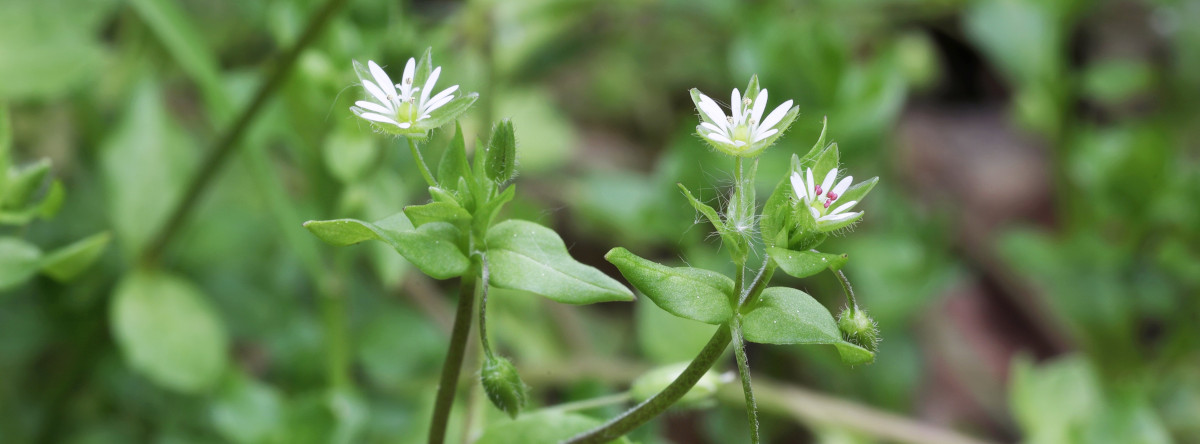
It often grows in gardens, on meadows or at woodland edges, sometimes even simply in the middle of a flower pot. It forms dense carpets of small opposite leaves with delicate, star-shaped, white flowers. It is frost-hardy – it seems as if eternal spring prevails for it. Stellaria can reach up to 40 cm in height. It grows and blooms in every season – even under the snow it can continue to grow. Its seeds also germinate in winter beneath the snow cover, so that it not infrequently, to the farmers' dismay, completely overgrows winter rye and lamb's lettuce. Self-intelligently it folds its leaves protectively over the fast-growing, sensitive young shoots in severe cold. In England it is tradition to look at the chickweed leaves in the morning to know whether a raincoat is needed. If the little star-flowers open early in the morning, a sunny day is ahead. If they remain tightly closed, rain is coming.
The pharmacological healing potential of chickweed
Active and vital substances
What makes chickweed a cornucopia of vital substances is above all its richness in vitamins (A, C, D and E), minerals (calcium, potassium, magnesium, copper, iron, phosphorus and zinc) and secondary plant compounds such as flavonoids. It also contains valuable essential oils.
Besides the many and partly rare minerals, Stellaria contains abundant saponins, which produce a foaming effect. (Saponins are often used in natural detergents because of this foaming property.) Saponins act mainly on the mucous membranes in the body. They are expectorant, digestive-promoting, diuretic, but also anti-inflammatory.
Many studies have identified the pharmacologically active constituents. Thus Stellaria media contains more than 80 bioactive secondary plant compounds. These include, in addition to saponins, alkaloids, cardiac glycosides, fatty acids, tannins and terpenoids [Study]. Both extracts from the fresh plant and the compounds isolated from it have proven pharmacologically significant. In vitro the plant has shown positive effects on hepatomas [Study]. It is mainly known for its fever-reducing, anti-inflammatory and antioxidant properties [Study], antimicrobial activities and anxiolytic effects [Study]. There are also promising findings regarding obesity [Study].
In the Middle Ages Stellaria was attributed a cooling energetic effect, which is why it was often used for poultices. Perhaps this also explains why many indigenous peoples use the crushed fresh leaves for skin infections, swellings, or even styes and conjunctivitis.
Other outstanding properties
Chickweed is bursting with iron and is therefore also a wonderful natural source for people with iron-deficiency anaemia. Reports of experience show that Stellaria can also help with skin eczema due to its high iron content.
To treat acute gastrointestinal and respiratory illnesses, the leaves of S. media are traditionally used in Asia and tropical Africa to make a decoction. Various parts of the plant are also recommended there for treating jaundice, inflammations of the kidneys, sexual organs and respiratory tract. They also act as decongestants and are used as poultices for bone fractures. [Study]
If chickweed is boiled, it can be used for its unique moisturizing and soothing properties, e.g. to relieve itchy skin or menstrual pain [Study]. A mixture of leaves, stems, flowers and roots is often macerated and proves effective in supporting regulation for mental disorders, respiratory inflammations and herpes simplex [Study].
Skin
Chickweed has anti-inflammatory properties and is nowadays mainly used as an ointment for skin rashes. This corresponds to its traditional use in skin disorders. It helps especially with irritated skin, itching, but also with eczema, hives and venous ulcers. For babies, an ointment with chickweed can help reduce nappy rash. For itchy rashes that appear with some childhood diseases, such as roseola (three-day fever), a compress of moistened, crushed chickweed leaves or a bath with chickweed tea added can be tried.
Stellaria media for inflammations
The anti-inflammatory properties of chickweed make it a natural support for inflammatory conditions. Internally, chickweed supports digestive problems, rheumatic inflammations and weight reduction.
Strengthens the immune system through its high vitamin C content
Chickweed is rich in vitamin C and that is precisely what makes it the unique and potent herb that it is. It not only promotes wound healing but also strengthens the immune system. Vitamin C contributes to normal collagen formation, which is important for the normal function of blood vessels, bones, cartilage, teeth and gums. In addition, vitamin C increases the absorption of iron from the plant itself. And vitamin C reduces tiredness and can contribute to normal psychological functions.
Stellaria media in diabetes
Traditionally in folk medicine, chickweed tea was also used for diabetic ailments. Diabetes is a metabolic disorder that has now become a widespread disease in humans. Therefore, science is also investigating the influence of Stellaria media on this disease. The combination of secondary plant compounds contained in chickweed has proven particularly effective. The secondary plant compounds such as tannins, saponins, flavonoids and flavonoid glycosides contribute to the plant's antidiabetic potential. Tannins regulate blood sugar levels and the concentration of the lipid profile [Study]. Saponins control serum glucose levels in diabetics [Study]. Flavonoids undergo metabolic processes to combat diabetic complications and improve insulin secretion from the pancreas. They also reduce oxidative stress, insulin resistance, apoptosis and inflammation in muscles [Study].
Stellaria media for rheumatism and arthritis
A tea, a tincture or a warm bath with the power of chickweed can prove helpful for arthritic complaints. This effect is described by Wolf-Dieter Storl in Heilkräuter und Zauberpflanzen zwischen Haustür und Gartentor as well as by Nicole Apelian & Claude Davis in their book Das verlorene Buch der Kräuterheilmittel. Die heilende Kraft der Pflanzen. Supposedly, for rheumatoid arthritis a strong tea is added to a warm bath to relieve pain in the knees and feet.
Application
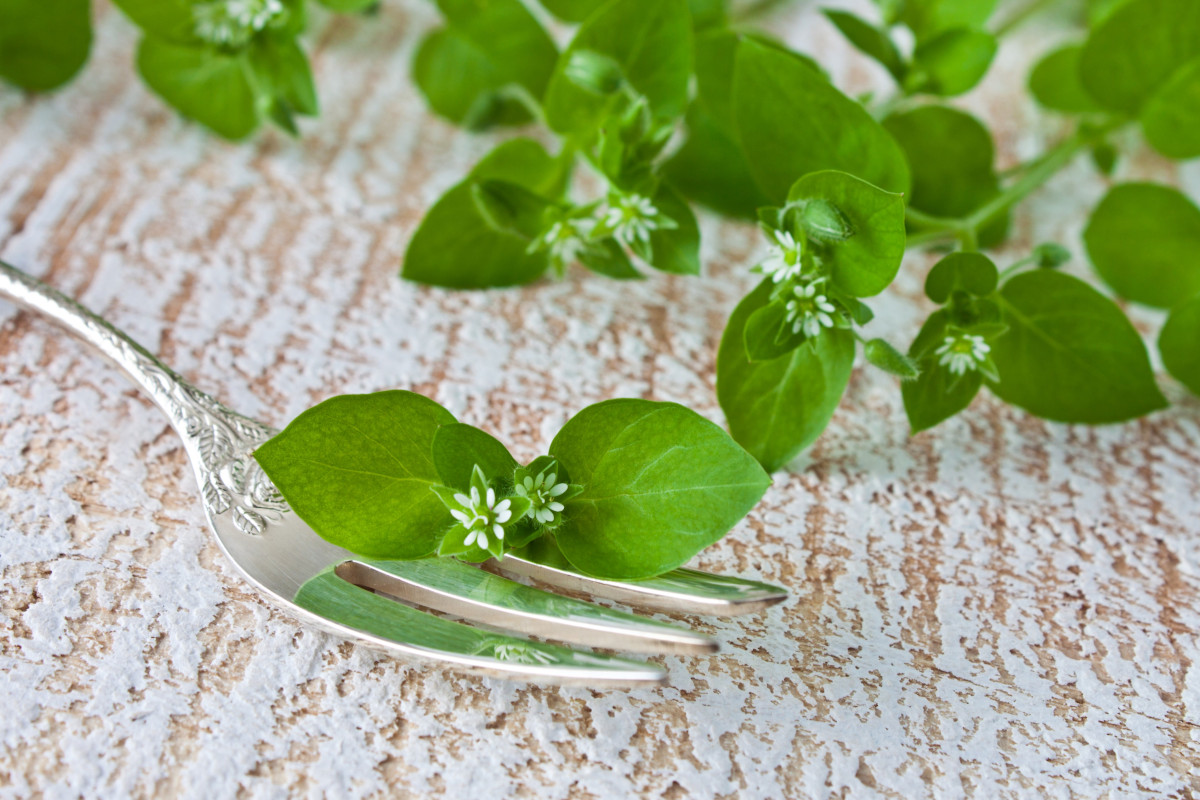
Above all, the above-ground parts of the plant are used in a variety of ways.
Leaves, stems and flowers are edible raw or cooked. You can use chickweed as a tea, as a tincture, as a bath additive and as a cream, and you can even prepare a salad from it.
Chickweed tea
For an infusion, simply take one teaspoon of dried or fresh chickweed, pour over with hot water and let it steep for about 10 minutes. As an internal and external cleansing preparation you need 1 cup of freshly picked chickweed and 500 ml of water. Bring the water to the boil and then add the herb. Let it simmer for 15 minutes and then cool. For internal use the dose is 30–60 ml. (Cf. Nicole Apelian & Claude Davis. Das verlorene Buch der Kräuterheilmittel. Die heilende Kraft der Pflanzen.)
Chickweed ointment
Chickweed is well suited for making ointments. An infusion can be mixed with a neutral ointment base and applied to the affected areas of skin.
Chickweed salad
A salad of chickweed and wild garlic not only tastes good but is also excellent for a spring cleanse. Finely chop a large bunch of chickweed and a handful of fresh wild garlic and mix with 20 g soured cream. Add seasonings to taste. (Cf. Wolf-Dieter Storl in Heilkräuter und Zauberpflanzen zwischen Haustür und Gartentor.)
Conclusion
Chickweed, this small delicate plant, is a great teacher. It shows how much strength dwells even in the smallest things, how much will to survive and vital richness there is. To perceive and feel this treasure in nature is a great step that both the plants and we humans need. For we only feel a plant when we open our hearts.
And therein lies a great power, for everything is connected. We are woven into the cosmic interconnection, into the harmony between heaven and earth. This harmony was once considered by people to be the fulfilment of their lives, for from this state they recognised the selfless giving of Mother Earth.
The plants, even the smallest, were sacred to them. They processed them with mindfulness, gratitude and devotion. Therefore: when you next stand before chickweed, feel the plant once and perceive it as a being. This alone will already bring about a change within you.
Disclaimer
In general, chickweed is safe to consume. In very high doses, however, it can cause vomiting, nausea and diarrhoea.
It is always advisable, before using medicinal plants, especially if you have existing health problems or are pregnant or breastfeeding, to consult a doctor or herbalist.
Image 1: Ottmar Baumer/shutterstock.com; Image 2: PhotoSGH/shutterstock.com

