
Levofloxacin C30 for tendon ruptures
Specific "side effects" as a homoeopathic indication – Part 1
Go to Part 2
By Ulrich Welte
Summary: After the last newsletter on the homoeopathic use of Phenytoin C6 for disorders of gum growth, today the phenomenon of the specific "side effect" as a homoeopathic indication is explored further using the potentised antibiotic Levofloxacin. Because of its specific side effect of tendon ruptures, Levofloxacin C30 was used successfully as a homoeopathic remedy in a case of tendon ruptures.
The "side effect" is here regarded not as a disturbance but as part of the drug picture and serves as a homoeopathic indication in illness. A side effect is specific only if it stands out from banal side effects such as non‑specified "gastrointestinal disorders", headache or skin itching: it should primarily be rare, for example the muscle disorders seen with statins (myositis, muscle weakness or paralysis), or at least differ markedly in frequency from the average occurrence.
Clinical drug picture of Levofloxacin
 Main indications: Disorders of tendon insertions. Achilles and patellar tendon ruptures. Also rupture of a finger tendon has been reported with Levofloxacin intake. The so common anterior cruciate ligament ruptures in footballers are usually associated with sports accidents with adequate trauma, yet an application here as postoperative support for physiotherapy is conceivable.
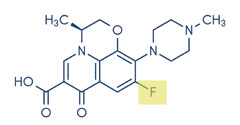
Levofloxacin is a fluorine‑containing antibiotic from the fluoroquinolone group (older name gyrase inhibitors), which generally should be used with caution in bacterial infections because they 'can cause potentially long‑lasting adverse effects on muscles, tendons, bones and the nervous system'. It is recommended to stop treatment with one of these antibiotics if the first signs of an unwanted effect such as pain, inflammation or even ruptures of tendons or muscles, muscle weakness or joint pain or neurological disturbances such as pins‑and‑needles sensations, suicidal thoughts or disturbances of sensory perception occur. Essentially, this already gives us a fairly detailed drug picture, which was found by 'testing' on millions of patients, but which is not used therapeutically because 'one' generally rejects the use in potentised form and according to the similarity principle.
The fluorine component from a homoeopathic perspective: If there are also indications of the homoeopathic remedy picture of Fluor[1], the remedy may be even more clearly indicated, although this is not a prerequisite for administration. Fluor symptoms include a smooth hardness and ruthlessness, with everything sliding off as if on a Teflon layer (Teflon is a fluorine product); physically, severe caries or even bone resorption can be mentioned (hydrofluoric acid, HF, quickly corrodes any metal). Also included among the side effects are suicidal thoughts and a general tendency to psychotic episodes; pleasure in the style of the new age, smooth and non‑committal; making quick money, also quick sex without commitment and drugs belong to it. The observed rapidity with which destructive side effects occur with Levofloxacin intake also speaks for the fluorine component: in extreme cases fluorine is a cool killer that shoots faster than its shadow.
Possible tendon damage became known quickly: After Levofloxacin was introduced in 1998, the French drug authority pointed out after a short time that this antibiotic should be prescribed with caution because there was a risk of tendon damage. The problem thus became apparent early on. Soon warnings were also issued about cardiac arrhythmias (partly life‑threatening cardiotoxicity), peripheral neuropathies and even about severe central nervous system excitation up to psychosis and increased light and sun sensitivity. In Germany the Arznei‑Telegramm already recommended in 2001 that gyrase inhibitors be prescribed only very restrictively because of severe harmful effects, especially tendon ruptures. Patients should be advised to consult a doctor immediately at the first signs of tendon damage or cardiac arrhythmias. It is also interesting that in susceptible patients the tendon disorders occur very quickly after Levofloxacin intake: the tendinopathies under gyrase inhibitors occur in 30 (68%) of 44 affected patients within one week, and in 9 (20%) already within two days of starting treatment. The report was published under the headline: Tendon ruptures under Levofloxacin (TAVANIC) conspicuously frequent. [2]
The symptoms in the orange bold therefore already give us a fairly orderly clinical drug picture of Levofloxacin, whereby the particular frequency of an otherwise uncommon symptom can be regarded as a keynote: the tendon ruptures and in particular the Achilles and patellar tendon rupture (insertion tendinopathies, that is inflammation and irritation at the tendon insertion) as well as generally tendon pain and tendon inflammations. Also muscle (fibre) ruptures without sufficient reason, i.e. without sudden extreme strain, could be considered an indication, yet the keynote of the remedy is the rupture of a tendon at its insertion point.
DD Rhus‑t: also prefers the tendon insertions and can be tense as if about to tear.
PS: Levofloxacin is available in various potencies via apodil.de or remedia.at.
[1] See "Homoeopathy and Minerals", by Jan Scholten, p. 173 https://www.narayana-verlag.de/Homoeopathie-und-Minerale-Jan-Scholten/b238
[2] A very informative article: https://www.arznei-telegramm.de/html/2002_01/0201015_01.html
Photo: Shutterstock_770813191, Copyright: StudioMolekuul

