
Treating itch homeopathically
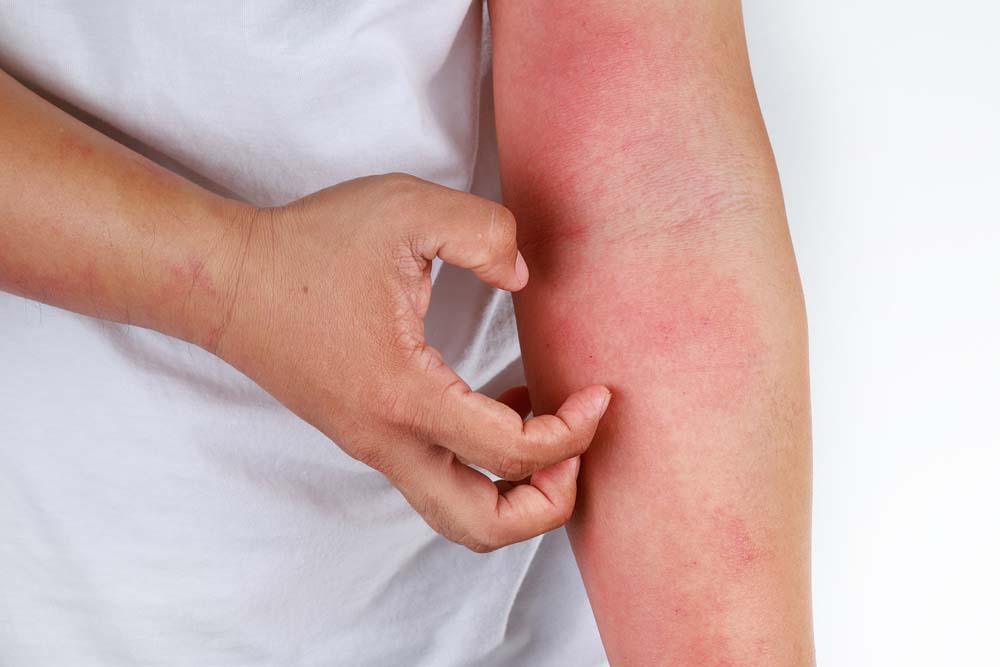
No matter what you do, it is (almost) always wrong.
When we are plagued by severe itching, most of us use creams that contain cortisone (steroids). However, these creams can set off a whole vicious cycle.
Why? The answer is simple: Because they work.
The problem is that they work in a way you basically do not want.
Adverse drug effects
For one, these creams carry a certain potential for dependence and often you cannot just stop using them.
There are countless stories online of people who have been dependent on them for years. Cortisone creams often lose effectiveness over time, which leads sufferers to use their cream more and more frequently and, above all, in larger amounts. That was not how it was originally intended by doctors.
Long-term and excessive use can lead to many complications, from additional skin problems to serious systemic health issues. When sufferers then try to stop using the cream, they often suffer from topical steroid withdrawal. Withdrawal symptoms include intense itching and reddened skin.
That's why I say “No matter what you do, it is (almost) always wrong.” But it doesn't have to be that way if you know a little about homeopathy.
Many sufferers ask me how long it takes for a homeopathic treatment to take effect. In light of the agonising itch, that is a legitimate question.
Antimonium for severe itching

As a first step towards a life without cortisone creams, I would like to introduce you to the Banerji protocol for very severe itching all over the body:
Antimonium crudum 6, to be taken twice daily.
In a second step it may be necessary to choose a different homeopathic remedy for the itch or to consider a completely different strategy. I want to remind you that Antimonium crudum 6 is not our only weapon against itching. But in my family, this remedy has often and reliably proved particularly effective for severe itching without visible rash.
Let me briefly say a few words about the term “improvement” because it is important. “Improvement” means that the symptoms are better than before and not necessarily that they disappear without a trace.
Here is an example to illustrate it better: One of my friends recently had very severe itching. Of course I immediately helped her to treat the itch. A few days ago I asked her whether she was feeling any better. She replied that the itching was still there. I then immediately wanted to know whether anything had improved at all and, if so, by how much.
My friend's answer to my question is the most important part of the whole conversation: “I still have itching… but it no longer keeps me awake at night. Also, I no longer have to scratch myself until I'm bleeding. That changed after the homeopathic pellets.”
That's exactly what I wanted to know. An improvement. A net gain. For me that means we stick with this remedy because it was well chosen. We continue it until either the itch has completely gone or the remedy stops working.
If she had told me that she had already been taking the homeopathic remedy twice daily for two weeks and still couldn't see any change or – God forbid – that the itch had even become worse, that would also have been important information.
It would mean that a) the remedy has not been taken for long enough OR b) it was not the right remedy from the outset and needs to be discontinued.
Onset of action (latency) of homeopathic remedies
How do you know that a remedy still needs longer to work properly?
I wish I could simply give you a list so that you know which remedies act more slowly or which conditions need a bit more time to heal, but the answer is that it has a lot to do with experience. If I can answer this question at all, I would say that – provided the itch has only recently appeared and has not been (or has not been long) treated with cortisone – you should be able to notice an improvement after a few weeks.
With a chronic skin disease it's different. In these cases the remedy must be taken for at least six to eight weeks before one can judge whether it has fully exerted its effect, whether it needs to be stopped because it causes initial aggravations, or whether it has changed nothing at all.
So many rules... I know it's not easy, but I'm sure the penny will drop.
I'll repeat briefly so that it's really understood:
For chronic complaints you should take the remedy for at least six to eight weeks, or until the symptoms improve significantly and the itching stops.
If you have not noticed any change by then, or if the itching has become worse, you must stop the remedy.
This also applies to all homeopathic applications. If the symptoms worsen, you must stop the homeopathic remedy.
If after six to eight weeks you cannot recognise any improvement, you should reconsider the situation and reassess the symptoms. Homeopathy is indeed a very complex medicine. With my posts I want to convey the basics to you as simply as possible.
It is important that you learn to take care of yourself without getting caught in a vicious cycle. I very much hope that this information will help you on your way to freedom and a life without topical steroids!
Warmly, Joette
.png)
--------------------------------------------------------------------------------------------------------------
Source: https://joettecalabrese.com/blog/itchy-skin/
Photo: 1061073509 by TY Lim, 1502338919 by Serge Vo
--------------------------------------------------------------------------------------------------------------

