The world is a dangerous place, I need protection:Homeopathic proving of Oplopanax horridus |
|
 |
|
| Oplopanax horridus is classified as follows: | |
|
Kingdom |
Plant Magnoliophyta Magnoliopsida Apiales (umbel-bearing order) Araliaceae Oplopanax Oplopanax horridus |
| The Araliaceae are a family of flowering plants that include 254 species of trees, shrubs, vines and perennial herbaceous plants. | |
|
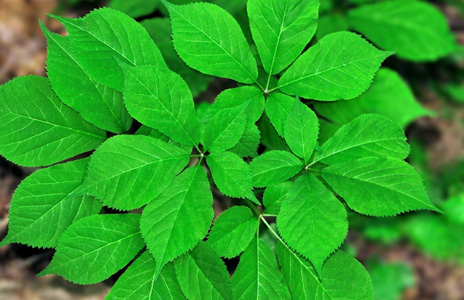
Devil's Club (Oplopanax horridus) belongs to the well-known medicinal plants that also include Asian ginseng |
|
|
It is interesting to consider the chemical composition of Devil's Club both in relation to the symptoms from the proving and also to the plant's use by the Canadian Indigenous peoples (First Nations (1)). Chemical analysis of Devil's Club (Kobaisy et al., 1997; Moore 1993; Xu L., 2000) revealed that it contains certain compounds with notable antibacterial and antifungal activity. |
|
| These compounds are most active against common bacteria such as Staphylococcus aureus, Bacillus subtilis, Pseudomonas aeruginosa, Escherichia coli and Candida albicans — all organisms known to cause serious infectious diseases and which have recently become resistant to most commonly available antibiotics. In addition, Devil's Club contains other compounds effective against Mycobacterium tuberculosis and Mycobacterium avium, which can cause tuberculosis in immunocompromised individuals. | |
|
As chief prover and proving leader I researched the literature on Devil's Club. To avoid any bias I did this only after I had recorded the provers' symptoms and the symptoms in the materia medica. It was fascinating to find, in the proving, certain symptoms typically associated with tuberculosis. Some of the relevant rubrics are: |
|
|
A number of rubrics related to a dry, persistent cough — a cough with expectoration of yellow, grey or green phlegm streaked with blood. A desire to be in the fresh air was also recorded in the proving notes of several provers. Tickling cough was aggravated by dust, smoke and exertion. |
|
|
It is interesting that the Canadian Indigenous peoples (Pojar and MacKinnon, 1994) drank Devil's Club as a tea to treat tuberculosis (Lummi, Skagit, Dena'ina First Nations). |
|
|
I found that naturopaths elsewhere also treated their borderline diabetes patients with tinctures of Devil's Club. Again it was fascinating to find diabetes symptoms appearing in the proving reports: |
|
|
Prover No. 7 reports on day 7: “Compared with the amount of water I drink, I have to urinate frequently.” |
|
|
Prover No. 2 reports on day 4 at 5:30 am: “I felt that my energy was very heavy. The heaviness slowly disappeared. I felt run down, but after breakfast I felt normal again.” |
|
|
Prover No. 5 on day 10 at 10 am: “It is as if my energy is being pulled away from me.” |
|
| Prover No. 3, day 13, 3:30 pm: “Before dinner I felt shaky, as if I had low blood sugar. I checked my blood sugar and it was actually 13.4 — that was a few years ago. I had this feeling a few times about 3–5 years ago, but then not for a few years as far as I can remember ... I used to panic and wonder what might be the cause, but this time it was OK.” | |
| Others reported cravings for sweets between meals. There were feelings of weakness and loss of energy, of exhaustion and being drained, associated with dizziness or light-headedness before breakfast or before a meal. These sensations were relieved by eating: all of these are symptoms of diabetes. | |
|
Accordingly, the Canadian Indigenous peoples have used tea made from the inner bark of Devil's Club to treat diabetes. |
|
|
|
|
| American ginseng (P. quinquefolius L.) | |
| Another aspect of the Devil's Club proving is its effect on the joints, especially pains in the extremities and back pain. The rubrics include back pain with burning, biting, stabbing, stiffness and muscle soreness. Pain is better from warmth, lying down or movement. Pains are worse in the morning, when going downhill and when rising from sitting. | |
| The pains in the extremities include cramps, numbness, lameness, soreness, sciatica, pulsation, intermittent complaints, pulling and pressing. Knees, hips and arches are most affected. | |
|
In addition there were swellings with stiffness and tenderness. These proving symptoms can be associated with rheumatism and arthritis — although for a homoeopathic prescription, of course, the rest of the remedy picture would also have to fit. Again it was striking to learn that the Canadian Indigenous peoples used Devil's Club as a tea for rheumatism and arthritis (Nuxalk, Ditidaht, Coastal Salish, Cowlitz, Sechelt, Squamish, Halq'emeylem: see report by Lantz et al., 2004). |
|
|
Wild Devil's Club is harvested in worrying quantities for its antifungal and antibacterial properties and also for its use in diabetes (Lantz et al., 2004). |
|
|
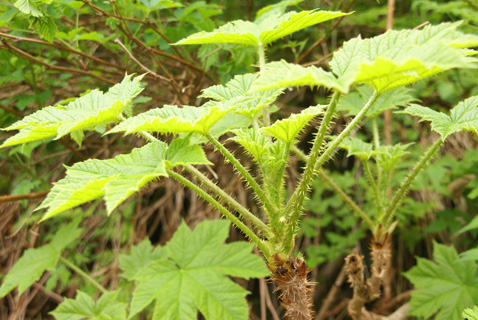
When I first decided to undertake a proving of Devil's Club, I was astonished by the plant's enormous defensive armament, with thick spines on the stems and even under the leaves. The spines on the trunk break off easily, and the tip of the spine drills into the flesh, causing a local infection. |
|
|
The area becomes red and swollen with a dull pain; within a few days a green-grey tip appears, the area begins to throb and the pain increases. Finally the pain ceases when the pus discharges. |
|
| This strikingly resembles the typical picture of a Staphylococcus aureus skin infection, (MRSA) or certain superbug infections (2). If like cures like, then a substance that can produce a disease in a healthy volunteer may be able to cure the same disease in a sick person. Devil's Club can produce a superbug-like infection: can it therefore also cure a superbug infection? | |
|
The plant defends itself, as is evident both from its form and from the experiences of many provers. The themes of protection and defence, however, do not apply only to the plant itself and its effects: the same themes have been observed previously: both in the use by the Canadian Indigenous peoples and nowadays there is concern for the survival of the plants. To ensure their survival, Devil's Club, although still found from the Alaskan coast to central Oregon, Montana and Idaho and around Lake Superior in Michigan and Ontario, has been placed on the USDA (3) list of threatened plants in the state of Michigan. It goes without saying that large quantities of the plant are needed for naturopathic tinctures and pharmaceutical preparations, whereas only the tiniest amount of the substance is needed to prepare a homoeopathic remedy. Homoeopaths therefore loyally support the protection of Devil's Club. |
|
|
The Canadian Indigenous peoples formerly removed the spines from the plant parts first, then cut slightly above, and used the spine-covered stick as a handle and weapon (hence the name). |
|
|
They also mixed the black charcoal produced by burning Devil's Club with bear fat, and painted their faces with it before a battle. The black paint frightened their enemies, so the painting had a protective effect — aside from the effect of the substance penetrating the skin of the warrior. Working with the plant gave me a fantastic feeling of strength, a strong self-confidence and the sense: “I can do anything!” Such an inner attitude is, of course, a very helpful gift for a warrior. |
|
|
Strength, as well as themes of violence and protection, were central aspects of the proving. During the day there arose a feeling of strength and self-confidence and the awareness of being able to do anything; at the same time a desire for company occurred. Later this feeling was replaced by exhaustion, boredom, lack of energy and depression, and the need to be alone became apparent. |
|
|
The lack of energy led to a craving for stimulants; the provers wanted beer and coffee, even though they had had no desire for these drinks before the proving. |
|
|
At night they had vivid dreams of corpses, murder, drug dealers, disease and people destroying the earth. Dreams came of people searching the world for ways to survive on this overcrowded planet. As mentioned, protection plays a large role with this remedy — not only does the plant protect itself, it is also about species conservation, the Indigenous peoples, the health of people and the whole earth, and all of this was experienced in vivid dreams during the proving. There were also dreams of people gathering for a celebration. |
|
|
The image of veterans came to mind: after returning home from battle they often become depressed, feel isolated and frequently take stimulants. The dreams of the veterans I know are so terrible that they usually refuse to talk about them. Again, if the remedy picture fits, Devil's Club may help people with post-traumatic stress disorder. |
|
| A short case report | |
|
A 53-year-old Canadian Indigenous woman had banged her leg on a corner and split the skin of her left leg; a purulent ulcer the size of a business card had formed. The ulcer was deep, and she had had two skin grafts within four years which had become infected with MRSA. The first time the infection responded to antibiotics. The ulcer was about 13 x 6 cm; it was deep. Devil's Club was given because she said: “If I were with my people they would make me a tea of Devil's Club and alder.” |
|
|
Therefore Devil's Club was administered in liquid form: 3 globules were dissolved in her water bottle and sipped throughout the day. She was also taking several medications and methadone and was using an asthma inhaler because she had breathing problems. She had a cough with greenish-grey phlegm and experienced difficulty walking, especially climbing stairs. After taking Devil's Club the ulcer began to discharge a light brown, unpleasant-smelling fluid. The ulcer healed, became smaller and less deep. In addition the ulcer was washed out with distilled water in which 3 Devil's Club globules had been dissolved. We started with C30 in water, later moved to C200, and then over a period of several months gave C6. (We find that in many patients from Vancouver's Downtown Eastside the remedies “run through” very quickly.) |
|
|
Although the ulcer clearly healed, antibiotics were given to her again at one stage; the drainage and the healing process then slowed down. The leg was operated on and became infected again, and the other leg also developed a hole with burning pains. Over time the drainage resumed, and her leg healed. After two grafts and antibiotics even the nurse was convinced that the turnaround in the case was due to the homoeopathic remedy Devil's Club. |
|
| The last time we saw her she was running down a flight of stairs because a taxi was waiting for her below. Since then she lives with her family and brings up her children as her grandmother once did. | |
| ************************************************************************** | |
|
(1) First Nations refers to the indigenous peoples of Canada (excluding the Métis and Inuit). |
|
| References | |
| De Pieri L, (2007) A homeopathic proving of Oplopanax horridus, Devil's Club. http://homeopathyvancouver.com/wp-content/uploads/files/oplopanax.pdf | |
| Kobaisy, M., Abramowski, Z., Lermer, L., Saxena, G., Hancock, R.E.W., Towers, G.H.N. (1997) | |
| Antimycobacterial polyenes of Devil's Club (Oplopanax horridus), a North American native medicinal plant. J. Nat. Prod. 1997; 60:1210-1213 | |
| Lantz TC, Swerhun, K., NJ Turner (2004) Devil's Club (Oplopanax horridus): An Ethnobotanical Review. HerbalGram, 2004; 62: 33,48. The Journal of the American Botanical Council | |
|
Moore M. (1993) Medicinal Plants of the Pacific West. Santa Fe (NM), Red Crane Books |
|
|
Pojar, Jim and MacKinnon, Andy (1994), Plants of Coastal British Columbia |
|
| Lone Pine Xu L., Wu, X.H., Zheng, G.R., Cai, J.C. (2000), First total synthesis of optically active oplopandiol acetate, a potent antimycobacterial polyene isolated from Oplopanax horridus Chinese Chemical Letters, 2000; 11, 213-216 | |
| This article was published on www.interhomeopathy.org. | |
|
Photo: shutterstock.com |
|
|
Category: Provings |
|