
There are homeopathic remedies that you cannot find when repertorising. These remedy pictures must be memorised; they include the two remedies Selenium and Stillingia.
If a patient complains of backache and has suffered from tooth decay from a young age, we can legitimately ask whether she cannot go out into the sun without a head covering (cannot tolerate sun exposure on the head). If this question is answered positively, we immediately think of Selenium. The following key symptoms confirm the remedy Selenium:
- Profound despair, persistent sadness – Boericke's Materia Medica
- Unable to do any work – Wilkinson
Look at the bedridden patient with osteoporosis: he lost his teeth years ago. The condition of Selenium can also be described as "premature ageing". A 62-year-old patient who looks like a 72-year-old, feeble old man. About 2% 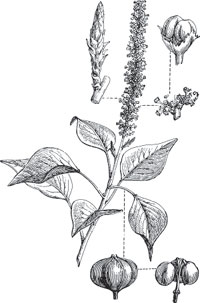 of our patients are Selenium types.
"Selenium is a constant constituent of bone and teeth" is the first sentence in Boericke's Materia Medica.
Why should we also talk about Stillingia here?
You only have to look it up in Boericke. At the end of the remedy picture for Stillingia you will find the sentence: "Valuable as an intercurrent remedy". In our practice, when we prescribe Selenium 10M (single dose), we give Stillingia 10M four weeks later, then Selenium 50M eight weeks after that, and after one month we prescribe Stillingia 50M.
Why is Stillingia a complementary remedy to Selenium?
With Selenium we find the following mental symptom (Boericke): profound despair. Persistent sadness.
For Stillingia (Wilkinson) the following is written: miserable gloom.
There is only a slight difference between the two mental symptoms.
If a patient tells you he would give away half his fortune to cure his headaches or another complaint, you know that you must give Stillingia ("miserable gloom").
*************************************
Photos: Shutterstock - Selenium symbol handheld in front of the periodic table © concept w, Tallow Tree (Stillingia sebifera) / vintage illustration from Meyers Konversations-Lexikon 1897 © Hein Nouwens

