
Contents:
- Specific symptoms of the pandemic
- Indications for Camphora
- Case examples by Rajan Sankaran
3.1 A 27-year-old woman
3.2 A patient isolated by Covid
3.3 A 22-year-old patient with throat and head pain
3.4 Main symptom: fever
3.5 Diarrhoea, bloating and a feeling of fullness
3.6 Role reversal of a doctor
3.7 Loss of appetite of a nursing assistant - Severe courses of disease
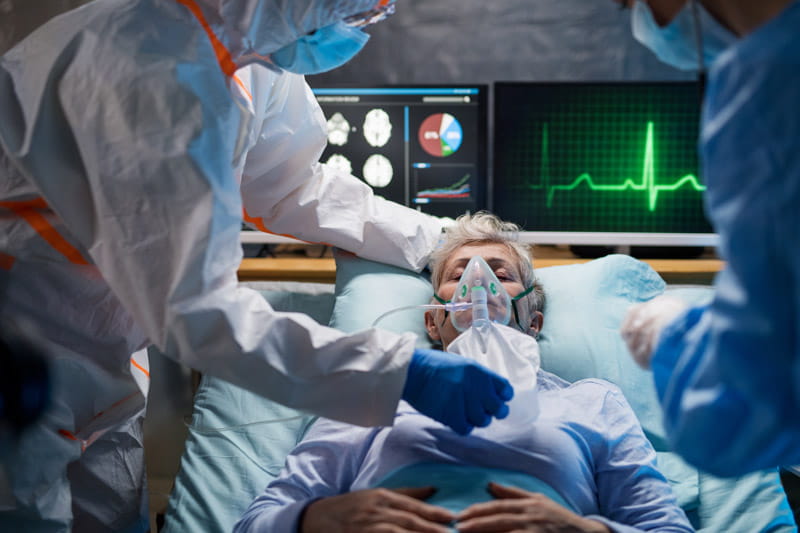
4.1 Mechanical ventilation of a 70-year-old patient
4.2 Sweating at the slightest exertion - Potency level of the remedy
- More Homeonews on COVID‑19
Dr Rajan Sankaran gives insights into his method for differentiating the three different levels of COVID‑19 symptoms. These include the common symptoms of the virus, the acute symptoms and the constitutional symptoms. Dr Sankaran illustrates his approach with several case examples.
The government’s Ministry of AYUSH (Ayurveda, Yoga & Naturopathy, Unani, Siddha and Homoeopathy) has approved homeopathic treatment of COVID as an adjunct therapy to the standard protocol. Many homeopaths are now being asked to treat COVID patients in hospitals. Many of our patients who contracted COVID also received homeopathic treatment.
In view of the current situation I would like to share my own experiences with COVID‑positive cases so that both new and experienced colleagues can benefit.
Before I go into detail I would like to thank my colleagues Dr Shrikant Talari, Dr Sonali Bhonsale, Dr Faiza Khan, Dr Meghna Shah, Dr A. K. Arun, Dr Kshiti Mehta, the team at Prana Homeopathy Yoga Center in Pune and the team at The Other Song Academy in Mumbai for their collaboration.
I will also present some of their COVID cases here, as we consider ourselves a team in treating this illness and work together. Before I elaborate further, please watch one of my lectures on YouTube in preparation for this article:
In this video I discuss the three levels of symptoms and how to recognise which level is most prominent in a case. The first level relates to the pandemic itself, where we find the common, pandemic‑specific symptoms.
The second level becomes apparent when patients show very pronounced, highly acute symptoms. Acute symptoms are those that appear only with the onset of the infection and were not present before. With the onset of the acute illness the acute totality of symptoms also appears.
Thirdly, in many cases we also see symptoms of the constitutional remedy that come to the fore during the acute phase. In every case one of these three levels will be seen very clearly and distinctly.
So there are three possibilities:
- Symptoms specific to this pandemic
- The totality of the acute symptoms
- Symptoms pointing to the constitutional remedy
1. Which symptoms are specific to the pandemic?
Foremost is the great weakness, described as sudden weakness, which mainly affects the lower limbs. Walking is difficult. The weakness is felt both in the limbs and throughout the whole body. Another symptom of COVID is loss of smell and taste. These symptoms describe a state resembling numbness, like a kind of collapse or weakness similar to anaesthesia.
It also happens that no active symptoms are observable — no body‑ache, no pain or restlessness. The prominent characteristic symptoms in these cases are weakness, loss of taste and loss of smell.
On the mental plane it is noticeable that relatively little fear is present, as in the example of a patient who has to be admitted to a COVID ward but does not become nervous or seem afraid. Hospital admission implies the possibility of complications and the risk of a fatal course. Still the patient does not appear worried.
Or the patient appears rather cheerful, which is very odd. The opposite pole to this mood state is panic. Panic and fear of being left alone, a feeling of isolation, of abandonment. The thought: 'What will happen to me?'. Both expressions of this mental state combined with the weakness described above are indications for the remedy Camphora.
Indications for Camphora
- Weakness
- Anosmia (loss of smell)
- Loss of taste
- Sudden weakness, weakness in the legs
- Mental state: cheerful and confident, without fear or
- Panic/fear of being isolated and left alone
We see these indications in a large proportion of patients because they are asymptomatic. Nearly 80–85% of cases are asymptomatic — that is, the patient has the disease but no distinct acute individual symptoms; one could compare it to a state of numbness. These cases respond well to Camphora.
On the next level we find the acute symptoms. Here we either have the pandemic‑specific symptoms — and can prescribe Camphora — or we have a range of acute symptoms from which we derive the totality of acute symptoms: the particularities of chills, heat and sweating during fever, the time modalities and concomitant symptoms. Other complaints such as headache, shortness of breath, limb pain, cough, etc. also belong here.
Alongside these symptoms we examine the patient’s general condition — are they anxious, relaxed, lethargic and dazed or active? How is their appetite and thirst? Do they sleep well, do they have particular dreams in this acute state? In the case taking we must collect this information because it can lead us to a specific acute remedy.
The third possibility occurs when symptoms of the constitutional remedy are recognisable in the acute illness. These are usually symptoms you have seen in your patient before. The chronic state also shows itself in the acute situation. We have observed this in many cases.
For prescribing we orient ourselves to the striking symptoms — that is, to the level that is most clearly expressed. The following case examples illustrate this method of prescribing.
The majority of cases were admitted to conventional hospitals and were also treated homeopathically in addition to the standard protocol. The exception are three cases. The results after administering the homeopathic remedies were significant and all patients recovered very well. Many became symptom‑free and later tested negative for COVID.
Case example 1: A 27‑year‑old woman
This is a 27‑year‑old woman. She reported that someone in her house tested positive for COVID and she therefore had to make far too many phone calls. She decided not to answer the phone or reply to messages any more. Since she made that decision she is happy and content. This mood was noticed by others and she was asked whether she used drugs — perhaps cannabis. The case was taken by phone by one of our doctors who confirmed that the patient sounded very cheerful and content. This feeling 'to shut the world outside. I don’t want to take phone calls; I'm in my own little bubble and happy with that' is typical for Camphora.
We can also see the pain‑insensitivity of Opium here. Opium comes from the same subclass — Subclass 1 — and is therefore in a confident and cheerful state. This aspect of the case presents clearly. If we enter the search terms happy, pain‑insensitivity and confident in MacRepertory, Camphora appears at the top of the hit list.
Case example 2: A patient isolated by Covid
In this case example we see the opposite, contrasting symptom picture of the remedy Camphora. The patient’s father contracted COVID and later died from the disease. She and her mother later tested positive as well. The mother had to be hospitalised and the patient and her small child had to quarantine at home. The little daughter also tested positive.
At the time the case was taken, we asked about the main current symptoms and she reported that she was very worried about her daughter. She didn’t know who would look after the child.
No one wanted to take on childcare. When we analyse the case and the mental state we see a child, alone and abandoned. The patient is in a state of panic — 'What will I do with my child?'.
She also said that she and her daughter would prefer to kill themselves to escape this feeling. This state is the exact opposite of the case described above. Here we see panic and a feeling of being overwhelmed — 'it’s all too much for me'.
She mentioned that everyone feared for their life and that her cousins and relatives had abandoned her. She felt completely alone, isolated and in panic. That is the opposite of the intoxicated state 'I have no problems, I'm happy and content'.
If we enter these symptoms as rubrics in MacRepertory we see Mental — Desire to kill; Mental — Feeling of being abandoned; Mental — Crying for help and the despair, hopelessness and flu‑like symptoms. Camphora is the appropriate remedy here too. The patient responded very well to the remedy. She was also admitted to hospital and treated there, but recovered very well.
From this case example we can observe the opposing polarities of Camphora. On the one hand we have panic, isolation and fear. On the other hand the feeling 'to shut the world outside, I feel happy and content'. During the COVID pandemic people stay at home, are alone there, but fairly content because we are provided for. We also recognise this state for Camphora.
Case example 3: A 22‑year‑old patient with throat and head pain
This example concerns a 22‑year‑old patient with throat and headache, mild nausea, a feeling of heaviness, weakness and dizziness on getting out of bed. She also has lower‑abdominal pain before stool and passes a little diarrhoea.
She always has an urgent need to go to the toilet for stool passage and can only pass small amounts. Afterwards she feels better. She had already taken hydroxychloroquine tablets. She suffers from nausea but does not vomit. She is generally weak with drooping eyelids.
Despite everything she is optimistic about her recovery and expressed this to us. She reports that she is not afraid. She has little thirst for water. This paints a picture of her state and we prescribed Camphora. The key pointers were the weakness and the lack of fear. The patient responded well to the remedy.
Case example 4: Main symptom fever
A 36‑year‑old patient whose only symptom was fever. After three days of fever (38.1°C) he was admitted to intensive care. At that time he had a dry throat with sore throat and very thirsty. He felt drowsy.
On questioning he reported that during the fever he just wanted to lie in bed and sleep. Here we see a very different picture; the symptoms point to Bryonia. Bryonia patients do not want to be disturbed or bothered. The main symptom in this case is not the weakness but the dryness, together with thirst and the desire to lie in bed and not be disturbed.
Case example 5: Diarrhoea, bloating and a feeling of fullness
A 36‑year‑old patient with diarrhoea, bloating and abdominal fullness and foul‑smelling stools. Even the mere thought of his illness provokes weakness. The main symptoms in this case are the foul smell of the stool, concern about his illness, weakness and palpitations. The patient’s anxiety is not about being alone, as we might see in Camphora.
This patient’s anxiety revolves around what will happen to him: 'What if I get worse, will I die? I have no control, I worry about my work and my finances. I feel I will lose everything — money, health, job.'
The patient is a very tidy person and values cleanliness. He is generally better in warm weather. The symptoms — weakness and anxiety, inability to sleep until three in the morning (time modality) and worry about work, money and health — are characteristic themes of Arsenicum album.
In the periodic table of elements Arsenicum album is in period 4. In this series the themes concern money, security, home, work, health and endurance. Arsenicum album is on the right side of the periodic table, which corresponds to the inner attitude 'I will lose everything'. This is different from Bryonia. Bryonia wants to be left alone, to stay in its comfort zone undisturbed. 'I don’t want to be disturbed and I don’t want to move.' This basic sensation we find in Subclass 4 of the plant kingdom.
They want to remain in one position, not move; no change should disturb them; they simply want to stay in bed; this is the main theme of the fourth subclass and also of the remedy Bryonia.
Returning to our patient: here we have the rubrics Thinking about the complaints agg.; Fever — Diarrhoea — after — agg.; Foul‑smelling; Mental — Desire to be at home; Speaking amel, plus anxiety with weakness and palpitations and insomnia until 3am. All the symptoms are characteristic of Arsenicum album and are confirmed by repertorisation. We have now considered the different acute pictures of Camphora, Bryonia and Arsenicum album. The patient was prescribed Arsenicum album three times daily.
My colleague Dr A. K. Arun from Delhi has already treated many symptomatic and asymptomatic COVID patients. He compiled an Excel file with an overview of 70 patients whom he treated exclusively homeopathically. He treated 58 patients with Camphora, two with Arsenicum, four with Bryonia, three with China and two with Eupatorium perfoliatum. All patients recovered well with the help of the remedies.
From these data we can conclude that we do not have to give every patient Camphora or Bryonia and that many remedies may be relevant. This should always be considered.
The most important indication for Bryonia is dryness and great thirst for large amounts of cold water. The patient does not want to move and stays in the same position. It is the opposite of Rhus tox, who is constantly changing position and cannot find rest.
The Bryonia patient does not like to be disturbed and answers questions irritably and unwillingly. For example: I questioned a patient who tested positive for COVID about her symptoms. She reported that she preferred to sleep all the time and did not want to be disturbed. If someone spoke to her and asked how she was, she sent the person away and said she wanted to be left alone. That is the main indication for Bryonia.
With Arsenicum album the mental state is different: Arsenicum patients feel they are losing something. For example the patient who says 'my health is dwindling', 'I will lose my money' and 'I will have no job'. He says 'my future is uncertain', he is troubled about 'what will happen to me and my life'. Additionally there is a worsening around midnight and the patients feel better with something warm to drink. They also sip small amounts more often. These are the key symptoms of Arsenicum album.
The key symptom of China is periodicity. The fever occurs at regular intervals. With the fever comes a bitter taste in the mouth, another major symptom of this remedy. We may also observe a strong craving for fruit and juicy, refreshing things.
On the mental level these patients are highly excitable. They cannot sleep, thoughts are restless and go round in circles. After all, China belongs to the Rubiaceae, the family of Coffea. It is the persistent thoughts, ideas and plans that keep the patient awake.
China belongs to the malaria miasm, hence the periodicity and weakness accompanied by the feeling of being unlucky. They ask 'Why me?', 'Why does it always happen to me?'. This is one of the mental states of China.
A China patient might ask, for example, 'Why did I get infected with COVID and others did not?', 'Why do I always have so much bad luck?', 'I am really unlucky, I am constantly plagued and have to struggle.' This inner state — of being persecuted by bad luck — can be an important indication for China. In the rubric Mental — Delusions — being persecuted the feeling of being followed and hindered by bad luck is reflected.
The main indications for Gelsemium are drowsiness and lack of thirst. There is also an aspect of shock or bad news. The patient says, for example: 'I was shocked when I read the report.' This feeling of shock and surprise can be traced back to the fact that Gelsemium, like Ignatia, belongs to the botanical family Loganiaceae. The main theme of the Loganiaceae is sudden being startled and shock.
These remedies are the most commonly indicated and are also most frequently prescribed.
Interestingly, it has shown in COVID illnesses that during the acute infection the constitutional remedy often needs to be given. This aspect will be illustrated by the following case examples.
Case example 6: Role reversal of a doctor
This case concerns a 26‑year‑old patient, a doctor by profession, who was questioned about his symptoms by our team of doctors. He began with the following statement: 'I like martial arts and admire Bruce Lee; I like to keep fit and train one hour every day; I let someone stand on my stomach to get fit. Even if five people attack me at once, it does not bother me; I can drive away five robbers at the same time.'
Actually we had asked the patient about his COVID illness and symptoms but he spoke about something entirely different, which is also relevant for the case analysis.
Even during a COVID infection he thinks about martial arts. In this context he says: 'One day I trained harder, maybe that's why I got a swelling in my thighs, afterwards I had severe vomiting. I couldn’t even drink water. I vomited every two hours and kept nothing down. It felt as if I was vomiting my intestines. As if there were knots in my intestines.'
That is strange and interesting. We try to understand what is striking about COVID. This patient's complaints manifest as knots in the intestines, severe vomiting, as if his intestines were coming out, nearly as if there were a violent cramp forcing the intestines out.
He then spoke about himself and mentioned that Obama and Abdul Khan were his great role models because people remember them even after their death. He would also like people to remember him after his death as a man who did something good. He then spoke about Iraq and Syria, which ideally should not be bombed because innocent people die.
It was important to him that people remember him as a good person, a man with a good name who does good deeds and is respected for it. Here it becomes clear that the patient speaks about achievement. He needs to do good deeds so that people remember him. The themes he engages with are: being attacked, building strength and power, developing his martial arts abilities and achievement. These themes belong to the mineral kingdom.
For this patient everything revolves around developing his own abilities, it is about attack and defence, about fights and the knot in the intestines. If we enter these search terms in Reference Works as 'knot not more than three words away from intestines, attacked not more than three words away from delusion (the fundamental feeling is being attacked), in the same remedy as knot in the intestines (the sensation of having knots in the intestines)', we come across the remedy Cuprum metallicum.
'Knot not more than three words away from intestines, in the same remedy as attacked, not more than three words away from delusion (2): cann‑i., Cupr.
Cuprum is a remedy given for severe cramps. Everything is marked by cramps: muscle cramps, epilepsy, vomiting; everything is violent and comes in spasms — the main symptom of this patient. He was prescribed Cuprum metallicum and responded very well to the remedy.
In this case one can also recognise the patient’s basic state in the narrative of the acute COVID illness: the acute symptoms that feel like knots in the intestines and the severe spasms with vomiting point to Cuprum and the mineral kingdom. Cuprum fits this man — he practises martial arts because he believes he could be attacked at any time and must be able to defend himself.
Case example 7: Loss of appetite of a nursing assistant
This case concerns a 36‑year‑old patient, a nursing assistant in a hospital, who tested positive for COVID. His main symptom was a complete loss of appetite. Normally he feels hungry between ten and eleven in the morning, but at the moment he cannot eat anything at all.
He felt weak and feverish, with heat in the soles of his feet and in his forehead. He likes dairy products. Before he fell ill he used to eat 1 kg of curd a week. He also liked lassi (a traditional yoghurt and buttermilk drink). He consumed many fatty dairy products: cream, milk ice‑cream, buttermilk with cream and jaggery (unrefined cane sugar). He could drink seven glasses of drinking yoghurt at once.
He was very worried about his family. From the case taking we learn that he has an extremely strong craving for milk and dairy products, but we must also understand that this craving is not an acute symptom — it has been present for a long time. In this case it is likely that the patient needs his constitutional remedy rather than a remedy specific to the acute state. The patient also reported that his father had had an accident and was unconscious in intensive care.
He was supposed to look after his mother and sister. He felt like crying but could not express his feelings because he felt responsible and wanted to keep his emotions under control. He fell ill in his grief, developed a runny nose and headache. He had lost hope and thought his father would die.
As he told the story tears came and he began to cry. His grandmother was also unwell and he believed she would soon die. He became very emotional and wept. We can therefore see that this is a very sensitive and emotional person who, because of his strong sense of duty, cannot express his sorrow.
He also mentioned that he had an affair with a woman although both were married. He was concerned for his social reputation. He reported: 'I am not afraid that someone might beat me up — that I don’t worry about. But when I feel that fear my legs start to tremble. When I quarrel it is usually because I stand up for other people. You know, at the company I work for an employee committed suicide. They tried to cover it up, but I opposed it.'
At the same time he wanted to keep fit and attended the gym regularly. So far the description of his symptoms and mental state. If we analyse the case we can see that this man is very sensitive, has a strong sense of duty, a great craving for milk and dairy products and suppresses his sorrow.
He wants to defend himself but is very sensitive; he is easily embarrassed and worries about his reputation. This became very clear when he told us about his affair and said he was worried about what would happen if the relationship became public.
We chose the rubrics Milk, Desire for; Mental — Argumentative; Mental — Crying — weeps easily; Trembling; Mental — Sensitive to injustice; Mental — Compassion; Mental — Complaints — embarrassment, from; Mental — Duty — excessive sense of duty; Extremities — Trembling — Legs — Fear, on.
Ignatia is at the top of the list here. Ignatia is a plant remedy. These people are very sensitive and harbour much quiet grief. At the same time they have a great sense of duty and take on much responsibility.
The patient was prescribed Ignatia because there was no great difference between his acute and chronic state. He took the remedy in potency C200.
Next I would like to write about the level of very serious and severe cases. Up to this point we have only discussed asymptomatic cases or patients in whom the typical symptoms of this pandemic were prominent, such as weakness, severe and sudden symptoms, either accompanied by a feeling of panic and fear or calmness and cheerfulness. All these cases responded well to Camphora.
On the second level we have acute states in which we must record the totality of all acute symptoms and arrive at the remedy through these symptoms. The remedies that were frequently indicated at this level are Arsenicum, Bryonia, China, Gelsemium and Camphora.
In a few other cases the characteristic symptoms led us to the constitutional remedy: the mental state, the constitution, the general symptoms, cravings and aversions. In these patients we must prescribe the appropriate constitutional remedy because there are no striking acute symptoms and the typical pandemic symptoms are not prominent. We must approach such cases accordingly.
Severe courses of disease
I have not much experience with very serious, severe cases — i.e. patients whose oxygen saturation is below 90 or who need to be ventilated. Among the few cases I treated I would like to highlight one here.
Case example 1: Mechanical ventilation of a 70‑year‑old patient
This concerns a 70‑year‑old patient who needed ventilation. She had dyspnoea, was very weak and could no longer get out of bed. She complained of burning in the palms and in the stomach. She sweated over the whole body and had restless legs. Due to the weakness she had great dyspnoea and could not even sit upright.
She also suffered from vomiting with a bitter taste in the mouth and she was underweight. She mentioned that she was confused and did not know where she was. She could not say whether she was on the ground (as opposed to floating; note) or somewhere else. Her mouth was dry and she had little thirst.
The patient was very worried about her grandchildren. The stronger the weakness and vertigo became, the faster her respiratory rate increased. She wanted a cold cloth for the soles of her feet and palms to stop the burning. We gave her Camphora 10M, one dose every six hours. The great weakness combined with the desire for something cold for the extremities is a good indication for Camphora. The patient recovered well and continued to be treated in hospital.
Another important aspect of individual prescribing is that one must always be vigilant. The patient’s state can change and so can the indication for the appropriate remedy. Under certain circumstances the prescription must be adjusted and a new remedy given. I want to present a case here in which we gave the patient Camphora, Arsenicum and China.
Case example 2: Sweating attacks
The case of a 26‑year‑old woman who tested positive for COVID and had symptoms for ten days. She had had some appointments in our office building when she felt tired and broke out into sweat at the slightest exertion. She even fainted, felt weak and after the incident had palpitations and a low‑grade fever.
The woman was admitted to hospital on suspicion of a urinary tract infection, but it turned out she was COVID‑positive. She did not feel well and did not understand what was happening to her. Her father was ill too. She asked herself, 'why did this happen to me?'.
At first the patient was prescribed Camphora because of the weakness and the pandemic‑typical symptoms. At follow‑up the next day her condition had neither significantly changed nor shown improvement. If the administered remedy has no effect, the case should be reconsidered.
In homeopathy there is no panacea or single remedy that cures everything. Camphora is a useful remedy but it does not fit every case. If the symptoms change and we do not see improvement, we must give another remedy. This patient grew ever weaker and began to drink water in small sips. She also worried about her father’s health and her own. Her oxygen saturation changed and she became very anxious about it. These were good indications for Arsenicum and the remedy was given every six hours.
The next day she was much better. She was less nervous, had slept well and felt stronger. She was more confident and less fearful. Her cough had also improved. We continued to give her Arsenicum album 1M.
Then something strange happened. I had asked the patients to tell me how they felt. Instead of saying she felt better, she only said that everything was fine but that she had only fallen asleep late. She had lain awake until four or five in the morning thinking about the future and making plans.
I probed further and asked her to tell me more about herself. The patient reported that she was very creative and liked to write books. I realised that the patient needed China and not Arsenicum. We asked the patient to stop the Arsenicum and take China because the anxious nervousness of Arsenicum was no longer present, whereas the restless thoughts and excitement of China were.
The patient refused and said she preferred to continue taking Arsenicum, as it had suited her better. I had to insist strongly and eventually she agreed. The indications for Arsenicum were simply no longer present; the symptom picture now corresponded to China.
When the indications for a remedy are no longer present, we must give another remedy, even if the patient feels better. We must always prescribe according to the current state.
After taking China the nervous anxiety returned on the following day. The patient said she would prefer to take Arsenicum again. She said: 'I felt well, but you stopped the remedy.' On the psychological level the anxiety reappeared, but I continued to give the patient China because I had seen that constitutionally China suited her better.
The next day she felt better and was back to her previous self. In such cases we must be very attentive. If the patient does not improve we must give another remedy. But also, if the patient makes progress and the symptoms change, we should give a new remedy because the patient’s condition has changed.
Potency level and repeated administration of the remedy
- When emotions and local symptoms predominate, we should give potency C200.
- If emphasis is on general symptoms, mental state and dreams, we should choose 1M.
- For very intense, violent symptoms, for example severe weakness or other intense symptoms showing energy and sensation level, 10M is indicated.
- Regarding repeated administration of a remedy, it depends on the intensity of the case. Normally I give a remedy twice daily, with severe conditions three times daily. In acute situations I have the remedy taken every three hours. Afterwards we taper the remedy off and stop it entirely once the symptoms subside. We then usually give the patient a placebo.
More Homeonews on COVID‑19
03.06.2020 by Joette Calabrese
Homoeopathy and pandemics
17.04.2020 Dr Aditya Kasariyans and Dr Rajan Sankaran
Update on the study of homeopathic treatment of Covid‑19 infections in Iran
19.03.2020 Dr Aditya Kasariyans and Dr Rajan Sankaran
Homeopathy for infections with the coronavirus Covid‑19
11.03.2020 Dr Manisha and Dr Manish Bhatia
Coronavirus Covid‑19 and homeopathy
--------------------------------------------------------------------------------------------------------------
Source: https://hpathy.com/homeopathy-papers/treating-covid-19-with-homoeopathy/
Photo: 1660181482 by Fotomay, 1743855053 by SKY2020, 1035422257 by Microgen, 1661222104 by Halfpoint
--------------------------------------------------------------------------------------------------------------


