
The cases described here were selected because they were all successfully treated and had previously been diagnosed by a veterinary oncologist.
I will present three different methods for treating cancer.
1. The Banerjee Protocols. Two articles by Dr Banerjee – on breast cancer and on brain tumours – were published in the 'International Journal of Oncology'. His clinic has treated more than 30,000 cancer patients homeopathically. In 21% of cases the cancer completely regressed, and in 23% a marked improvement was achieved – a 'success rate' of 44%. His protocols are freely available on the internet and discuss appropriate remedy selection for different kinds of cancer. The recommendations can be applied directly and without difficulty to veterinary medicine (a).
2. The Ramakrishnan method. Dr Ramakrishnan has likewise treated many thousands of cancer patients homeopathically. His handbook on this topic is easy to understand and is 100% transferable to veterinary medicine. He recommends selected remedies for the various types of cancer. He prescribes the appropriate remedy in weekly alternation with Carcinosinum, made from cancer cells of a mammary tumour, using the Plussing method (b).
3. Classical homeopathy. One finds the remedy that considers the patient as a whole, including modalities, personality and history. To be able to use this method, one must delve into homeopathy.

Case 1: Example of the Ramakrishnan method in conjunction with an analysis of the periodic table of the elements. Lymphoma with remission within seven months.
In February 2010 the 10-year-old female collie Jessie began licking her lips. Examination revealed a right-sided lesion of the gums and inner cheek. It was reddened, raised, hard and inflamed. A biopsy confirmed an epitheliotropic T‑cell lymphoma. An oncological veterinary practice had carried out treatment with interferon and chemotherapy, which did not lead to a cure. Jessie's owner brought the dog to me in despair; at that time Jessie was still receiving 6 mg prednisolone every other day. Jessie’s owner was able to describe her dog very well. "Jessie is the mother and pack leader. She cleans the ears and eyes of all the others. She never relaxes and always has to lie by the garden gate until the whole family plus the dogs are home. If someone in the family becomes ill or upset, she sits beside them. She then keeps coming back to check how the patient is. If another dog is ill, she fetches the owner. Outside our home she will attack any dog that threatens her. She would never run away."
The main themes in this case are strong responsibility and the dog's dominance. This suggests a remedy from the gold series (c). The exaggerated maternal instinct points to a chloride (salt). Ramakrishnan describes Aurum muriaticum (gold chloride) C200 as one of the best remedies for mouth cancer. Jess took it three times daily in weekly alternation with Carcinosinum C200.
After five months I additionally gave Kalium chlorosum C200 (potassium chlorate), because an ulcer had developed on the left side of the mouth. After seven months the tumour had disappeared. The homeopathic treatment was continued unchanged for a further 18 months. Jess is now 14 years old and shows no signs of cancer. Once a week she receives Kalium sulphuricum C200 (potassium sulphate) for her joint stiffness.
Case 2: an example of a homeopathic treatment according to the Banerjee protocol. Squamous cell carcinoma with remission within six weeks.
In February 2012 Bedford, a 12-year-old large mixed-breed male, developed a growth on the left side of his head. For some time he had been sneezing frequently and occasionally had slight nosebleeds. A biopsy had been performed and X‑rays taken. Bone resorption was detected in the maxillary sinus and a soft-tissue tumour was found. The soft tissue of the frontal sinus was hardened. The biopsy result was squamous cell carcinoma. Tramadol and non-steroidal anti-inflammatories were prescribed and Bedford was referred to a specialist. The report described a palpable mass of 5 cm. An MRI or CT scan was recommended, but Bedford’s owner could not afford the treatment.
31.06.2012: Bedford was brought to me. His history beautifully illustrates how important it is to consider the special accompanying circumstances in a severe illness. Homeopaths have known this for 200 years and regularly apply this knowledge when treating disease. Mainstream medicine is now also paying attention to this aspect. Bedford's owner tells his story: "Bedford was my 'firstborn' and became my everything. Two years ago my eldest son was born, who takes a lot of my time and energy. Bedford looks after him tenderly and checks on him immediately when he cries. He has become more clingy with me. He is like Cary Grant: strong, calm, stoic, cool and composed. He has no need to be an alpha; he rather reminds me of a stag. He has something majestic, he is like a tame lion. When I cry, he howls with me and has to be close to me. He reacts very sensitively to punishment. If someone raises their voice, he comes straight to me to protect me."
In this case it seemed to be about responsibility and caring, themes that correspond to the gold series. Again I prescribed Aurum muriaticum C200, to be taken three times daily. This remedy is used in the treatment of mouth and nasal cancers.
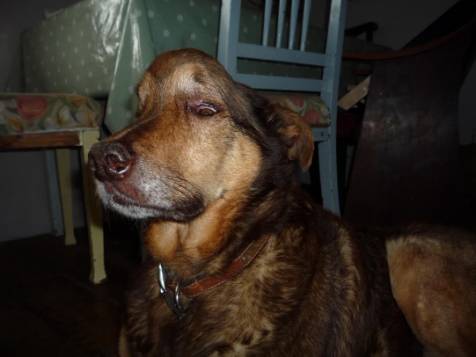
10.07.2012: Bedford was very unwell, his condition had deteriorated and the tumour had grown considerably (see photo). He could no longer fully close his eyes and had to take painkillers. The eyes were also treated locally with an ointment. We discussed euthanasia.
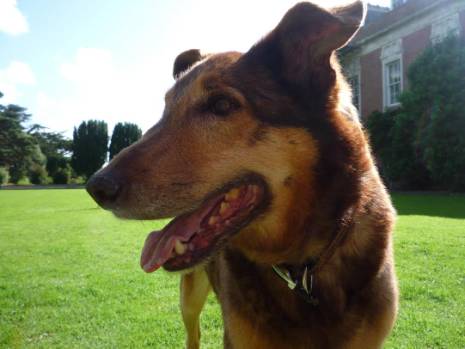
29.07.2012: Bedford came to my clinic again and I reconsidered my prescription. The gold series had evidently been indicated, but in this case we were not dealing with dominant behaviour. Bedford was a "tame lion". The tumour had invaded the bone and Banerjee recommends the remedy Symphytum for tumours that attack bone tissue. It is a plant from the borage family (Boraginaceae) and is commonly known as 'comfrey'. For centuries it has been used to treat bone fractures. Jan Scholten explained to me that the whole botanical family Boraginaceae can be used homeopathically. It is always indicated when the intimate sphere within the family is violated, when the patient does not feel recognised and has to work hard simply to be noticed – 'forget-me-not'. Symphytum seemed the right choice and was given in C200 three times daily. The effect was dramatic and immediate. The tumour went into remission straight away (see photo; the image was taken one month later). His local vet called Bedford 'the miracle dog'.
Over the following two years Bedford developed signs of kennel cough, mild arthritis and occasional epileptic seizures.
At the age of 14 he had to be euthanased because of an epileptic seizure, almost two years after the tumour had first appeared.
Case 3: an example from classical homeopathic practice incorporating the newly discovered lanthanides. Gastric lymphoma with remission within three weeks.
In September 2012 Dorothy, a 10-year-old bulldog, developed vomiting with weight loss that did not respond to symptomatic treatment. She had increasingly undigested and foul-smelling faeces.
11/12: The X‑ray suggested an abnormal change in the stomach and the dog was referred to a specialist. An endoscopy was performed and showed a thickening of the gastric mucosa in the middle of the antrum, which protruded into the stomach even when fully distended. A biopsy was taken and an epitheliotropic small-cell lymphoma was diagnosed. Chemotherapy was recommended to the owner, but she wanted to try homeopathy first.
Dorothy was very self-assured in my consulting room. Her owner is a canine behaviour therapist. She reported: "Dorothy works for me – she is so clever and intelligent and very intuitive. She can read other dogs and knows how much authority she needs to use. She is a matriarch and is wonderful with puppies, whom she pampers. By nature she has leadership qualities and is the good-natured alpha bitch in my pack, although she didn't want the job. She only took on the role because none of the other dogs were able to. She is a free spirit, a freethinker. She listens when there is a valid reason, but she is by no means an automated robot that obeys unconditionally. She knows her place as the alpha bitch well and is respected by all. She needs no recognition – she knows who she is and is comfortable in her position."
Since becoming ill, Dorothy has lost weight despite being very hungry. She drinks often, paces restlessly at night and seeks her owner's attention. When I asked why she demands more attention, her owner reported: "She wants me to reassure her because she is insecure due to her illness."
The outstanding emotional symptoms were autonomy and self-confidence. The appropriate remedy probably comes from the mineral kingdom (d). Dorothy is a highly developed personality who must determine her life herself. She does not seek to dominate others, but possesses a natural authority. The themes of power and responsibility belong to the gold series. The lanthanides, hidden within that series, have autonomy as their archetypal essence. I chose Gadolinium, which stands at stage 10 in the periodic table of the elements.
I also took into account the changes in Dorothy's behaviour. Night-time restlessness, the desire to be carried and increased thirst point to the remedy Arsenicum. I had already used Arsenicum very successfully in the treatment of intestinal cancer in cats.
So I prescribed Gadolinium arsenicosum M, to be taken twice daily. Within a few days an improvement was noticeable and Dorothy now receives the remedy once a week. The tumour has been in remission for 13 months.
Summary
Homeopathy has proven to be very useful in the treatment of cancers. At present homeopathy in the UK is being discredited as ineffective thanks to large-scale campaigns, political calculation and influential lobbying. Unfortunately the general public only knows what is reported in the media. Studies into the efficacy of homeopathy in veterinary medicine are increasingly going unfunded.
*******************************************************
Sources
(a) Homeopathy: Treatment of Cancer with the Banerjee Protocols PrasantaBanerjee and PratipBanerjee PrasantaBanerjee Homeopathic Research Foundation.
(b) Homeopathy for Cancer – A.U. Ramakrishnan / Cancer: A Homeopathic Approach – A.U. Ramakrishnan
(c) Homeopathy and the Elements – Jan Scholten
(d) Practical Veterinary Homeopathy – Peter Gregory
(e) Secret Lanthanides – Jan Scholten
Photos: Geoff Johnson
Category: Cases
Keywords: Cancer, Banerjee Protocol, Ramakrishnan Method, Plussing, classical homeopathy, lymphoma, squamous cell carcinoma, stomach cancer.
Remedies: Aurum muriaticum, Carcinosinum, Gadolinium arsenicosum, Kalium sulphuricum, Symphytum
Original article: Interhomeopathy.org

