
Rembrandt has always been a horse with special needs. He was born five weeks prematurely and would certainly not have survived in the wild. He surprised us with his will to live; he thrived and apparently had no physical complaints. He lived with three miniature mares and it soon became clear that he was a bit slow to catch on. He processed information at a snail’s pace and his reactions were severely delayed. The mares made all the decisions and Rembrandt trotted along behind.
Learning was a real challenge for him. But once he understood something, he never forgot it. As an adult horse he developed a weakness of the respiratory tract with recurrent infections, swollen neck glands and chronic cough.
Baryta carbonica had always helped him best:
Slow development
Slow learning
Lack of self-confidence
Swollen cervical lymph glands
Recurrent respiratory infections
Fear of strangers
Chronic cough
At about six years of age Rembrandt developed an increasingly arched, stiff neck (despite changes in diet and adequate exercise) and hard fat deposits on his tail, shoulders and chest. In addition, his owners noticed that his hooves became increasingly sensitive and he changed from a wonderfully expansive stride to a small, choppy gait.
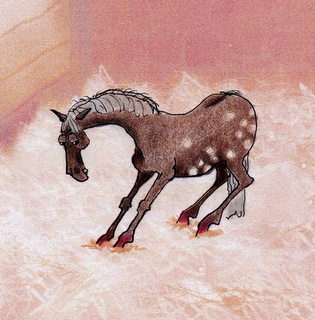
One winter morning his owners found him standing motionless in the stable in the typical stance often seen with laminitis. His condition was puzzling, since the usual causes for laminitis — obesity (apart from the fat deposits), incorrect diet (too much grain) and hoof injuries from hard ground — were not present.
From then on he lay down more and more and was difficult to coax away from his bedding. Over the following three months Rembrandt was given Baryta carbonica, Belladonna, Hypericum and Crataegus together with phenylbutazone by the vet. Although the remedies given eased the pain somewhat, his general condition was miserable and euthanasia was considered the best option.
As we still did not know the cause of his condition, I wondered whether Rembrandt might be suffering from a metabolic disorder. With a little imagination his symptoms could be mapped onto diabetes in humans, and I decided to try a dose of Insulinum.
The response to the remedy was incredible! Within four days Rembrandt rose from his bedding and rejoined his herd of miniature horses. Over the next two to four weeks his neck became soft and relaxed again and the fat deposits disappeared completely.
We were even more surprised by the changes in Rembrandt’s temperament and responsiveness. He was now lively, clever and increasingly took the lead. It was a transformation from “What? Where? How? I don’t understand any of this” to “LET’S GO!”.
Rembrandt receives four drops of Insulinum daily. I have tried adjusting the dose and frequency of administration, but this always leads to a relapse into the old symptoms within 2–3 weeks. Repeated administration, however, seems to do him no harm — a slice of apple daily, drizzled with Insulinum, suits him very well.
******************************************************
Illustration by Vicki Mathison
Category: Cases
Keywords: laminitis, diabetes, metabolic disorder
Remedies: Baryta carbonica, Insulin
Original article: Interhomeopathy.org
