
by Willa Muir
The 6-year-old Fred is brought by his mother because of his temper outbursts.
Appearance: sweet face, brown eyes and hair, red lips, good eye contact, but fidgety.
Fred (F) says that he likes going to school, enjoys funny books and has lots of friends. Sometimes he does not like school: it is boring there, it lasts quite a long time and he has to sit still.
Mother (M): He is very irritable and scatterbrained. He cannot sit still and is constantly fidgeting on his chair. Fred is an alert pupil, can already read fluently and is far ahead of his classmates in spelling. He is a lovable, sensitive boy; if he sees another child crying, he bursts into tears himself. If another child is absent, he notices immediately. He likes to measure himself against others in competition and always wants to win. Although his elder brother Harry is four years older, Fred can run as fast as him. Until recently they used to go riding together. Fred was better than his brother at galloping, which upset him. Out of consideration Fred gave up riding; he says that he does not mind not riding horses any more.
F: Riding is just as great as running; galloping is my favourite. I like show-jumping best, it feels as if you were flying in an aeroplane. I like aeroplanes and flying.
M: Fred prefers to do everything with his brother Harry, even at bedtime he likes his brother with him. The two share a room. Fred is always sad when Harry is not there and only becomes cheerful again when his brother is at home. He is not particularly jealous, he is very attached to his siblings. He is very self-confident and easily starts conversations with other people. However he does not like being alone, he always wants someone around, he needs the closeness of his family.
M (on the subject of discipline): Fred has temper tantrums; if I used to ask him for something, he would get angry after the third request, today he gets upset immediately. When he cannot have his own way and I therefore send him to his room, he turns into a screaming bundle of energy. He throws things about and does not really know what he is doing. Five minutes later everything is fine again and he is sorry.
His mother is sad that he is so destructive and breaks things.
Fred describes what it is like when he gets angry: “It feels nervous; it tingles as if someone were tickling me, like with a feather duster. When I am really angry, Mum carries me upstairs. That drives me crazy. I really cannot stop. It feels as if I were going to die. What if she drops me? I could hurt myself. I could not get any air; she held me so tightly. She took me to my room and would not let me out. I was very upset, I was trembling. I am afraid she will do that again. When she lifts me up, it feels as if I am being pinched, or as if a digger scoop were grabbing me; or it feels as if someone had hit me in the stomach. I then become very fidgety.
General:
Warm; perspires easily
Food: likes pizza, hamburgers, roast chicken, spices, salami, bacon, milk ++
He is very untidy.
(Tuberculinum?)
Mental
Hobbies: enjoys playing pool with his dad
Fears: of the dark; of a purple, slimy monster he saw on TV (he is afraid it might eat him).
Is frightened by the shadow of the cat that sneaks into his room at night and jumps on his bed.
Had a fear of heights on the Eiffel Tower.
Is afraid of being alone.
WM: What are you afraid of when nobody is there?
Fred: That the police will come and take me. I do not want them to take me away. I am not allowed to stay at home alone. If I were alone at home, I would go to prison.
WM: How does that feel?
F: Sad, dark and horrible; someone just took me away; they would put me in a prison – like in war – and just leave me there.
WM: What is it like in prison?
F: There are lots of iron bars and a padlock, no light. I would be very afraid.
F: Once I got lost in a shopping centre. I was watching telly there and then could not see my mum any more, she had walked on. I tried to find her. I was very afraid that someone would lock me in a shop and I would not be able to get out.
M: He loves our cat, but is always sad when it catches a mouse, a rat or a bird.
The mother only realises how much her son fears punishment when he tells how frightened he is of being locked in. Once she found him standing on the windowsill and was worried that he would climb out of the window.
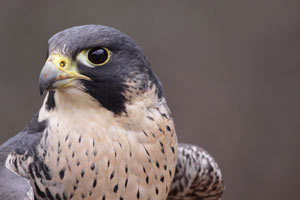
Prescription: Falco peregrinus 1M.
Follow-ups
4 weeks later: Fred is well; he no longer has temper tantrums.
1 year later:
M: He is a real bundle of energy; runs about and knocks everything over while doing so, afterwards he is completely exhausted.
Since Fred watched a scary film he fears dark monsters. Has nightmares, he dreams that someone comes and takes him away.
Observation: Fred has conspicuously red lips.
He must eat a lot ++.
M: He is a good actor and a great swimmer, he is even in the swimming club. He loves playing football. He is very clingy and cuddly and reacts very sensitively to the moods of his siblings – and to mine. He empathises with everyone and is sad when they are sad.
The mother reports that she has four strong-willed children, but Fred always wants to be the leader. He never starts a fight, but will happily join in one.
His mother describes him as an “animal”; at home they call him “Caveman – who came out of the cave”.
Prescription: Falco peregrinus 1M
18 months later:
M: He was absolutely fine, but now he has had tantrums again and has been angry with his siblings. He gets really angry, throws things about and kicks the door in, although he does not intend to hurt anyone. He is very hot-tempered.
Fred is being bullied at school and says that his mother does not believe him that it is happening. The boy who bullies him is quite mean to him, but always very friendly when his mother is around. Fred worries about his family. He is afraid that his mother will have to go to hospital.
He is very explosive in his anger and cries a lot. He believes that his mother prefers the other children to him.
There was an incident when Fred’s mother had a bleed during a cinema visit and had to go to hospital. Then the grandmother also had to go to hospital. The mother is currently caring for the grandmother and is therefore often out. Fred senses that his mother is sad and worries because of it.
Prescription: Falco peregrinus 1M.
Follow-up 2 months later:
M: He had a slight initial aggravation in the two days after taking the remedy and then he became calmer. He is no longer so angry, he is himself again.
Analysis
Fear of being locked in
The central theme of Falco peregrinus is the great fear of being locked in, coupled with a strong desire to flee.
In this case study the theme of being locked in, associated with fear and the desperate attempt to escape, was clearly apparent. Falco-p. fears the dark; interestingly falconers train their birds of prey with hoods (darkness/confinement).
Although Fred is the youngest of four siblings, he wants to be the best and the leader. His emotional symptoms – temper tantrums and anxiety – are triggered by his concern for the family in general and by the fear for his mother, grandmother and brother in particular.
Concern for the family
All birds carry out parental care and worry for their family. Bird patients enjoy the freedom of rapid movement – they like to run, ride or cycle. In the present case study we can clearly recognise the boy’s strong compassion, who out of consideration for his brother gives up the beloved riding sport, although he feels especially at ease when galloping fast. The boy has a strong will, but can restrict his own freedom and joy out of consideration for the family.
He has a fast metabolism, which is also typical for patients who need a bird remedy.
Editor’s note: Willa Muir notes that she intuitively chose a bird remedy in this case study. From the case analysis we can see that she also gained an overview of the core themes – similar to most bird patients she grasped the underlying pattern using conceptual thinking.
Falco peregrinus
Core theme
Dominance, pride, humiliation.
Fear of being locked in, of being trapped, fear of institutionalisation.
The desire for freedom is expressed as resistance to another person’s dominance; resistance to subjugation.
Abuse and abandonment.
Protects the children and worries about the family – fear for the children and desire to flee from the family.
Anger about anything perceived as constriction. Cold, hard, indifferent, unfeeling.
Strength of will and determination, or lack of willpower, powerlessness.
Intense, strong and direct.
Resignation, paralysis, despair, hopelessness.
Feels lonely; without family, support, without work.
Terrible images of earth and water, of pollution; bleak landscapes.
Handicapped child.
Gives up one’s own freedom to gain recognition. Obliging, wants to please others. Places great value on the good opinion of others. Wants to be flawless.
Speed
Addiction, alcohol
Mythology
A messenger from another world, a stranger in ours. According to the Native Americans of North America the falcon is a messenger connecting us with the spirit world.
The ancient Egyptians believed that the falcon brings the sun in the morning and takes it away again in the evening.
Sources
Jonathan Shore 'Birds – Homoeopathic Remedies from the Avian Kingdom'
Peter Fraser 'Birds in Homoeopathy'
Synthesis
Vermeulen 'Concordance'
**************************************
Photo: Shutterstock: Suzanne Tucker, shutterstock.com 143478901 Chris Hill
Category: Cases
Keywords: locked-in, trapped, enclosed, flee, freedom, speed, fast movement, compassion, siblings, concern, anger, resignation
Remedy: Falco peregrinus
