
by Markus Kuntosch
Karin is a 12-year-old, self-confident and headstrong girl who can usually hold her own against her two brothers. Four years ago she had two episodes of acute laryngitis with a musty breath, which responded well to Sulfur and Mercurius.
She now comes to the surgery with a sore throat and cough that are made worse by cold air and physical exertion. Her condition improves at rest, when lying down and when warmly wrapped in blankets. Karin has no thirst or fever, but looks pale, grey, very distressed and ill. Breath sounds over the right lung (middle and lower) are diminished; on examination a fine crackling can also be heard, and percussion is dull: there is a right-sided pneumonia. Strangely the patient has no fever but has been coughing for two weeks. The symptoms began the day after a hike during which, despite the cold wet weather, she had sweated heavily. On the day of the hike she had been deeply hurt twice: she had lost the election for class representative to her friend and had also been stood up by her godmother, who had promised to spend the afternoon with her but simply did not come. Karin now doubts whether her godmother really loves her, because she had once forgotten her birthday. Karin's favourite colour is dark red (10D). She prefers savoury foods to sweet ones.
.gif)
Analysis
The repertorisation according to the polarity analysis places Sarsaparilla only in 16th place, but it is the first and only remedy that also matches the girl's colour preference (10D). For remedies 1–15 there are either contraindications or the colour preference does not match.
The loss of social status is a possible cause in this case and it reminds me of Veratrum album, a plant from the same botanical family, the Liliaceae. Veratrum comes to mind when the birth of a sibling calls into question the status of the firstborn, who must then share the attention of the parents and grandparents.
Sarsaparilla is known as a remedy for urinary tract infections and had helped the patient a year earlier in an acute cystitis with burning pains in the urethra that occurred at the end of passing urine. It seemed worth a try.
Prescription
The patient was given Sarsaparilla C200, dissolved in a glass of water, to take one teaspoonful of it hourly.
Analysis according to Jan Scholten’s new plant classification
The main problem in this case is the hurts the patient experiences from her classmates and her godmother. This is typical of the Silica series. She has lost her leadership position as class representative. She remains part of the class community but feels underchallenged and no longer wants to meet her friends’ expectations. She no longer wants to take part in the intrigues and to wear expensive brand clothes like everyone else. She is half in and half out. She has already had throat infections with musty breath. The term 'musty' can be assigned to Phase 6 and the class situation fits this. Both confirm Phase 6.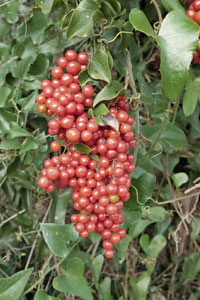
The girl feels unrecognised, she does not properly belong, is insecure and is sometimes even laughed at by her classmates. Being laughed at belongs to Subphase 2.
Jan writes in his book 'Wunderbare Pflanzen' about Sarsaparilla under number 633.62.08:
“As children they have the feeling of not being noticed in their family; later they feel passed over and ignored by friends or colleagues.” He describes Sarsaparilla as a remedy for pneumonia.
The painful experience with the classmates and the godmother, coupled with the pneumonia on the physical level, fit Sarsaparilla.
Follow-ups
The next day the patient was already significantly better: she slept well, the cough was gone, she was eating well and wanted to play with her dog again. Three days later I auscultated her lungs again. The middle lobe was now clear, only a slight crackling could still be heard in the lower lobe. Four days later the lung was completely clear and the girl was able to return to school. All in all this is a good course for a severe acute pneumonia. I asked my young patient directly about the psychological trauma. What had been worse for her? Losing the class representative election or the disappointment by her godmother? At first she named the matter with her godmother, but then she told me about an incident that had taken place on the morning of her illness at school: a boy in her class had tripped her up, she stumbled and was laughed at by the others. She feels excluded because she does not wear expensive clothes and does not want to take part in class intrigues. Although she tries hard to make friends and belong to the class, she does not feel accepted; she is merely tolerated. In retrospect this was a very good confirmation of the themes of the Liliaceae family according to Sankaran. The girl feels excluded, not part of the class community. Two weeks after the acute illness we hear from the happy mother that her daughter is well again – she has found her self-confidence, is cheerful and is currently visiting another school. At her present school she felt underchallenged. At the new school she feels very comfortable, although she has to catch up on a whole year's French. She has found new friends and is securely anchored in the class. She can now develop according to her inclinations and abilities.
Summary
In this case the correct remedy – Sarsaparilla – can be approached in different ways. The choice of remedy is confirmed both by the polarity analysis according to Bönninghausen with the addition of the colour preference, and by the family themes of the Liliaceae and Jan Scholten's plant theory.
****************************************
Photos: © Varandah shutterstock.com 158460926
©flaviano fabrizi shutterstock.com 161828765
Sarsaparilla berries; homeredwardprice; Creative Commons Attribution 2.0 Generic license
Keywords: laryngitis, pneumonia, cystitis, loss of social standing, excluded, ignored.
Remedy: Sarsaparilla

