
Job is a three-year-old female Golden Retriever. She is brought to the clinic by her owner because she becomes biting when stressed. She mainly bites her owner when off lead, but can also attack strangers and other animals. Her owner's panic is driven by the fact that her previous Golden Retriever had to be put to sleep because of aggressive behaviour. He had the rage syndrome.
When Job becomes panicked she starts to bite. The relationship between her and her owner has meanwhile deteriorated greatly; trust between them is increasingly eroded. The dog herself is very outwardly responsive and reacts to every stimulus. If she cannot process a stimulus, she bites. Remarkably, she immediately shows remorse afterwards – she behaves submissively and licks her owner's hands.
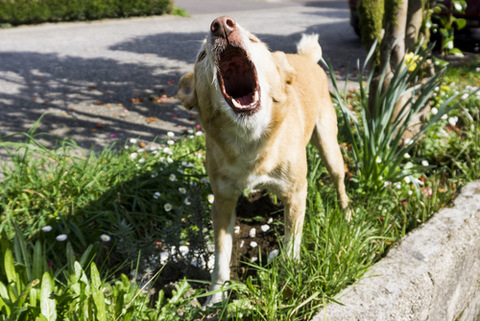
Job has various fears: noises (she will not go into the kitchen when the dishwasher is running), quiet noises make her startle, she is afraid of the sprinkler and of screaming children. Strangely she has no fear of fireworks! If a cracker explodes between her paws it does not bother her in the least. When frightened she withdraws under the table and presses herself close to the wall. In windy weather she becomes hyperactive and chases anything blown through the air.
 Other characteristics are: she is demanding, possessive, irritable, nervous and timid; she responds exclusively to her owner.
Her eating behaviour is unremarkable. She has thick, stringy saliva.
She came into season for the first time relatively late. The season lasted five weeks instead of the usual three weeks.
She is rather warm-blooded; she prefers to lie in the shade and avoids the sun. She is vaccinated every year; the vaccination programme also includes the rabies vaccination.
Prescription: Lyssinum C30, repeated dose after two weeks. Lyssinum is the rabies nosode.
Follow-up: Job makes enormous progress until her owner has her vaccinated again. She receives the full programme plus a deworming treatment. Afterwards she has severe diarrhoea and becomes hyperactive: she chases everything that moves and attacks cyclists.
Prescription: Lyssinum C30 was repeated, but no longer had the same effect. The remedy was given once again as C200, a total of three times. The response was positive. The owner was advised to forgo the rabies vaccination and to stop deworming the dog monthly.
Differential diagnosis
Stramonium. However, the fear of water in combination with the thick saliva confirmed the choice of Lyssinum.
Rubric: Mind – Anger – alternating with – Repentance; with rapid
An unknown number of dogs react to the rabies vaccination with this behavioural disorder. Usually this change does not appear immediately, but only after the second or third vaccination. Nowadays asking about possible vaccination reactions is part of the standard repertoire of a homeopathic treatment of dogs that suddenly become aggressive or show other behavioural changes.
In dogs that need Lyssinum we see contradictory behaviour – on the one hand they are afraid of small things, on the other hand they react indifferently in situations where one would expect an anxious response.
************************************
Photo: Shutterstock
Dog barking; Cesar Outon
Category: Cases
Keywords: rage syndrome, barking, biting, demanding, irritable, nervous, timid, rabies vaccination.
Copyright: Interhomopathy

