
The world-renowned and experienced Indian homeopath Prasanta Banerji died suddenly and unexpectedly on 17 May 2018 at the age of 84. He suffered a heart attack. 
Prasanta Banerji developed the so-called Banerji Protocols. These are tried-and-tested homeopathic remedies for specific indications. They range from simple bronchitis, hypothyroidism and heart disease to cancers. They are standardised, disease-specific protocols that can be used in the primary treatment of all cancer cases and other serious illnesses with homeopathic medicines. His protocols have had a lasting influence on homeopathy.
Prasanta Banerji ran a large practice in the heart of Calcutta together with his son Pratip and 14 other doctors, where they saw about 1,000 to 1,200 patients daily, of whom about 100 were cancer patients each day. Prasanta Banerji was not only a practising homeopath but also served as an advisor to the Indian government.
Interesting articles about Prasanta Banerji:
The Banerji Protocols: Review of the seminar with Dr Prasanta Banerji in November 2012
Much more than a placebo: Homeopathy pushes back cancer
Obituary by Joette Calabrese:
Farewell, dear Baba
“I do not fear death, for I have had a very fulfilled life.” – Dr Prasanta Banerji
Today we must say goodbye forever to Dr Prasanta Banerji. Even though this great man has left us, he leaves behind a world better than the one he was born into. There are certain traditions in our lives that enrich and inspire our society and one of those is to pay our respects to the few extraordinary people who deserve a great farewell. Dr Prasanta Banerji is one of those extraordinary people. The world will long remember his dedication to the suffering, the sick and the poor among us, whom he helped with generosity and homeopathy.
This passion and dedication were instilled in Prasanta from birth. His father and great-uncle had already laid the foundation for what Prasanta eventually expanded through his brilliant mind, tireless commitment, hard work and innovative spirit. Prasanta followed his family tradition of helping those in need on this earth. He advocated for those who have no voice, tirelessly and with great dedication; he was a patient, understanding and attentive physician and at the same time an outstanding and gifted healer.
I had the great privilege of working by his side repeatedly over a period of seven years. He honoured me with the great privilege of calling him Baba – that loving and respectful form of address reserved among Hindus for an honourable father or teacher.
He was indeed an honourable, great father and a wonderful teacher.
As a young doctor Dr Banerji worked in his father’s homeopathic practice before setting up independently in 1950 and treating over 500 patients a day in his own clinic. He very quickly realised that he had to find a new form of homeopathic prescribing to be able to help, even in a small way, the many, many people who filled his waiting room day after day and often formed long queues in the street.
The old, classical homeopathic method of case-taking and repertorisation was too slow and cumbersome for the demands Prasanta faced. Prasanta’s father, Pareshnath, who was himself very popular and treated enormous numbers of patients in his clinic every day, had already begun to work out standardised protocols for a range of complaints. Inspired by his father 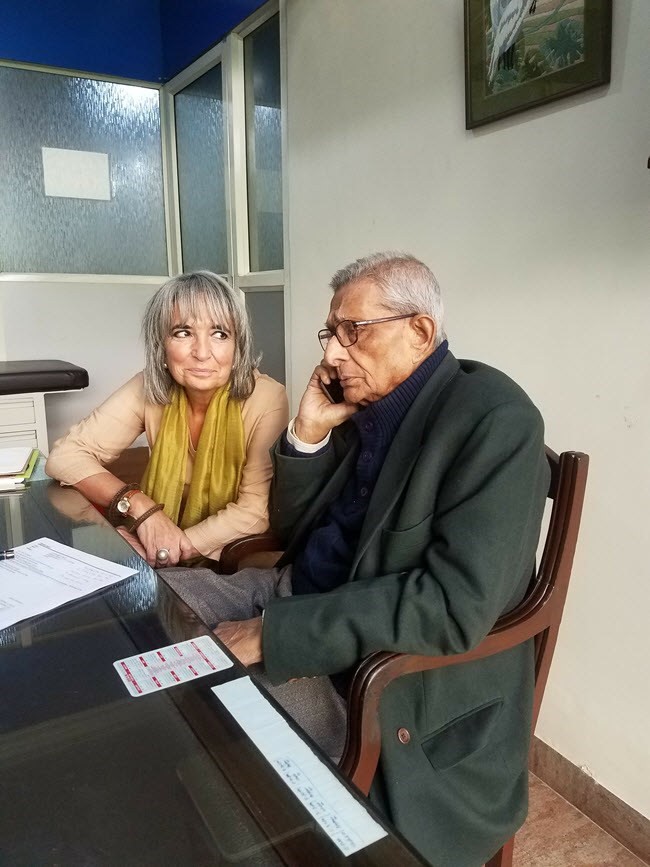 Prasanta developed this approach further. And at this point Prasanta and his father stood out from the crowd. Most homeopaths would have given up; they would have turned patients away, remained conventional and ordinary, they would have resigned themselves. But not Prasanta, who here performed the extraordinary and thus ranked among the great heroes of this world.
With his brilliant and innovative manner and his conscientious, tireless work, Prasanta not only refined the homeopathic method but also revolutionised homeopathy as a science and art of healing.
As the saying goes: necessity is the mother of invention. But necessity only gives us fertile ground. It takes an inspired and courageous thinker to sow the seed and then, after arduous but determined work, reap a great harvest. It was Pareshnath who planted the seed and thus laid out this metaphorical garden. Prasanta inherited it from his father and turned it into a huge, fruitful orchard.
Within a few years as an independent homeopath, Prasanta had acquired enough knowledge to recognise a specific pattern in every disease and to work out a standardised treatment protocol for it. This methodology differs markedly from classical homeopathy and in its speed, efficiency and focus on reproducible results is more comparable to conventional medicine.
Prasanta Banerji did more than anyone else to reconcile conventional medicine with homeopathy. He and his son, Dr Pratip Banerji, attracted the attention of conventional medical institutions and researchers from around the world. This is especially true for the field of cancer research.
In 1993 the Dr Prasanta Banerji Homeopathic Research Foundation was established. The aim of this foundation is to make homeopathy accessible to a broad public, to ensure comprehensive healthcare and to create a database of all seriously ill patients treated according to the Banerji Protocols in the foundation’s clinic.
The diseases documented in this way include various types of cancer, kidney failure, multiple sclerosis and other serious illnesses. The foundation also finances conventional diagnostic procedures for patients without financial means. Today — 25 years later — over 500,000 patients have already been treated there.
Dr Prasanta Banerji and his son Dr Pratip Banerji have presented their treatment method — known as the Banerji Protocols — at numerous scientific symposia. In 1995 Drs Prasanta and Pratip presented their paper on the ‘Regression of brain tumours by highly diluted medicines’ at the ‘th International Conference of Anticancer Research’ in Corfu, Greece. More than 1,000 participants from around the world were present. Scientists from the USA, the UK, Australia and the Caribbean invited the Banerjis to collaborate on a joint scientific project. The two regularly lectured at the National Cancer Institute (NCI), attended by cancer specialists from leading cancer centres such as Memorial Sloan–Kettering Cancer Center, Johns Hopkins Medical Center, the University of Texas MD Anderson Center and many others.
Over the past 20 years interest in the Banerji Protocols has grown worldwide and several research projects at various institutes have already been completed. In 2003 the International Journal of Oncology published the result of a study carried out by the Banerjis in collaboration with the Department of Molecular Genetics at the MD Anderson Cancer Center in Houston. The researchers at the institution found that administration of homeopathically prepared Ruta graveolens C6 in combination with Calcarea phosphorica 3X led to complete regression of the tumour in 86% of participating patients with glioblastoma. Among oncologists this form of cancer is regarded as practically incurable. The usual five-year survival rate for adult glioblastoma patients is about 10 percent.
Between 2004 and 2013 more than 25,000 cancer patients were treated at the Banerji clinic. Half of these patients experienced a marked improvement or a complete regression of the cancer and a further 28% stabilised, i.e. their condition neither improved nor worsened. Today 1,200 patients are treated daily in the clinic. Many of them are cancer patients, but not exclusively; the treatment spectrum is wide-ranging. Approximately 700 to 800 of these patients are treated there free of charge.
Dr Prasanta was so tireless and felt so committed to his vocation that he never truly retired. Even this year he had accepted numerous invitations to speak at various conferences and symposia. He also continued to oversee many complex cases in the clinic.
Dr Prasanta Banerji was the soul of homeopathy and his heart beat for his great cause: that homeopathy should spread throughout the world — and not only be practised by doctors in clinics, but be used by anyone willing to learn. My revered mentor, my esteemed teacher, my dear Baba will be sorely missed but never forgotten. In my heart I am convinced that Prasanta’s influence on this world will continue to grow — exponentially.
****************************************
Copyright:

