|
|
"All the cosmic and natural laws are written in the trees, in the flowers, in the grass, in the shining of the sun, in the flow of the rivers, in the rain and the wind ... and in the whole beauty of nature." Edmund Szekely, "Medicine Tomorrow", 1938 | |
|
Jan Scholten presented his new system in October to a North American audience in two well-attended seminars in Vancouver, British Columbia and Toronto, Ontario. These seminars introduced Jan's new book "Wonderful Plants", which will be published in early 2013. He presented interesting cases of many remedies that he describes in his recent Lamu provings (Alonnissos 2011), a new book with sixteen plant provings. |
||
| In Scholten's own words his aim is to create a systematic overview of the plant kingdom in order to develop a feel for prescribing plant remedies. From my perspective as a homeopath, his system allows a clearer and more comprehensive access to the plant kingdom—just as his elements system does for the mineral kingdom. | ||
|
The periodic system of plants uses many aspects of Scholten's elements system in conjunction with the botanical APG III classification (Angiosperm Phylogeny Group(1)). APG III (published in 2009) is based on current DNA analyses. Jan Scholten's new system has the advantage of using a clear, systematic approach while still taking into account the complexity and multidimensionality of plants. |
||
|
He believes for various reasons that categorising plants for homeopathic prescribing is a difficult process: - their complexity far exceeds that of minerals- relationships within the plant kingdom are not as certain as those in the mineral kingdom - the vast majority of plants are unknown with regard to their homeopathic use (i.e. very few plants have been developed for homeopathic application) |
||
| He emphasised the importance of evolutionary theory for our prescribing of plant remedies, since evolutionary differences are reflected in the APG III classification and are evident throughout nature. | ||
The System |
||
| Scholten believes that a good classification works on all levels; for example, the periodic table functions not only in chemistry but also in homeopathy. The same applies to the APG classification: it is suitable for botany and should therefore also be useful for homeopathy. | ||
| He has developed an innovative number-based classification system that takes into account the peculiarities of each plant. I would like to compare it to the Dewey Decimal System—a library classification system. It is similarly structured, leading from a general arrangement to a specific grouping and thus allowing the user to place the plant in a broader classification context. In Scholten's system each plant is assigned its own seven-digit number, which, following the APG III classification, indicates phylum, order, family, class, subclass and genus. | ||
| The seven digits are no accident. Jan believes that the number seven is something very special and that it is determined by nature. This is seen, for example, in the seven series of the periodic table and in the development of life cycles. A particularly ingenious aspect of Jan Scholten's elements system is the series concept, which follows the life cycle. Man is born into life (Hydrogen series), goes through childhood (Carbon series), then enters puberty (Silicea) and eventually passes through the different stages of adulthood (Iron series to Gold series). | ||
| Scholten combined the conception and organisation of the APG III system with the elements system and thereby underpins his new periodic plant system. In his botanical system the angiosperm phylum corresponds to the Gold/Lanthanide series in the periodic table. This shows a high degree of self-reflection and evolution. Scholten believes that everyone is an angiosperm and thus part of a monophyletic group (phylum); i.e. they descend from a common evolutionary ancestor or ancestral group that is distinct from other groups. This is the sixth series, and it is represented by the number 6. | ||
| As in his elements system, the question "Where is the problem?" is addressed if the analysis leads us to a series. In the plant system this appears as the class, e.g. monocotyledons. Once this is determined, one asks further: "What is the focus of the case?"; this leads to the subclass. There are seven classes and seven subclasses that reflect the series of the periodic table. To determine the phase and the sub-phase, one asks: "What is happening? (externally)", "How is this for you?", and "What feelings does that evoke?" | ||
| There are seven phases and seven sub-phases, which correlate with the 17 stages of the periodic table and synthesise them into seven. Finally it is about "how they handle things" and "how they react to what happens"; this is the stage, as in the elements system, e.g. they fight (stage 12). There are 17 stages. | ||
| The charts and tables of the plant system help answer these questions. Detailed maps, including those needed to determine the sub-phase, are found in the book. | ||
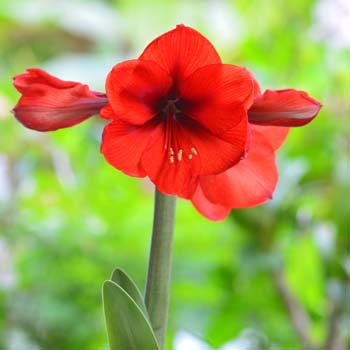
| For example, an Amaryllis remedy in Scholten's plant system would have the number 63356.12. The number 6 represents the angiosperm, 3 the class (monocotyledons), 3 the subclass (Liliales), 5 the phase (Asparagales), No. 6 the Amaryllidaceae (sub-phase) and No. 12 represents the stage, just as in the elements system. |
|
|
| Jan Scholten explained that his plant system is still in development and is constantly being refined. A wonderful side effect of this system is that it clearly shows where gaps exist in our materia medica, and which remedy provings we should conduct in future. He noted, for example, that we have none or very few remedies from the plant families Amborellales, Pandanales and Celastrales. | ||
| What I like about Jan Scholten's system is that it works with current botanical knowledge and the latest research findings. His system evolves along with changes in botany. It reflects the entirety of homeopathy by mirroring the aim of our work and following the principles and orders of nature. This is urgently needed in our difficult times. I already know that his book, when it comes out, will transform my prescribing just as "Homeopathy and the Elements" did, and that the whole world and everything in it will benefit. | ||
 |
||
| ************************************************************************** | ||
| (1) The Angiosperm Phylogeny Group is a group of botanists led by Mark Chase, who worked together on the phylogeny of the angiosperms. They published three classifications between 1998 and 2009 that quickly supplanted older systems. The final 2009 publication, APG III, replaced all previous APG drafts. The plant theory of the APG III classification, the latest widely accepted classification of the plant kingdom, is based not only on chemistry and morphology but also on DNA analyses. | ||
|
|
||
| This article was published on www.interhomeopathy.org. | ||
|
Photo: |
||
| Category: Book review Keywords: Jan Scholten, periodic system, Wonderful Plants, APG classification |
||