
A proving of Gaillardia aristata; blanket flower, Indian blanket |
||
|
|
Natural history classification: | |
 |
Class: Subclass: Order: Family: Genus: Species: |
Magnoliopsida |
|
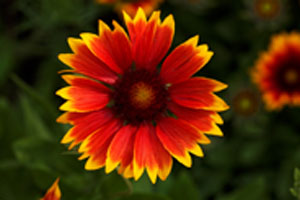
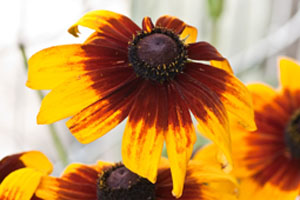
Gaillardia aristata, also known as the blanket flower or Indian blanket, is a perennial wildflower that thrives in northern and western North America, growing in many habitats. It reaches a maximum height of 20–70 centimetres (7.9 to 28 inches). Its lance-shaped leaves are clustered near the base and several erect, naked stems bear the flowers. The flower has in the centre a disk of brownish-reddish florets and a fringe of ray florets about 1–3 cm long, yellow to reddish on a darker base. |
||
| Uses: | ||
| - Some highland Native American tribes use the blanket flower for treating wounds and fever [1]. - Gaillardia aristata is widely cultivated as a perennial ornamental and garden plant. |
||
| Comment: | ||
| I planted Gaillardia aristata in my garden about six years ago and I enjoy how abundantly it blooms and how colourful it is. It reminded me of Mexican huipiles, the colourful traditional garments worn by indigenous women in Mexico and Central America, so I gave it the name “Frida Kahlo”. When I arrived in Toronto I found out that a few days earlier the exhibition “Frida and Diego: Passion, Politics and Painting” had opened at the Art Gallery of Ontario. The provers did not know Frida Kahlo's story, but the feelings that arose even before anyone asked about Kahlo's history were: deep “sad longing”, broken heart, shattered structures, broken bones and images of basins of fresh blood. Survival, passion, self-discovery, the search for meaning and healing were also strong themes. At the start of C3 – the third trituration – Jan, who had visited the exhibition the day before, brought the book: Frida Kahlo: Retrospective, by Helga Prignitz-Poda et al., Prestel. The provers looked through the book and were astonished to recognise that the themes that emerged in the proving were reflected in the artist's paintings. I feel that the theme of this substance is a strong survival instinct. The shadow side of this is the fear of not surviving the severe challenges that threaten inner and outer integrity. Not surviving means separation, loneliness and loss. To get through the challenges they must find and preserve their inner fire. |
||
|
According to Jan Scholten's plant systematics: |
||
| 666-44.12 Gaillardia Series: Lanthanoid of the lanthanide series. Tribe: Flowering plants; Asteranae; Campanulidae; Asterales; Asteraceae; Heliantheae; gaillardia Phase: 4; Sub-phase 4 Stage: 12 The following presentation shows exemplarily the main themes of the remedy proving. The full proving can be found at: www.greatlakesprovings.com. |
||
| Mental / emotional themes | ||
| Vitality / Self-confidence Jan: C2 Powerful flower, lots of strength 2: C2 The plant experiences itself as a survivor. No matter what happens, one endures and is okay. 2: C3 One of the paintings shows a person with roots instead of legs. The tree roots convey the idea of being grounded and rooted. 2: C3 I think it is a strong, stable plant. It thrives no matter how often you cut it back; it develops into its best form and cannot be destroyed. |
||
| Fire / Inner fire or Inner source / Spirituality / Passion | ||
|
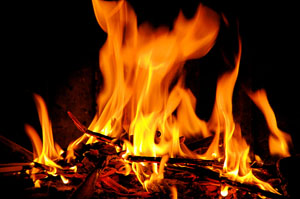
1: C1 Vision of natives, perhaps in Africa; they sit around a wood fire and talk about everyday things. Some joke. “How was your day? What did you do today?” Conversations at the end of the day about the day's events in a village gathering. |
||
|
1: C3 Having the resources to sustain life ... The inner fire. That means accessing inner resources: the healing fire. It is soul healing on a deeper level. |
 |
|
| 3: C3 It has something to do with fire, bringing fire and light into one's interior. Frida's passion found expression in her art. She found a new passion; it is the solution to find a new passion. 2: C3 brings back the religious aspect: passion, Easter, crucifixion and resurrection. The structure is healed. Frida incorporated all those nail-images into her painting. 1: C3 That could be the soul one tries to get back. Returning to the fire. 3: C3 Romance itself needs the fire, and one feels so good in that warm rich connection when the soul is there, as opposed to when it is not. |
||
| Blood / Birth / Nurturance | ||
| 3: C1 I get an impression of blood. The centre of the plant and the colour of my shirt remind me of blood, blood, blood ... deep red, thick blood. And I'm not a bad person, but I think that about myself. The flow of blood ... Cholesterol comes to mind ... blood pumping ... the cardiovascular system. 3: C2 I think of red Bordeaux. Think of the colour of wine and of blood. I think about blood and bone marrow ... that rich, thick stuff, hmmm. It mostly tastes like copper. The blood I see is not simple blood from a small cut. It's quite a powerful stuff. It's also not blood from a particular piece of flesh, not that rich, thick stuff. I see a basin full of thick blood (laughs), that's not normal for me. But it is not an unpleasant feeling. 1: C2 The blood is a source. It is the essence of life, if you like, and you need it to live. It is also fiery. 2: C3 The blood is umbilical cord blood for the baby. It is rich, an essential blood that allows the baby to survive even if the mother dies. 1: C3 That is the placenta (in relation to the Frida Kahlo book). |
||
| Sorrowful longing / Heartache / Loss | ||
|
3: C2 Although a sense of heaviness is present, it is not a dark medium or a dark substance. I feel a very deep sensation ... depression would be too strong a word. I'm not sure it's sadness, rather a deep sad longing. It is not a need like sexual desire or a lack of anything, but the longing for something that is lost. |
||
|
Structures / Destroyed structures / Broken bones |
||
|
3: C2 Something about structure. I make these lines on the bottom of the bowl while I triturate and scratch, and a grid forms. Having strength means having structure, I think…; perhaps this refers to the bones and joints. Broken structures. It is also about inner strength and inner structure, about having structure in one's life. |
||
| 1: C3 Look at the “broken spine” on page 147. The woman's torso is open at the front, revealing the broken spine repaired with nails. | ||
|
Lost identity / Fear / Dark foreboding / Indecision |
||
| 1: C3 The flower has lost its identity. It is neither this nor that. What are we? Which path are we on? Here there is indecision: You cannot choose “should I go left or right?” It is something very profound, and there is no choice. It depends on how things unfold. Your greatest fears will come true if you develop in such a way that your partner is no longer able to be with you. 3: C3 I think about the theme of birth. I can't get it out of my head. You are not the one who makes this decision, therefore you bleed. If you stay in the middle you can be cut. That is the ambivalence between one direction and the other. 3: C3 She (Frida) made a beautiful sketch of her female body parts, which is interesting. For the 1940s she was very progressive. 1: C3 Looking at photographs and paintings you notice that Frida had some pronounced masculine features, such as her moustache and her joined eyebrows. Her hormonal balance was apparently disturbed. A picture shows a heart framing a face. Half of the face is hers and the other half is Diego's face. The first impression I have, before recognising the faces, is confusion about gender identity – that is the problem. |
||
| Connected / Separated / Unaware of oneself or one’s strength. Jan: C2 What is the problem of this plant. What state is it in? 1: C2 Lack of community. 1: C2 Being alone, not connected. 3: C2 Not knowing oneself. Lack of self-confidence, not knowing one’s strength, or not realising you possess strength. Feeling unable to get excited. Pull yourself together and stand up. |
||
| Other themes | ||
| Colour Clarity / Radiance Rhythm/calm/quiet |
||
| Physical: | ||
| General: | ||
|
3: C1 Dryness from the upper chest up to the jaw and mouth. Feeling of constriction. |
||
|
Note: |
||
| Head: | ||
| 3: C1 Pressure in the right temple. 3: C2 A burning pain on the top of the head, more burning than anything else, better from pressure on the skull, not a headache. |
||
| Eyes: | ||
| 1: C1 Sensation at the right eye, I wouldn't call it pain, just a kind of… 2: C1 Mild headache over the right eye; circumscribed spot over the eye. 3: C1 Pressure in the area of the right temple, the right eye contracts. |
||
| Face: | ||
| 2: C1 Very serious expression. 2: C1 Red face. 2: C2 Pain in the laugh lines extending to the lower part of the nose. |
||
| Mouth: | ||
| 3: C1 Phlegm in the mouth which I rid myself of easily. 2: C2 Sharp pain at the right temporomandibular joint – clicking when opening the mouth. |
||
| Throat: | ||
| 3: C1 Gagging sensation, can't breathe. 3: C2 Tightness sensation |
||
| Stomach: | ||
| 3: C1 Belching, difficulty swallowing, and a feeling of tightness in the chest. 3: C1 I have mild reflux. |
||
| 3: C2 Heartburn. I am now attracted to this word (“heartburn”) because it contains heart and fire. More burning than I've ever had. I know it will subside again. 1: C2 Heartburn in the middle below the sternum. |
 |
|
| Abdomen: | ||
| 3: C2 Tightness in the solar plexus under the chest, more on the left side, but I also lean to that side when sitting. | ||
| Chest: | ||
| Jan: C1 Pressure on the chest and need to take a deep breath. 3: C1 Belching, difficulty swallowing, and feeling of constriction in the chest. 2: C2 Fluttering sensation in the heart. |
||
| Respiration: | ||
| 3: C1 Fear of suffocating, that I will not be able to breathe anymore. 1: C1 Sighing. Jan: C1 Sighing. Jan: C1 Pressure on the chest and need to take a deep breath. |
||
| Extremities: | ||
| 2: C1 Sharp pain in the left ankle joint, right at the ankle; it began very suddenly and is still present. 3: C1 Pain like that from a pinprick on the right shin, not directly stabbing. It went away quickly. It was exactly in the middle of the shin. 2: C2 I often have joint pains. |
||
| Skin: | ||
| 3: C1 Itching on the head and at the right temple. 1: C1 (Rubbing the back against the chair back). The spot had already itched before, but now it is very strong. 1: C1 (Constant scratching). “It always itches me!” (Everyone laughs). He scratches his head. |
||
| Final remark: | ||
| Jan: The Asteraceae family has strong lanthanide and carbon qualities. Thus the themes of searching for your own self and the spiritual quest are lanthanoid themes. Wanting to see it reflected in the outer world is a carbon aspect. When you look at Frida's pictures you see an inner world, not the outer world – that too is a lanthanoid theme. | ||
| ************************************************************************** | ||
|
References: |
||
| Photos: Gaillardia aristata1©LianeM - www.shutterstock.com Gaillardia aristata2©Sue Smith - www.shutterstock.com The Broken Spine; Frida Kahlo (1907–1954) |
||
|
Category: Provings |
||

