
Homeopathy helps with musculoskeletal complaints - not only in people!
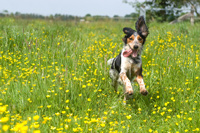 It was a few months ago when Buster, our cheeky little office dog, injured his hind leg while romping across the meadow. After a particularly daring leap he suddenly yelped terribly and came limping and whimpering back to us. Our poor dog was clearly in severe pain, as he could not put any weight on his leg at all.
It’s not unusual for a lively dog to twist an ankle while playing and limp briefly, only to sprint off a moment later as if nothing happened. Not our Buster! He absolutely refused and was unable to move his hind leg.
For several days I routinely gave him Arnica 200 three times a day for the shock and the initial pain.
By the end of the week he still hadn’t improved. Buster’s hind leg was so tender that he could not bear weight on it and snapped at anyone who even came near his injured leg. Fortunately we are friends with a wonderful vet who not only treats holistically and knows dogs extremely well, but also lives very near us. After a thorough examination the diagnosis was clear: Buster had suffered a meniscus tear.
The meniscus is made of elastic fibrous cartilage and sits in the knee joint like a cushion between the thigh and shin bones. It functions as a kind of shock absorber, absorbing impacts and keeping the joint supple. Meniscal injuries are among the more common complaints in athletic dogs and often occur in conjunction with cruciate ligament tears. Standard therapy for such injuries is surgical intervention, and subsequent consequences can include arthritis, bone spurs and joint degeneration.
All of this now seemed set to befall our poor Buster!
A conventional vet would very likely have recommended surgery in this situation and we would have had to dig deep into our pockets. Such an operation costs several thousand dollars, after all.
Of course we immediately treated Buster with Symphytum officinale C200, a wonderful remedy that should not be missing from any home medicine cabinet. The cost of this medicine is about $20, so the decision was easy.
The homeopathic remedy Symphytum is derived from the comfrey plant, which herbalists and gardeners have valued for centuries for its healing powers. Because the plant helps heal broken bones and wounds, it is commonly called "wallwort" or "comfrey".
Symphytum is an excellent remedy for bone fractures. It is so effective that we even advise against administering it before a fracture has been properly set by a professional, because it can otherwise cause premature and uneven bone healing.
In homeopathy fractures are initially treated with Arnica C200 (higher potencies can also be given). Arnica reduces the initial trauma, helps stop bleeding and relieves pain. This is followed by Ruta graveolens (C30 or 200), given over several days to repair muscle and ligament tissue. After the fracture has been set by a specialist, Symphytum (C30 or C200) is given to allow the bone to heal.
Symphytum does not only help with fractures; it also heals back pain, knee complaints and eye injuries. For injuries to tendons, ligaments and cartilage tissue comfrey shows great effect. Give Symphytum C200 and you will be amazed how quickly and exemplary the healing proceeds.
This wonderful plant is an excellent remedy for blunt injuries to the eye, especially when the cheekbone has been affected.
Perhaps the most important healing effect of Symphytum, however, is for injuries to the structures surrounding bone tissue — cartilage, ligaments and tendons. This versatility naturally makes the remedy an important medicine for the treatment of numerous traumatic injuries, including sprains, dislocations, overuse, arthritis, haematomas and injuries from blows or falls.
Conditions that generally respond well to Symphytum include tennis elbow, plantar fasciitis, sprains and dislocations of the ankle, knee and joint pain, arthritis and bone spurs. It is the specific remedy for osteomyelitis.
So Buster was treated with Symphytum — to heal the acute injury and to help prevent future problems.
The Banerji protocols from India recommend using Symphytum in combination with other remedies for treating a wide range of chronic conditions in people and dogs.
Remember the following treatment strategies:
For a slipped disc, chronic back pain or back pain from lifting:
Symphytum C200 in combination with Hypericum perforatum C200, taken twice daily.
For knee joint arthritis: Symphytum C200 in combination with Arnica montana C200, taken twice daily.
For plantar fasciitis and heel spur: Symphytum C200 in combination with Rhus tox C30, taken twice daily.
For ligament or meniscus tears (as in Buster’s case): Symphytum C200, taken twice daily.
The conditions mentioned above usually take a long time — in some cases several months — to heal completely. During the recovery phase these remedies will relieve pain and minimise stiffness.
By now Buster is almost his old self again — only sometimes he still limps a little. On the vet’s instructions he is still carried up every staircase. Buster loves it and by now we wonder whether he doesn’t rather enjoy the occasional helplessness a little too much.
Be that as it may: Symphytum should not be missing from any home medicine cabinet. Ask Buster!

