
Link - News on homeopathy for influenza 2015
Update 24 March 2016
For already 5 weeks the incidence of acute respiratory infections in southern Baden has been consistently and markedly increased: https://influenza.rki.de/MapArchive.aspx.
Meanwhile the suspicion that Phosphorus is the epidemic remedy has been confirmed: in the last week we have given Phosphorus at least 20 times with good success. In only about one fifth of the flu patients was another remedy necessary.
Update 16 March 2016
Flu patients are increasing again in our practice. This week a remedy that is often successful has emerged for the first time: Phosphorus and its compounds. In the last three days we saw six cases that improved very quickly or were cured.
We saw four pure phosphorus cases, one of which will be sketched here as an example:
A 3-year-old boy, blond, blue-eyed, had been troubled for four weeks with sticky eyes and a tickly cough, not really ill, not really well, until last night when he developed a 40 °C fever and became genuinely ill. The eyes hurt, the throat too, and he had no appetite. He very much wanted to drink something cold, which relieved him. The mother had already given Belladonna without effect. Here the PA indicates Phosphorus in first place.
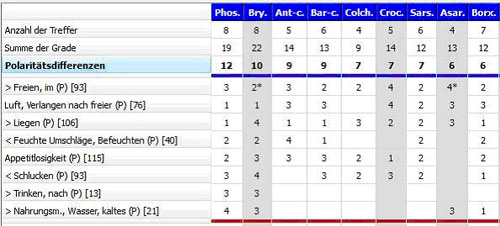
Phosphorus 200, plussing method, helps rapidly: after three hours the fever falls to 39 °C, he becomes more lively again, wants to go out and play, and drinks well. Then the appetite returns, and in the evening he is quite well, fever-free; the next day everything is OK.
We also saw two phosphorus compounds, Natrium phosphoricum and Antimonium phosphoricum, where constitutional characteristics were included in the remedy choice.
Nat-phos: A 45-year-old woman with sudden onset neck pain, pressure on the eye and nose area, sore throat, pronounced malaise, fatigue and limb aches and night sweats, increasing for three days. She had the sensation as if the eyes were being pushed forward. The polarity analysis yielded Natrium muriaticum and Phosphorus, Nat-m with a clearly leading polarity difference of 25 points.
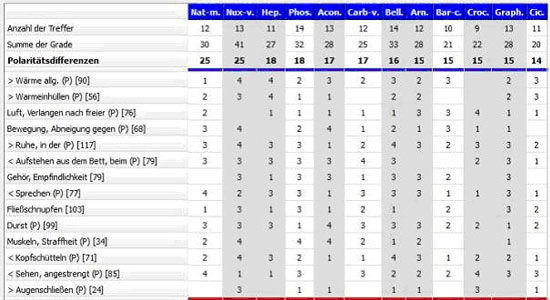
We gave Natrium phosphoricum 200 using the plussing method, because both components are clearly recognisable in her nature: she is reserved, Natrium, and yet open and friendly, Phosphorus; together they produce the very characteristic, odd mixture of two contradictory traits in the remedy. One senses the friendliness, and yet they close up when approached. The effect was prompt and pleasant: the progression of the symptoms halted immediately, then reversed on the first day, by the second day she was practically well, and from the third day everything was back to normal. This is remarkable insofar as most courses are protracted and often last for weeks.
Update 02 March 2016
After the infection rate subsided in February, there is now again a clear increase in severe influenza-like infections, partly also influenza pneumonias, very often tracheo-bronchitis with painful coughing. However, there is no uniform picture. Due to the lack of a genius epidemicus we continue to prescribe individually in each case.
We have already pointed out the increased incidence among middle-aged people. It is also of interest that the circulating influenza virus at present is of the H1N1 type, i.e. like the so-called swine flu and the historical Spanish flu.
In the polarity analysis the remedies that occur somewhat more frequently are Arsenicum album, when vomiting and diarrhoea predominate; Bryonia when patients are monosyllabic, sullen and grumpy and give little response; Causticum when hoarseness and sore throat prevail; Gelsemium when eye pain is present that radiates into the back of the head and is associated with paralysing weakness.
Update 11 February 2016
The initially homogeneous picture of influenza-like infections blurred increasingly over the last 2 weeks and the number of cases fell sharply. Thus we prescribed only according to the individual symptom picture. At present there is no talk of an influenza wave here. Occasionally, however, we did see more severe cases with pneumonia. Worth mentioning is a very good, surprisingly rapid course with Ferrum cyanatum C12.
Spiegel Online reports today of increased activity of the swine flu, whose characteristic is primarily afflicting especially robust and healthy young patients: http://www.spiegel.de/gesundheit/diagnose/influenza-schwere-grippe-trifft-vor-allem-gesunde-erwachsene-a-1076811.html.
This severe affliction particularly of robust young adults is reminiscent of the Spanish flu, where this feature stood out. It is explained by a "cytokine storm", a particularly intense immune reaction in immuno-strong healthy people with a very severe course. The picture of the Spanish flu had much similarity with the remedy picture of Acidum hydrocyanicum.
Thus Ferrum cyanatum might perhaps be a tip for severe courses, especially when cyanosis is observed. Probably other cyanates or Acidum hydrocyanicum would then also be indicated. If anyone has experience in this regard, a prompt report would be welcome.
Update 21 January 2016
The spread and intensity of acute respiratory infections in southern Baden is clearly visible on the current second January map of the RKI: https://influenza.rki.de/. The depiction corresponds to our experience in the Kandern practice, where we see a moderately increased activity. A check of Lyc as an epidemic remedy would be interesting in the areas around Berlin and Cologne, also in Saarland and the Allgäu, since there the influenza activity is still somewhat higher than with us in southern Baden.
We do not have particularly high case numbers, significantly fewer than last winter; since 7 January about 30 patients with influenza or influenza-like infections. We have given Lyc in only about 20 cases, otherwise other remedies that were better indicated. Nevertheless Lyc was helpful in around 15 patients, in only 5 cases it was ineffective or only slightly helpful.
As of 13 January 2016
by Ulrich Welte
After Christmas many patients in the southern Baden area have fallen ill with influenza again. Since the turn of the year the number in our practice has increased, though the incidence does not seem as dramatic as last year. A common symptom is the distressing night-time tickly cough.
The main remedy appears to be Lycopodium. Aralia is also effective when the cough occurs mainly on falling asleep.
The following three cases have shown us the way. However the number of patients is still relatively small: since 7 January after the holidays Lyc has been given in about 12 cases. In all those who have so far reported back it helped. We think that despite the small number it may be useful to pass on this tip early for verification.
Case 1
30 December 2015: 50-year-old female patient with distressing tickly cough, especially at night, steadily increasing since Christmas Eve. She feels shattered. Two days ago the out-of-hours medical service gave her dextromethorphan, which did not help. The condition worsened so that she went to hospital yesterday and there received oxygen and codeine, which eased the cough but not the malaise. A chest X-ray excluded pneumonia. Today she is in our practice with severe bronchitis, without sputum, suffering greatly and appearing genuinely ill.
A polarity analysis (PA) with the questionnaire "Acute respiratory diseases" (see http://www.heinerfrei.ch/ressourcen) yielded the following result:
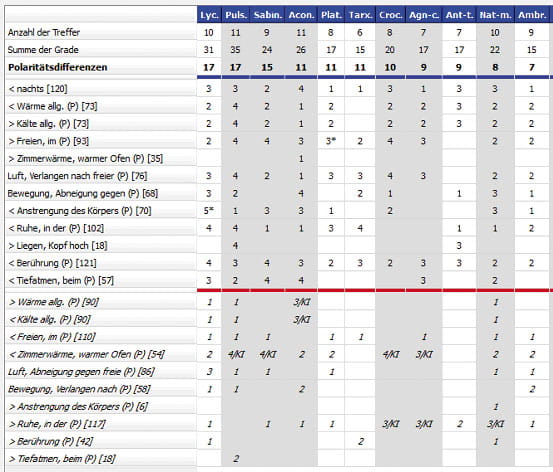
Lycopodium clearly leads in the polarity difference among remedies without contraindication with 17 points. Pulsatilla has the same score and has helped her several times before, but her very pronounced improvement from warmth is a strong contraindication (field greyed). Pulsatilla practically always worsens with warmth. Thus it is excluded in this acute illness.
She is given Lycopodium D6, 3 times daily 10 globules. The next day she calls: yesterday the cough had already decreased markedly after the first dose, much better than with the two cough suppressants, and the night was good for the first time, she could sleep through. The cough loosens, the general condition improves rapidly, and in a few days the acute illness is resolved.
12 January 2016: When the tickly cough returned slightly two days ago, she took the remedy again, which stopped the cough immediately.
Because in the first days of January Lycopodium also appeared at the top of the PA in two other flu patients with mainly night-time cough and then helped, confidence in this remedy as the most likely epidemic one grew.
We then saw the following impressive case:
Case 2
On 8 January a 35-year-old man came with influenza bronchitis. He has had a progressively worsening dry tickly cough for about three weeks, initially mainly at night. Increasing malaise. The illness began with a sensation of heat in the eyes (lyc3). Since yesterday he has had fever up to 39.6 °C. The right shoulder is painfully tense, especially in the afternoon 3–4 pm (lyc). The lungs give no indication of pneumonia, ENT unremarkable.
He is currently under rehearsal stress and the dress rehearsal of a large musical performance is imminent. That does not make things easier, since he cannot perform in this condition.
In the polarity analysis Lyc is in position 4:
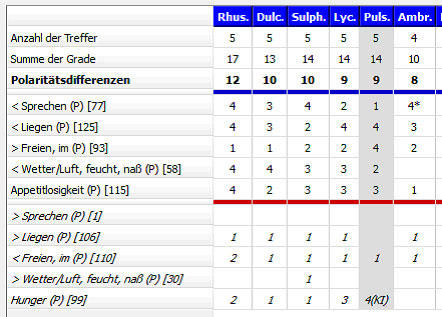
Comment on the PA: a perhaps interesting incidental finding is that Ambra again appears high up; perhaps an alternative, although it has not yet been used.
He receives Lycopodium C200, plussing method.
11 January: The tickly cough eased immediately. The dress rehearsal on 9/11 went surprisingly well. Yesterday he had some night sweats, then his fever subsided and his general condition is much better. Continued with Lyc D12 3x5 globules until everything is completely OK.
Case 3
11 January 2016: A 50-year-old man has had a severe nasal cold and tickly cough with strong gagging and urge to vomit for almost four weeks. Over the last four days the whole condition has worsened greatly. Various remedies have not helped. For the last few days he has been completely without appetite, with pronounced malaise. The lungs show no sign of pneumonia.
Since Lyc is now focused as the likely main remedy, a PA is carried out with interest to see if the remedy is recognisable here as well: it is in first place.
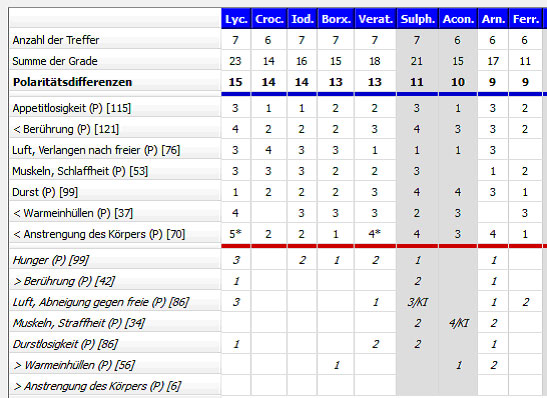
Lycopodium C200 split dose, several times daily.
12 January 2016: already after the first intake a clear general relief, reduction of the tickly cough, slept better, feels freer today, gagging and urge to vomit 70% better.
Influenza map of the Robert Koch Institute:
The RKI https://influenza.rki.de/ still shows no increased influenza activity in southern Baden in the last week of December 2015. Only in Franconia is the incidence clearly visible. In the update of the epidemic map at the beginning of January one can see the decline in Franconia and the beginning in southern Baden.
********************************
Photo: Shutterstock.com
Fever Flu © Organic Matter

