Everything starts all over again, the old becomes new: pandemics and the panic that accompanies them.
Our civilisation has existed for a very, very long time. By comparison, we have only just arrived on the scene like adolescents. That is one reason this first pandemic in many generations feels somehow completely unexpected.
Yet while the comprehensive global response to COVID-19 is virtually unprecedented, this is by no means the first pandemic on our planet.
Over the past 200 years homeopathy has recorded major successes during epidemics and pandemics. I wrote about this in my illustrated book Paradigm Homeopathy – a short history.
And because we are all experiencing a pandemic together right now, I would like to share an excerpt from my book here:
“The power of homeopathy is not limited to headaches, colds and fever. Homeopathy can do more. It is capable of combating even the most deadly diseases and has been so successful that that success is of historical significance.
But we also know that prejudice, misinterpretation and inaccurate portrayals can distort history. To our detriment, the contributions that homeopathy has made to the treatment of epidemic diseases have largely been ignored.
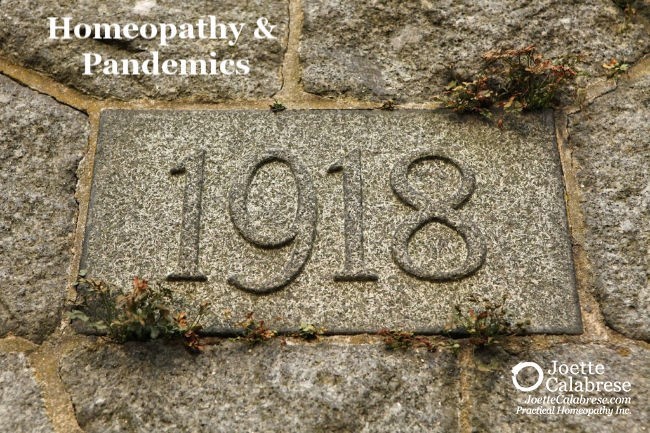
From the terrible devastation of the influenza pandemic that struck America in 1918, homeopathy emerged as a sustaining and effective force.
And that is saying a lot, when you consider that this pandemic – also known as the Spanish flu – claimed 50 million lives worldwide. That is 34 million more than in the First World War.
This influenza could become fatal within a few hours or days. Most often the sufferers died a terrifying death by suffocation because they had fluid in their lungs. Young adults in particular were struck with enormous force. But homeopathy literally came to the rescue when it was applied.
Please consider the following: a man from Philadelphia named Dean W. A. Pearson collected information about influenza cases treated by homeopathic physicians. The mortality rate among the 26,795 homeopathic cases was only 1.05% compared with an average of 30% among conventional patients!
One of those humble practitioners, a Dr T. A. McCann from Ohio, wrote: “I treated 1,000 influenza cases. The cases are well documented. I did not lose a single patient. The recognition belongs to homeopathy and not to the Scotch-Irish Americans!”
Also in Rhode Island, a Dr Dudley Williams reported that he had not lost a single patient to influenza – not one! His mortality rate for pneumonia was 2.1%. That is remarkable given that the allopathic doctors – who mostly treated with aspirin and quinine – lost 60% of their pneumonia patients.
Another physician, this time from Chicago, Illinois, reported that in a factory with 8,000 workers only one man died. The homeopathic remedy Gelsemium was used there virtually as the sole remedy. Neither aspirin, vaccinations nor other medicines were administered.[1]
 Those are powerful stories and strong data.
Indeed, it would be lazy to explain these successes away by the placebo effect. Thousands upon thousands perished in this global epidemic, yet the thousands of people treated homeopathically stand out like powerful witnesses. Looking at the success rate of homeopathic treatment during the Spanish flu, it is very regrettable that the incredible healing power of this gentle method was not employed more widely. Perhaps many millions of people would not have had to die.
Almost a century earlier another epidemic had swept the world – Asiatic cholera. In the early 19th century the wave reached the USA, where homeopathy proved itself a worthy opponent to this terrible disease.
In 1840 the German homeopath Dr Joseph Hypolyte Pulte was received in Cincinnati, Ohio, in a most unpleasant manner upon his arrival. He was almost driven out by the local community, the residents besieged his house and covered him with ridicule and scorn, so that he wanted to leave the place immediately. Only for the sake of his wife and children did he remain where he was.
Thank God Joseph Pulte persevered and was still in Cincinnati when the cholera epidemic broke out. He was ready and able to save every one of his patients. It goes without saying that the entire community was very grateful to him and from then on gave him the respect he deserved.
In 1832 cholera claimed 3,000 lives in New York City. The homeopath William Channing treated his patients so successfully with Veratrum, Camphora and Cuprum that his cures were even acknowledged by the allopathic doctors and the city of New York. Also in New York, in 1832 the homeopathic physician Isaac Moreau Ward compared the success of homeopathic treatment with that of conventional therapy. He was able to confirm that the homeopathic treatment was without doubt superior to the allopathic one.[2]
The successes of the homeopathic treatment protocols of John Franklin Gray likewise attracted the attention of the allopathic doctors in New York City. Although the homeopath did not have access to public hospitals, he was able to cure many patients. For that he was respected by the medical profession, which reported extensively on him.[3]”
These are just a few examples of how powerful homeopathy is. At the same time it heals with very gentle force – or “mild power”, as the famous homeopath and father of American homeopathy Dr Constantine Hering called it. It possesses the ability to restore human health even in patients who are seriously ill, as is the case in a pandemic.
Homeopathy works, and very powerfully. It leaves no “numbing” traces that are often found in patients teetering between life and death who have been treated with medicines.
It is a pity that these extraordinary contributions to global health and medicine in general receive so little of the recognition they deserve.
It is up to us to learn how homeopathy works. Spread the word – it’s worth it!
Warmly,
Your Joette
P.S. In these turbulent times it is particularly important to stick together and learn together. Whether you are a homeopathy beginner or an old hand with globules: learning in a group is easier and thanks to Zoom or Skype very simple.
Let’s do it together – all over the world from mother to mother and family to family.
------------------------------------------------------------------------------------------------------------------------------------
Source: https://joettecalabrese.com/blog/homeopathy-and-pandemics/
Photo: Shutterstock_1673625835, Copyright: Chamille White
------------------------------------------------------------------------------------------------------------------------------------

[1] Julian Winston, The Faces of Homeopathy: An Illustrated History of the First 200 Years (New Zealand: Great Auk Publishing, 1999), 236–237.
[2] Winston, The Faces of Homeopathy, 40.
[3] http://sueyounghistories.com/archives/2009/11/09/a-homeopathic-history-of-cholera/; 5.18.2011