
A case study by Sally Williams
- June 2004, the patient, K.C., is a 44-year-old male.
- K.C. is brought by his sister for an initial assessment. He has an unpleasant body odour and smells of alcohol. His clothes are somewhat battered but clean. I have the impression that he had spent the night at his sister's, who had quickly washed his clothes. On the stairs to my consulting room K.C. stumbles very often. His sister confirms that this is typical for him; it is "as if he were drunk". K.C. shows symptoms of alcohol withdrawal or alcoholic delirium; he trembles and has drooling.
K.C.: "So, my problems are anxiety and panic with depression and paranoia."
His sister adds by way of explanation: "He is very withdrawn and has been homeless for years. We are very close, but he refuses to accept my help. We had a terrible childhood. Our parents were alcoholics and very violent. Our mother tried to kill herself when I was 10 and my brother 9. The youth welfare authorities removed us from our mother. We were placed with our grandmother, which was awful too. She cared for us even less than our parents. For a long time we had no contact with our mother."
K.C.: "Many of my problems have to do with alcohol. I had girlfriends and all sorts of things. I sabotaged every relationship. The girls I was with were not good for me. They cheated on me; I stayed in a relationship as long as possible until I couldn't anymore. Teresa, my last girlfriend, simply took our son when he was 6. She left me. I was devastated. She was my best friend and he was my son. I crawled into a hole and never came out. There was no joy anymore, nothing mattered; I couldn't think, couldn't hear, couldn't see…"
His sister: "He just hung around, stopped paying the rent and stopped looking after himself. He will look at you, but he's not really there. Eventually he ended up on the street with no roof over his head."
K.C.: "I couldn't work anymore. I would look for work again and again, but then simply not turn up. I get nervous when I'm with other people."
"Let's say I'm in the supermarket. I then tell myself – we must get out of here. I always find a place where I feel safe, for example the library. It's quiet there and people leave you alone. I like to read, preferably science fiction."
"When I'm walking along the street and two people come towards me, I have to cross to the other side. It's not that I think they want to hurt me, but because I can't bear the chatter, the staring or the touch."
"In my life I've reached a low point. I'm no longer productive, I can't get anything done."
"Being homeless is very convenient. Nobody expects anything of you. The only thing that can still happen is to die. You're not afraid, others are in the same situation. No responsibility, there's nothing I have to do."
Recurring dream: "I dribble a ball in front of me and the ball rolls onto the road. I go onto the road, lean over the ball to pick it up and when I come back up a lorry is right in front of me; it runs me over and I didn't hear it coming!!"
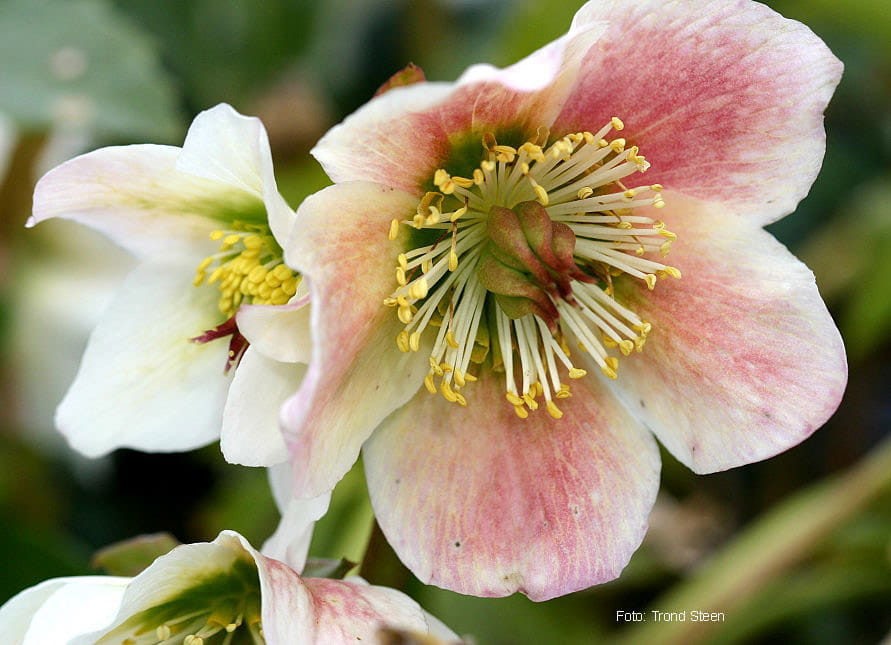
Remedy: Helleborus niger C200; two doses six hours apart.
Follow-up on 14 July 2004
K.C. returns accompanied by his sister.
K.C.: "I'm doing great. At first nothing happened for two weeks and then it began to take effect. I didn't tremble so much and I could walk better. Bit by bit I got better. My eyes became much clearer. My skin also looks much better, it has a different colour. Right after our first appointment I stopped drinking vodka. And I also stopped the psychotropic medication."
"I no longer had panic attacks and no longer had great anxieties. I haven't felt like that for a long time. Even if someone passes me in the street, I have no problems, no fears. It's completely normal, I feel capable of coping with everything again. I still drink beer, a six-pack a day. Two weeks ago I was still drinking two six-packs daily."
"Nothing new has come up. I dream about work. In my dreams it's about communication with others. I haven't worked for five years."
K.C.'s sister: "He doesn't smell as bad as before. It's a huge difference. Last time we were here he had dandruff, even on his face, it was awful. That's all gone now. He has changed a lot. He no longer shuffles when he walks. Before it took him a very long time to get from the front door into the house. When he comes to visit now, he can knock firmly and loudly on the door. He has become much more communicative; even since last week I can notice a marked difference. My children have also noticed that he is completely different now."
K.C.: "I don't think so much about the future anymore, I take each day as it comes. I go with the flow and enjoy feeling normal. I can see with my eyes and hear with my ears."
Plan: wait and see, no remedy given.
Follow-up on 4 October 2004
On this day K.C. comes without his sister.
K.C.: "I'm doing really well. I'm currently looking for an apartment in Allentown and doing a computer course at the Buffalo Training Centre. In January I'll do a web design course. I want to set up a company with my sister. An internet shop, I'll design the homepage."
"I feel well. When I go out on the street I'm no longer afraid of people, it doesn't bother me anymore. I only had to take the remedy once more and that was it."
"I still drink beer, but much less than before. I sit in front of the TV a lot, but I also have to prepare much for school and work. I now have a tomcat I have to look after. I've called him 'Effer'. I sleep much better now, eight hours a day; before it was rather sporadic. I now get up in good time when I have an appointment. Before I didn't care."
"I still don't like to phone. I don't like having just a voice on the line. I prefer to meet people in person."
"I haven't been to the library for a long time. In the supermarket it's okay, I haven't had anxiety there for a long time."
"I can make much better use of my time. I go for long walks. I eat better. My skin is no longer so dry and scaly. I can't even remember what it was like before. Everything has changed, I'm part of this world again. There's nothing that bothers me. I'm looking forward to my own little flat and my course."
For about a year K.C. and I had regular contact and spoke on the phone every two months. He continued to take the remedy in occasional doses and benefited each time. On the phone he told me that he had indeed found an apartment in Allentown and had returned to school.
Follow-up on 11 November 2006
I phoned K.C. to obtain his permission to publish this article. He still lives in his flat in Allentown, is doing a computer course and works part-time in a supermarket. He shelves goods there. He has met a very "special woman" and in his own words feels "blessed".
K.C.: "I'm not the same man who came to your practice two years ago. I can hardly remember how I was back then. I'm sorry I didn't get in touch for so long. But to be honest, I have completely forgotten all of that. It's as if it never happened."
 Analysis:
At first glance I had a feeling for this man. He was down-to-earth, but somehow not fully present. He looked through me as if I did not exist. He was distracted and had an empty facial expression. I immediately thought of Helleborus.
K.C. had had a hard life. He was neglected by his parents and had to live with his grandmother, who did not care for him. He was also abandoned by his partner and his son, a shock and a strong indication pointing to the Ranunculaceae family. Helleborus is in Stage 14. Jan Scholten writes that "the Ranunculaceae are very childlike. Childlike in a harsh, rough world; they need protection and support. They are very similar to the carbon series. The theme of shock runs through the whole family. In Helleborus there is a wall between them and the outside world."
Stage 14:
Empty, weak, excrete, distract, push aside, irresponsible, indifferent, distant, hide, mask, disengage, distract, ostracise, discarded, disposed of, exhausted, detached, apathetic, coward, mummy and fossil.
The Ranunculaceae according to Louis Klein:
This botanical family is indicated for children who live in a very lively, chaotic family. The parents like to party and live their sexuality openly. The children suffer because of this.
People whose parents were imprisoned or aggressive.
Alcoholism.
Shock.
Hysteria (Aconite).
Dazedness (Bufo, Hell).
Grief over lost innocence. As children they put themselves in situations or a sequence of events that lead to the loss of their innocence.
And Helleborus:
Responses are slow; someone who has experienced a severe shock; they have eyes but cannot really see; have ears but cannot hear; have feelings but cannot feel: everything is there, but they cannot comprehend it with the mind. Therefore they are dazed, blunted – "I don't feel connected to my life, what happened to me?"
This dazedness, this inability to understand can trigger great anxieties. In advanced stages they also leave these anxieties behind and then are in a state reminiscent of Alzheimer's disease.
Complaints due to disappointed love; people who suffer severe depression, but when you speak with them you notice that they simply do not understand much. They do not understand what is happening around them.
Memory disturbances or loss. Sit deeply sunk in thought, perceive nothing; stare into space, thoughtless; feeling of helplessness; slow; lose their intellectual abilities.
Helleborus also exists as Helleborus Double and Helleborus foetidus
Sally Williams RSHom (NA), CCH
------------------------------------------------------------------------------------------------------------------------------
Source: http://www.interhomeopathy.org/homelessness_and_helleborus
Photo: Shutterstock_1572237271, Copyright: nnattalli

