|
|
|||
|
|||
A fourteen-year-old boy complains of coughing and tiredness. He grew considerably over the past year and has gained height and weight. He is now 1.80 m tall and strongly built. For several weeks he has been coughing and it is getting worse. The cough comes in fits, during which he almost gags. The GP prescribed Ventolin and Flixotide, which helped. Two years ago he had whooping cough and was constantly tired. He just sat listlessly on the sofa. Since childhood he has had breathing problems, particularly a blocked nose. When he has a fever he gets nosebleeds. Case presentation During the consultation he does not contribute much to the conversation but lets his mother speak, while he merely sits and listens in a neutral, though not unfriendly, manner. His mother says: “He is always lying on the sofa, curls up in an embryo position or props his head in his hands. He drags himself up the stairs; everything is ‘too much’ for him.” Although he is so unwell and tired, he wants to go to school and says, “I want to sit this exam.” He forces himself to do everything, but once the most urgent tasks are done, he collapses. At home he just lolls about. He likes playing rugby and wants to be a good player. He continues to attend school, even though he hangs about on the sofa like a sack of potatoes before he leaves in the morning, but he never complains. He always wants to go, not just out of routine but of his own accord, and he does not want it to come to the point where he has to be urged. He even goes to school when acutely unwell: “I go and if I’m not well, I still won’t go home. If I’m already at school, I don’t want to leave early.”
|
|||
|
Everything he does is accompanied by deep sighs: “I don’t feel well.” He feels worse in the mornings and gets out of bed so awkwardly as if he were made of wood. Once he has moved a little, his concentration wanes and he becomes distracted. He has to start over again and again. His mother describes him: “His head is so heavy. He is always having to prop his head up, wherever he is. Sometimes he has headaches that feel like pins prickling his skull, and then he feels dizzy.” |
||
He is a quiet, attentive and self-sufficient boy. He seeks simple solutions, is very direct, and uses few adjectives in speech; his language is plain. At home his resignation is noticeable: “It’s too exhausting to play around or to resist. None of this pleases me, but I do what must be done.” He avoids confrontations with his parents; you can see that he looks for alternative solutions; but most of the time he does what he should because resisting would take far too much energy. He is very social, trusts other people and has the gift of mediating between people. Sometimes he can become quite angry without knowing exactly why. Analysis
His heavy head, described in the literature under “head, desire to lean on something,” is typical for the remedy Gymnocladus. Nosebleeds with fever are known from Melilotus, which, like Indigo, is also known for spasmodic cough. A tired head, nosebleeds and an uncomplicated manner could also fit Belladonna, but there are no other features to suggest a remedy from the Solanaceae family. The mental tiredness is listed under “mental work impossible,” where the remedies Copaiva, Indigo, Gymnocladus and Melilotus are named. T. Allen listed the desire to lean on something under Generalities for Gymnocladus. There is a typical flip in his behaviour. He starts something that needs to be done or that he enjoys and then is suddenly completely done in. He tries to achieve something but at the same time does not want to be troubled. He knows what he wants but then cannot manage it or prefers to put it off. These behavioural patterns are familiar to me from previous fatigue cases that responded well to Gymnocladus. Prescription: Gymnocladus canadensis 200K, single dose Follow-ups His energy increases, as do his abilities in sport and in studies. His cough disappears, although he still takes Ventolin before rugby matches. Three months later he has a relapse. His concentration deteriorates again, he is irritable and fails to get going. During school exams he has stomach pains and wonders, “How am I supposed to manage this?” His parents, who are fairly dominant, become annoyed when he does not perform at his best at school, yet he puts all his effort into sport. Here at least he can achieve something they could not, if he exerts himself and works hard (duty versus pleasure, a Fabaceae theme). He avoids people who submit to rules and regulations. He eats huge quantities of sandwiches. A repetition of the remedy almost immediately raises his energy level. It seems that being under external pressure – parents, school, work or social environment – and having to achieve more than one believes oneself capable of can be a Fabaceae indication. Two years later, after a concussion in a sports accident, he has another relapse. He becomes emotionally completely unbalanced and is unsettled by his weak school performance. He can concentrate for only a limited time; then his concentration drops markedly, as in his childhood. He is physically very restless and paces the room; he also stammers slightly (stage 5). Pleasant and enjoyable things seem absent from his life, but his “duties” – school and work – remain. The situation is typical for this life stage, but he experiences it as “my life is no fun; this is not what I imagined” (Fabaceae). This attitude brings further complaints. After a repeat dose of the remedy calm returns. Again, a year later a serious injury ends his sporting career. He develops eye problems (accommodation) that can be corrected with Manganum phosphoricum. Manganese is an important component of many plants of the Fabales order and is an important differential diagnostic criterion for the whole group. |
|||
| ************************************************************************** | |||
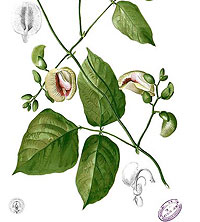
Photo: www.wikimediacommons.org |
|||
| ************************************************************************** | |||
| Category: Cases Keywords: Fatigue, cough, nosebleeds, concentration difficulties Remedy: Gymnocladus canadensis |
|||