“Pull yourself together! You are too thin-skinned!”
Does that sound familiar? Well, perhaps we can try to make our “psychological” skin more resilient by looking inward and getting to know ourselves better. But what can we do if our physical skin has become too thin?
Sensitive skin in later life
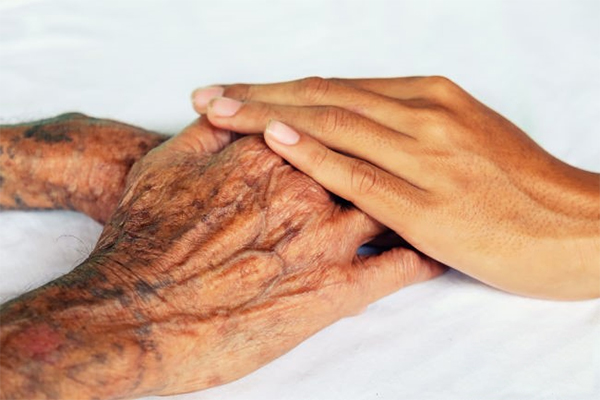
As we age, the skin becomes thinner and less elastic because the body loses more collagen and hyaluronic acid. This makes the largest organ – the skin – more susceptible to tears, ecchymoses, pressure ulcers, dissection (haematoma in the vessel wall, ed.), and poor wound healing. In short, our skin loses the ability to withstand mechanical injury.
The medical community only recently gave this natural process its own name – dermatoporosis. (I would say that is quite a distinguished word. Really worth its weight in gold!)
And what does that mean? The term “osteoporosis” was borrowed, which is known to describe a weakening of the bones. In dermatoporosis the term is applied to the skin: “dermato-” (skin) combined with “-porosis” (porous), so a weakened skin.
The term was introduced in 2007 and until then this type of skin degeneration was regarded as merely a cosmetic problem and was often ignored. However, it is now widely recognised that thin and weakened skin can, over time, lead to problems that require treatment.
And although conventional physicians readily admit that frequent use of corticosteroids can accelerate dermatoporosis, they are already poised to offer even more synthetic treatments! But nobody knows what diseases these new drugs might ultimately cause!
(Here you will find an interesting and informative article on the subject in the original English: Chronic Skin Fragility of Aging).
Gentle healing with Silicea
But WE have homeopathy!
If the pathology is due to the natural processes of skin ageing, a homeopath can use the Schuessler salt Silicea D3 or D6, taken twice daily. Further information on dosage and potency can be found here. Why? Silicea is a specific remedy for the skin – for skin that is thin and fragile and does not heal quickly enough.
As J. B. Chapman and Edward L. Perry write in their book “The Biochemical Handbook: How to Get Well and Keep Fit with Biochemic Tissue Salts”, “… Silicea restores the active function of the skin … often it can set the wound-healing process in motion.”
That sounds exactly like what is needed when ageing skin becomes porous. But ageing skin does not require the treatment options highlighted in the PubMed article: synthetic, topically applied creams such as retinoids, alpha-hydroxy acids (AHAs) or hormone replacement therapy with oestrogens.
No!
A healthy diet helps
Instead, we prefer treatments that act naturally and gently. Fortunately, the article also mentions that a healthy diet with plenty of animal protein is helpful. (This point goes to Weston A. Price, https://www.westonaprice.org/!)
Had the researchers consulted a homeopathic repertory for this complaint, they would have found that thin and porous skin responds very well to the very simple treatment with Silicea D3 or D6 when taken twice daily over an extended period.
There are still concerned people who are hesitant to use Silicea because Silicea can expel foreign bodies from the skin. These concerns are completely unfounded in this case.
Stay tuned, because homeopathy helps – spread the word!
Sincerely,
Yours
.png)