
Conium maculatum: |
|
"Madam, we must regard your child as blind; it is time to enrol her in a special school." It is February 2002 and A.'s mother is listening to Dr C., an ophthalmologist who is diagnosing her child's condition. At six years old she came to my practice as a completely withdrawn little girl. She constantly covers her eyes with both hands. She feels a burning sensation, her eyes are bloodshot, especially on the left, and they discharge pus in the mornings. As regards diagnosis, after a complete check-up by our excellent Parisian colleagues several hypotheses were considered. Fundoscopy showed atrophy of the retinal pigment epithelium, particularly on the left. An early Usher syndrome was considered (a genetic disorder that would also explain the hearing loss), but psychological trauma was not excluded, although there are currently no psychotherapeutic indications. The child's psychological trauma was triggered by the following incident: on a sunny day when A. was 18 months old there was a violent argument between her parents. They were walking on a snow-covered field and A. was being carried by her mother. The child had earlier urinated on a chair in the living room of their holiday flat at a ski resort, and the father accused his wife of neglecting the child's toilet training, while the mother argued that it was still too early. The argument escalated and ended with the father striking his wife violently. They then separated and A. saw her father only rarely. A. was the couple's only child and the father now has a new partner. Faced with such a difficult case, I consulted the rubric "Photophobia" in the "Eye" section of Kent's Repertory: the main rubric lists 192 remedies, and none of the suggested sub-rubrics aroused my closer interest. When I realised that I would not find a solution that way, I first examined the hypothesis that the photophobia, given its great intensity and the risk of blindness, might in some circumstances be psychosomatically induced: the child flees from the light. As is sometimes the case, in Kent's Repertory under MIND there is a rubric "Photophobia" containing seven remedies, of which only one is three-valued: Conium maculatum. Consequently I prescribed Conium maculatum in ascending potencies; C15, C18, C24, and finally C30, one dose every two weeks. This followed a purge treatment with potencies of the vaccines she had received, which might form an energetic barrier to healing (especially the hepatitis B vaccine, whose side effects have been mentioned several times at ophthalmology conferences). Follow-up: A. returned three months later and was markedly improved. We could finally see her beautiful eyes, for she no longer hid them. Her behaviour had improved. Remarkably, the hearing loss had fallen to 30% without a hearing aid, and with a hearing aid she now hears normally! We continued treatment with Conium maculatum C200, single dose. After another month 1M (1); a month later 10M, each as a single dose. Two months later she presented with persistent sore throats. Her father has a new partner and does not want to sleep in the same room as her when she visits. Lachesis C15 as a single dose was prescribed; Lachesis is the principal remedy in the Oedipus complex and its characteristic jealousy. Comment: |
|
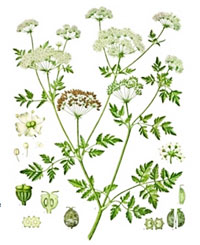 |
Conium maculatum (hemlock) is a plant whose properties have been well known since antiquity, and which played a significant role in Socrates' death. It causes a gradually ascending paralysis, so that the condemned man can still speak until the end. Socrates' last words were: "Crito, we owe Asclepius a cock. Will you remember to pay the debt?" (Asclepius is the Greek god of medicine). |
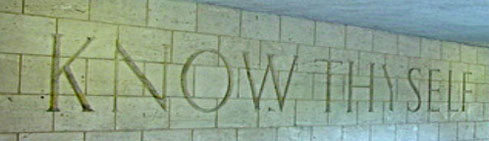
| Hahnemann, the founder of homeopathy, is in English 'man-rooster' ('rooster' meaning 'Hahn' in German). The cock stands for the double symbolism of man: womaniser, victim of his sexual impulses, and prophet. The cock also signals the beginning of the day, the dawn. Here he has sublimated his sexual drives and concentrated all his energy on the upper half of the body in order to gain access to knowledge and understanding. Hence the message Socrates teaches us: "Know thyself!" |
|
 |
|
In our case A. shuts herself off from the means that allow access to knowledge: first through her deafness, secondly through her blindness. This tragedy develops at eighteen months, an important phase in psychological development, when the influence of the father must enable the child to leave the oral phase and the symbiotic relationship with the mother; the father is the representative of society. Dr C.'s suggestion to place the girl in a boarding school and thereby separate her from her mother is the trigger that prompted them to seek homeopathic treatment. Conium maculatum enables, in its capacity as a homeopathic remedy for humanity, a rediscovery of the path to knowledge by moving energies from the lower to the higher chakras (as the Tibetans call them). |
|
| ************************************************************************* | |
| (1) C 1000 Korsakoff | |
| ************************************************************************* | |
References GRANDGEORGE, D., L'esprit du Remède homéopathique, Edicomm Ed., Juan-les-Pins, 2003. KENT, J.T., Repertorium der homöopathischen Materia medica, Sett Dey Ed. Calcutta, 1974. Plato, Phaedo, 118a |
|
| ************************************************************************* | |
Category: Cases |
|

