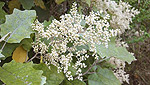
Brachyglottis repens in children - six cases resolved using the colour-preference method |
|
|
|
Short description: The situation of Brachyglottis: it operates under very difficult conditions, associated with problems with a strong male figure. They feel that the father places enormous demands on them. When they manage something themselves, they somehow hold their own; they are not easily discouraged. |
|
But when they are put down (sometimes even by small things) they are devastated, whine and cry pitifully. Only then does their sensitivity and vulnerability become apparent. There is always a dominant father figure in the background, a looming, large, powerful man with typically masculine qualities. There are similarities with Eupatorium (eu pater = good father), which wishes for a benevolent, strong father but also has that "broken, annihilated" type, as with Eupatorium perfoliatum, one of the main remedies used in the Spanish flu, which was accompanied by feelings of being crushed and destroyed. Clinical features: septic wounds that only heal slowly, frequent purulent infections with high fever and feelings of being crushed or annihilated; weak and numb limbs as if the vital force withdraws from the hands; cramps in the fingers; writer's cramp; cramp-like constipation, cystitis, nephritis, glomerulonephritis with excessive albuminuria; fluttering in the stomach. Colour preference: 23C, a yellowish-green like soft young leaves in spring. This colour was confirmed in 6 of our 7 cases. Brachyglottis repens, Brachyglottis repanda, Puka-Puka, Bushman's Friend. A member of the Asteraceae (Compositae) family, native to New Zealand. It is also called "bushman's toilet paper" (the underside of the leaves is soft and white). Formerly placed among the Senecioneae, it has now been regrouped with the Eupatoriae, the Eupatorium-like group, which is also supported by its homeopathic profile. The Maori, a warrior people with typically masculine behavioural traits, used it extensively for septic wounds and stubbornly suppurating wounds as well as for bad breath. It helped the British colonials with nephrotic syndrome (Bright's disease) and neuralgic rheumatism (1). Brachyglottis: summary by Jan Scholten Characteristics of the Compositae, plus: Case 1: My father is a strong tower, but he has been destroyed. A 9-year-old boy is frequently ill with high fevers up to 42 °C, which usually begin late afternoon between 15:00 and 17:00 and are accompanied by cervical stiffness. This illness has appeared for more than 4 years at regular intervals every 4–6 weeks. When he was 4 years old he had a purulent oozing wound on the head that would not heal for more than a year. This process was suppressed and after that the fever began. He received massive amounts of antibiotics. Recently several milk teeth were extracted because of suppuration. Then the left side of his face swelled and his hands became numb. Three months earlier he had infectious mononucleosis with enlarged occipital lymph nodes (Mercurius had helped). He has sad eyes, as if he had experienced many terrible things and had no good prospects. He appears gentle, but with a defiant chin which he thrusts resolutely forward, as if he is not easily upset. One or two days before the fever his mood tends to change. He becomes tearful, demanding and provocative towards his mother, insults her vulgarly and grins mischievously while saying nasty words to her. At the same time he seeks refuge with her and clings to her. When she says that he is again in this difficult and tearful phase and that she expects the fever in the evening or at the latest by the following evening, he immediately protests: "I'm not a toddler, I'm not naughty." His mother had a very difficult time during the pregnancy with him: her husband, a forester, was hit and badly injured by a falling tree and she feared he would die. There were also merciless fights in the family over inheritance. She did not know how to cope with all these difficulties and felt completely suspended in mid-air. Somehow she got through it, but it stretched her to the limit. The boy has repeated dreams of a tall, swaying church tower and stands beneath it. He is afraid it will fall on him and crush him and he runs for his life. He is interested in agriculture and has his own garden which he tends very nicely. His preferred colour is 23C. Analysis and follow-up In frequent infections with high fevers up to 42 °C, a plant from the Compositae family is indicated. The only Compositae that prefers the colour 23C is Brachyglottis (discovered by H.V. Müller (2)). Confirmation: aggravation at 17:00 is Brachyglottis. Brachyglottis has many symptoms accompanied by weakness, cramps in the hands and cervical stiffness, which are mentioned as accompaniments of his recurrent fever. The theme of Brachyglottis is: almost breaking down under a heavy burden beyond one's strength. This was the mother's feeling during pregnancy and it is also the theme of his recurring dream. So he is given Brachyglottis 1M (4), one dose every 4 weeks. The expected fever did not occur, nor the usual cervical stiffness or numbness in the hands. His behaviour normalised the same day and the swelling in his face subsided. On the first night he talks in his sleep (this is new for him and thus a symptom of the remedy, as mentioned by Knerr). In the following week he is, according to his mother, rather reasonable and pleasant to deal with. He is in much better condition, both mentally and physically. The day after the third repetition he becomes really wild and argues with his father, which he has never done before because he loves and admires him and always follows him. Then he cries and gets a headache. The day after this incident he changes and becomes more self-confident. He also no longer clings so much to his mother. This happens 3 months after the start of treatment. His mother says he is less stubborn and more open. The fever is gone and he does well for 2 years. During this time he paints a picture of himself: he stands smiling in a flowery meadow, arms wide open and the rising sun shining behind him. Case 2: My father is a big, strong policeman, but I'm scared of the dentist! The mother says she does not allow a doctor to examine her and if someone approaches her she resists violently with hands and feet. This is a problem for the parents. The dentist is at a loss and has given up treatment attempts with her. Her only physical problem is stubborn constipation that began a few months ago in connection with toilet training. This was the first time she refused physical influence. From then on she would not let anyone touch her, especially when others wanted something from her. After this short case history I asked her about colours. She picked 24C without hesitation and nothing else. Analysis and follow-up Her main problem is rejection of any physical or mental intrusion, especially by doctors. This points to Compositae or lanthanides. Her face is round with rosy apple cheeks and resembles more a Carbon type or a hobbit; it is not the ascetic, finely formed, intellectual, long face of a lanthanide. So a remedy from the Compositae (Asteraceae) family is the first choice. The only Asteraceae with 23C is Brachyglottis. She is given Brachyglottis 1M (4), a single dose. After a few days her father had to leave on a short trip. She was very sad, cried and whimpered, which was very unusual for her. She clung to him and would not let him go. Then she refused any contact for a few days, withdrew and sulked. The mother wanted further medicines for her. She was given Brachyglottis D6, 5 drops daily, for one week. After a week she suddenly changed her behaviour and joined a children's sports club on her own initiative, which she had previously flatly refused. She was surprisingly sociable and as easy as never before. This visible change was immediately noticed in the nursery. The carer was astonished. During a fire brigade drill the little girl insisted on doing everything herself: "I can do it now on my own!" When the fire brigade arrived she did everything very successfully and without any help. Earlier this would have been a typical situation in which she would have clung helplessly to the carer and sought refuge on their lap. Now the mother again takes her to the dentist, this time successfully. She had not even taken the remedy for 5 months and she is well. I test the colour preference again: still 24C. Case 3: I will never reach the outstanding level of my father or my successful brothers - the demands are too high. An 8-year-old boy is brought by his father because of learning difficulties and frequent infections of the ears, throat and nose. He has a full rosy face, looks well though a little dull, a bit like Sam Gamgee; he tries to appear cheerful and carefree. A conversation with him is difficult because he quickly drifts off topic and talks about other things, which is interpreted as ADD (attention deficit disorder). The case history is also partly complicated by his strong father, who is a dominating figure but tries to be understanding and attentive to his son. Unfortunately he is so clever and educated that his intellectual approach clashes with a simple emotional contact; a real understanding of his child on a direct level is apparently very difficult for him. He seems partly aware of this but cannot overcome it, however hard he tries. The boy senses this and respects him. But I wonder how he can reach his father's heart except through school success… Analysis and follow-up An Asteraceae does not initially penetrate deeply into the emotional area, therefore, given the emotionally disturbed situation with his father (3), the learning difficulties, and because he has few friends and contacts (phos) Zincum phosphoricum C 200. Case 4: Daddy's favourite has constipation. A 3-year-old girl has suffered from severe constipation for two years. Only with laxatives does she produce a hard, lumpy stool every 3–4 days. Twelve hours before the stool she becomes tearful and whiny until the lumps come out. She is rarely ill, but when she is ill she has high fever above 39 °C. She enters the room slowly and only after having decided to do so, hesitates to sit down, then pulls herself together and starts the conversation herself. The mother says she is stubborn and wants to be able to do everything by herself. If one tries to stop her from doing something she reacts irritated. Analysis and follow-up Her behaviour is typical for an Asteraceae, as we can see from comparison with other cases. The high fever confirms it. Her preferred colour also points to Brachyglottis, because the frequency and wavelength of this colour touch her basic emotional vibration, and therefore she likes it. Yes, it's really that simple: if you use this method confidently you only need a few further confirmations. Brachyglottis is a crampy remedy and her constipation is a kind of cramp. In the entire repertory you will find under "stool, knotty" Brachyglottis (4), as well as under constipation (4). If, of course, you first look for constipation remedies with hard lumps you will never come to this remedy and will instead give Alumina or Magnesium muriaticum or Silicea. But let us see what happens with this "small" remedy. She is given Brachyglottis C 1000, a single dose. That same evening she has two normal stools. From then on she has normal daily stools without pain or whining and no longer needs laxatives. She goes to the toilet by herself and weans herself from nappies on her own initiative. Two months later she has changed markedly, as the mother reports: "She used to be a total daddy's girl; now she is sometimes cheeky with him and also comes to me voluntarily." The dominant role of the father had never been mentioned before. Case 5: The value of the favourite colour in acute cases. Scarlet fever with high fever. A 6-year-old boy who had frequent middle ear infections in recent winters now presents with acute scarlet fever; he has the typical confluent red rash on the chest and markedly enlarged, inflamed and suppurating tonsils, worse on the right side, with pain in the right ear and a temperature of 39.6 °C. He is very quiet and does not speak. He is always quiet and cautious, but now even more so. A very thoughtful boy with deep, dark eyes. His preferred colour is 23C. Analysis and follow-up In frequent ear infections in winter with high fever a remedy from the Compositae family is indicated; 23C is Brachyglottis. There had previously been no proper case history, the mother had always only quickly brought him in for minor complaints. Now he is given Brachyglottis 1M (4) hourly, triturated in water. The next day the fever is gone, the rash has spread everywhere but begins to desquamate and is less red, his throat is better, he speaks again and overall is much better. The next day he seems like a different person; he is open and full of vigour. The skin peels. The tonsils are normal, the ear is pain-free. A very rapid recovery! Case 6: I hate it when my mother shouts at me, and I have to cry. Analysis and follow-up In his case I recognised Brachyglottis from my experience with other cases, as well as from his behaviour and his reaction of crying bitterly when put down (scolded). His colour preference confirms it. Suppurating ulcers and festering wounds are the indications for which the Maori used Brachyglottis. In his case the dominating figure is the mother; she plays the male role. This is also my impression of her, a masculine type, determined and uncompromising, and the boy strives to meet her demands. |
|
 |
See the Compositae characteristics! Defensive, fear of injury, defiant. Also the specific appearance of Brachyglottis: chin defiantly thrust forward and upward, but with anxious eyes and a stressed appearance; with cramped hands he clings to his weapon, yet stands bravely on the ground; sweating attacks and fear of being put down by a stronger person. |
| Category: Cases Keywords: father figure, spastic constipation, infections with high fever, colour preference Remedy: Brachyglottis repanda or Brachyglottis repens |
|
|
(1) The herbal medicine of the Maori, Murdoch Riley, Viking Sevenseas NZ, 1994, p.396 (2) Hugbald Volker Müller (1921–2000). The remedies of this colour rubric are: Acidum aceticum, Berberis, Bismuthum, Bismutum sal., Brachyglottis, Cahinca, Citrus vulgaris, Coca, Coffea, M-aust, Magnesium aceticum, Magnesium bromatum, Magnesium phosphoricum, Mandragora, Mezereum, Moschus, Acidum nitricum, Nitro o., Primula obconica, Ruta, Senega, Strychninum arseincosum, Strychninum i., Strychninum n., Stryninum sulfuricum, Zincum, Zincum arsenicosum, Zincum bromatum. (3) Emotional repression by a dominant father combined with the desire for good school performance was described as a characteristic of Zincum by Jan Scholten in "Homeopathy and Minerals" 1993 and confirmed by Farokh Master in Links 1999. Jan also mentions that this situation is not very specific and can be covered by other remedies as well p.273. (4) C 1000 Korsakoff |
|