|

"Um, I'm not sure what you mean by that."
Have you ever been asked a question that left you a bit puzzled because you weren't exactly sure what was meant? Well, recently one of my students asked me such a question and that's how I felt. Quite simply perplexed. You are probably wondering now what that question could have been! It must have been a real stumper, right?
To stop keeping you in suspense, here it is: Can homoeopathy treat advanced disease?
At first glance that doesn't seem like a question likely to cause a lot of confusion, does it? Especially not when the public has already been so thoroughly indoctrinated to fear the word "advanced" when it is used as an adjective before certain illnesses.
But let's take a step back, dear readers. What exactly is an "advanced" disease?
Advanced complaints – automatically incurable?
Does it mean the person has had eczema for thirty years? Does it mean they've had arthritis so long that their fingers are now deformed? Or are we talking about lifelong scoliosis?
Let's take that last example a little further ... scoliosis. People can have scoliosis without experiencing pain. Of course severe spinal curvature can cause pain, but it doesn't have to.
If you are treating someone who attributes their back pain to "advanced" scoliosis, you should first ask them to describe the pain in detail and tell you when it is at its worst.
The importance of modalities
"Well, it's really bad first thing in the morning when I get up. I feel like I've been run over! During the day I feel a little better. Sometimes I feel significantly better in the afternoon!"
So does that mean their scoliosis doesn't exist in the afternoon? Is their spine only curved in the morning? Most likely this pain pattern suggests that the scoliosis may not be the cause! It is entirely possible the person has scoliosis AND back pain from muscle strain due to overuse, or from sleeping in the wrong position, or from eating inflammatory foods ... or ... or ... or.
The same is true when people tell me: "Oh, Joette, you just don't understand. I can't walk in the morning because my knee is nothing but bone!"
So why can they walk in the afternoon with considerably less pain or even no pain at all? Has cartilage suddenly and spontaneously formed in the joint after lunch?
Perhaps the "nothing-but-bone" state isn't the reason for the pain.
Diagnoses are important, but they're not everything
Of course I don't want to dismiss diagnoses out of hand. I'm not a physician, so I can't and won't argue the diagnosis. But I can say from years of experience that just because someone has received a diagnosis doesn't mean it's a condition that belongs to them forever—that they are defined by that illness! "I am an asthmatic." Or "I am a victim of rheumatoid arthritis." or "My knees are just bone now."
This mindset is, of course, very seductive. And why? Because words are very powerful—especially the words that indirectly make us believe there is no hope for our suffering.
I appeal to everyone to meet their illness with a certain calm. Don't keep bringing it to the forefront of your mind. Let it roll off you. Like water on a duck's back. Otherwise we will become victims of every illness that crosses our path. And there will be many of them.
And don't we already have enough "victims" in our society today?
As you know, I place great importance on diagnosis. But here we've reached a point where a diagnosis can become a literal hook that you get hung on—to use a metaphor.
"Oh, Joette. I don't just have irritable bowel syndrome. The doctor told me I have advanced IBS." "I'm not an ordinary case because I have a chronic depression."
"You've probably never seen anything like it, Joette, but I have a dyshidrotic eczema!" "Listen, Joette. I don't think homoeopathy can help me because it's not an ordinary eczema. I have a nummular dermatitis?"
"I'll have to learn to live with the pain, Joette, because the doctor said I have advanced arthritis."
What adjectives tell us
Here again we've been conditioned to fear the adjectives attached to our illnesses. As soon as a patient hears such an adjective—whatever it may be—they will in most cases not hear any other word until the condition changes substantially. Patients become frightened. They believe that the …… (please insert the appropriate adjective here) complaint is permanent, will never change and most likely will continue to progress.
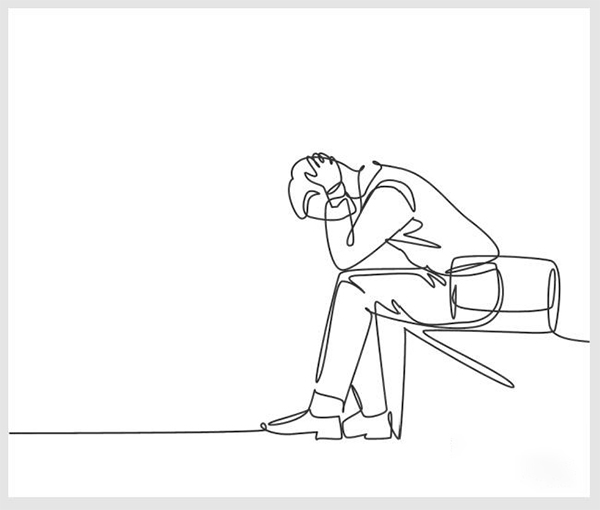
We humans constantly look for ways to complicate our illnesses—so that they become unique and individual. But that is not how we view disease in practical homoeopathy. I have watched "advanced" psoriasis regress. It can take a few years, but I have seen it!
Homoeopathy's answer
To get good results, a well-chosen homoeopathic remedy and a fair amount of time are needed. I have seen even stubborn irritable bowel syndrome turn around within a few months.
I also know people with so-called "advanced" back problems who now have very little pain. A practical-minded homoeopath is therefore not put off by that adjective.
We simply get to the point: "Are the back pains worse on first getting up in the morning and then slowly improve with further movement?"
"Yes."
As Sergeant Joe Friday used to say on Dragnet: "Just the facts, Ma'am."
If it turns out that the general homoeopathic treatment protocol does not act comprehensively, we can always take a closer look and investigate the aetiology in detail. But at the present time you can simply work with "back pain worse on getting up in the morning." It's as simple as that.
And what would the homoeopathic protocol look like for these back pains that worsen on first movement? Well, we would immediately consider the remedy that in English has picked up the nickname "rusty gate"—namely Rhus toxicodendron. Picture a rusty gate. On first movement it is stiff and squeaks; with time it becomes easier to open. Doesn't that sound exactly like our morning back pain?
For that reason Rhus tox should not be missing from any homoeopathic first-aid kit.
The Banerji protocol for back pain
In the present case we would use the Banerji protocol, in which Symphytum officinale 200 in combination with Rhus toxicodendron 30 is taken twice daily — and continued until the complaints have improved considerably or, after a reasonable period of administration, there is absolutely no improvement.
We discussed Symphytum — the main remedy for bones — in a recently published blog on shin splints. In combination with Rhus tox this creates a time-tested protocol for joints, muscles, ligaments and bones. This method has proven effective for joint pain regardless of cause — for overuse, menopause or arthritis, to name but a few.
"But you don't understand, Joette. This is advanced back pain."
It doesn't matter! Even if someone has frightened you with that adjective, the most effective protocol is often (though not always) still Symphytum officinale 200 together with Rhus toxicodendron 30! For more information on dosing and potencies of the remedies see here.
Of course homoeopathy can't perform miracles. It can't cure everything. There is no universal remedy for everything. But homoeopathy has a solid enough track record to offer hope in many situations that were deemed hopeless.
So don't keep thinking: "My condition is advanced. I'm a hopeless case. Nothing can help me anymore." Please don't do that! Homoeopathy has proven over more than 200 years that it can help people a little, moderately a lot, or in some cases even completely — regardless of whether the illnesses are "advanced" or not.
Because homoeopathy helps — spread the word!
Warmly,
Yours
.png)
Source: https://joettecalabrese.com/blog/advanced-disease-and-back-pain/
|