|
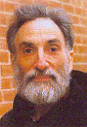
Ulrich Welte Alan Schmukler |
English original edition at Hpathy Ezine - June, 2007 |
||
|
Dr Ulrich Welte has worked as a homeopath for 30 years and has practised as a homeopathic physician in Kandern together with Herbert Sigwart since 1983 and with Markus Kuntosch since 1999. In his medical practice he has integrated the discoveries of Hugbald Volker Müller, Rajan Sankaran and Jan Scholten. He has published two books: “Colours in Homeopathy” and “Handwriting and Homeopathy”. Schmukler: I would like to hear about all the concepts you bring into your practice, including colour preference and handwriting. But could you first tell us how you came to homeopathy—what events and circumstances led you there? Welte: At medical school the first approach to the living human being was death. In anatomy class we had to dissect corpses. It was somewhat eerie, accompanied by a kind of black humour, but it somehow felt wrong. Something was off right from the start. It was as if one were taking a wrong turn right at the beginning. So I began to look for alternatives. I considered choosing a dissertation topic in that direction and asked the professor of medical history whether he would supervise a thesis on alternative medicine. He liked the idea and suggested I investigate whether there was anything on homeopathy and psychiatry. He showed me the homeopathic section of his library. I picked up Hahnemann’s “The Chronic Diseases” and the “Organon of the Healing Art”, because I thought it best to begin with the ideas of the founder. Wow! That was exactly what I had been looking for! I especially liked the identity of remedy and disease as represented by symptoms, because that approach to healing was so direct. I studied some remedy pictures and decided to try a self-experiment with Nux vomica. I developed a circular rash on my neck, near the spot where my tonsils once were. It really seemed to work! A few weeks later, out of curiosity I took Calcarea (I put it in my pocket and took a few drops every few hours) and the next day I had a headache, something I had never experienced before. I then looked up Calcarea’s head symptoms in Hahnemann’s Materia Medica and found exactly those headaches described—precisely my complaint. So there you are... Schmukler: With these self-experiments you began in the best Hahnemannian tradition. Is that an approach you favour? Welte: Personal experience goes deeper than any book knowledge. Schmukler: Can you tell us about the basic premise for using colour preference in homeopathy? How much time did you invest in this project and what direction did your research take? Welte: Colour preference is simply another valuable symptom, just like a food modality or an amelioration or aggravation on a general or mental level. Any homeopath can work with it, regardless of school or direction. Colour preference is a valuable supplementary rubric in the repertories. It is a clinical symptom and based on good cases. Cases healed or greatly improved by the same remedy showed a preference for identical or similar colours. It was Hugbald Volker Müller who discovered this correlation, and together we further developed this idea in Kandern after his death. Thus the colour repertory “Colours in Homeopathy” was produced at Narayana Verlag. This colour chart enables any interested homeopath to determine precisely a patient’s colour preference. In the repertory section of the book the corresponding remedies can then be looked up. We have been working in this field for 17 years and have analysed more than 2,500 good cases. We also collaborate internationally with interested colleagues. As early as 1998 H.V. Müller urged publication of this colour reference work, and Jan Scholten also contributed to its final completion. It took over five years to complete the work. Schmukler: That was a major undertaking you likely did not foresee at the start. Over all those years refining the method, have you encountered factors that might influence a patient’s response and distort their colour preference? And what about patients who fall into the category “indecision”—those to whom you show the colour chart and who cannot decide which colour they like? Is it somewhat of an art to do it correctly? Welte: The process of colour selection and possible difficulties are described in the colour book. Most of the time it is quite easy, especially with children. It is important to obtain the patient’s full attention and concentration. If they are distracted, you should politely but firmly make clear that this is about something important. It’s like tuning a radio station. Once their attention is directed at the overall view of all the colours printed at the back of the book, you usually get at least a preferred group, such as yellow or green. You can then open that group in the colour plates and refine the choice as precisely as possible, ideally to a single colour field. Ask patients to free themselves from purposive colour ideas (clothes, wallpaper, curtains in the new flat, etc.) and simply immerse themselves in the colours. They should choose a colour that feels good, that is simply pleasant to the eye, where one likes to linger, and that evokes a feeling of well‑being. Sometimes it can indeed be an art to find the right one. Then it is like searching for a vital sensation in the sense of Sankaran’s case‑taking technique. You may be distracted a few times and must ensure the patient’s attention does not wane until you feel the right choice has been made. Empathy is also necessary; YOU must also have the feeling that the patient’s choice was meaningful. Once the decision lands on 2–3 different colours, have the patient compare them directly and, if necessary, correct the order again. I also sometimes ask what the patients feel when they look attentively at the selected colours, what is triggered in them when they immerse themselves in that colour. Usually the general themes of the colours emerge, but sometimes there are strange and seemingly meaningless things which relate only to that patient and little to the colour itself. You could compare it to Sankaran’s nonsense level, although I would be reluctant to call it nonsense. In a higher sense these perceptions can make a lot of sense. They can correlate directly with the specific remedy and be illuminating for solving the case. Have some patience if you do not get positive results immediately. Scholten once advised to allow half a year of patience for this method. But I say again: most of the time it is really easy. I normally take two colour preferences as rubrics, even if the main colour choice was clear. And if I sense that the choice was not clear or was too superficial, then I pay little attention to the colour symptom. Colour is only one symptom and a good remedy can be found in so many different ways! There is no point in forcing a remedy on somebody by “fitting” and asking until one gets the desired symptoms. In that way one hardly learns the patient’s true state and will not find the correct remedy. Colour preference is a basic emotional vibration and says a lot about the patient’s “vegetative” state. It is an expression of the patient’s emotional condition. Physically speaking, colours are light frequencies. If you decompose white light (pure consciousness) through a prism (the mind), you get the colours (emotions). Schmukler: Therapists who use colours for healing, such as Peter Mandel in Germany and Julius Vasquez in the USA, associate colours with specific life themes. Vasquez, for example, links violet with the theme of trust and yellow with power and control. From your experience, does the theme of a colour chosen by the patient correspond to their own life theme or rather to the theme of a remedy? Welte: Max Lüscher demonstrated specific correlations between colours and emotions and checked this across many people, even independently of cultural background. We were often able to confirm his results. Thus the colour black expresses concepts like “I only do what suits me”, “independence”, “autonomy”, “hard”, “heavy”, “strict”, etc. Yellow conveys sensations like “free”, “light and easy”, “effortless”, “departure”, “take off”, “joy”, etc. Remedies associated with the same colour often have similar properties to that colour. I once had an extremely sensitive and difficult patient for whom the mere sight of pure blue at colour field 15C had the same effect as taking Dysprosium nitricum, which helped her very much (she had an autoimmune Prinzmetal angina, Hashimoto’s and vitiligo; her main complaints were anginal symptoms). In her case remedy and colour thus indeed coincided. Schmukler: Recently I had an injury (to the ankle) complicated by a burn that became ulcerated, inflamed and simply would not heal. Neither Causticum nor Kali bi, Hepar, Calc sulph, Pyrog nor Silica helped. I grew seriously worried about the wound. Then I took Calendula 200, which led to an 80–90% improvement. The next day I determined my colour preference from the chart in your book. I usually prefer indigo tones, but this time I was clearly drawn to a salmon‑pink colour. I then looked up the remedies related to it and only one was listed… Calendula! Can a local symptom shift the preference? Or could the intake of Calendula have altered my preference? Welte: What you described is very interesting! Possibly your latent state was activated by the injury and Calendula hit that deeper layer exactly—otherwise how could it have helped so well? I have not heard of that so often with other remedies. In the Calendula case described in the colour book the patient also changed her preference after taking the remedy. I would very much like to accumulate more experience with additional Calendula cases; so far we have only had two constitutional ones. Schmukler: Which new concepts have you integrated into your work and how have they changed your practice? Welte: Besides the use of colour preference and handwriting from H.V. Müller, the most helpful new concepts for me were the systems of Jan Scholten and Rajan Sankaran, as well as Massimo Mangialavori’s family concepts. From Scholten I learned more than from all other homeopaths combined. The deepest change for our method of remedy selection resulted from using the stages. We apply them to all kingdoms of nature, not only to the minerals. These four men were all experienced classical homeopaths and masters of the old approach, whose pros and cons they knew very well before developing a new systematic approach. There is a definite parallel here with Hahnemann’s own personal development. At first he gathered solid data (symptoms) through provings. As he became aware of the limitations caused by too few remedies, he began to prove further medicines and concurrently to classify the mass of symptoms through the miasms. His ensuing theory of chronic diseases is the first attempt to classify the proving symptoms. Classification is just as important as data collection. The ostracism of “theorising” or “mere speculation” is a misunderstanding. Theory and practice always go hand in hand. Every attentive homeopath analyses their cases. You do not simply feed your computer with all possible symptoms but make a selection. This “hierarchisation” of symptoms is nothing other than using a theory to pick the useful ones out of the huge amount of symptoms. The Künzli points do the same. Only skilful use of the repertory will yield meaningful answers and thus good remedies. That is a scientific approach. Selecting remedies on the basis of generally recognised systems like the periodic table of elements or botanical families has repeatedly been extremely successful in our practice, and we owe this to those great new pioneers who gave us a meaningful homeopathic translation for those systems. It should be emphasised that this new approach does not exclude the old but rather builds on its undisputed importance. In the first 15 years as a homeopath Hahnemann’s and Kent’s ideas—and to some degree Hering’s—became so familiar to me that today I am certain at least two of those old masters would have adopted the evolutionary developments in homeopathy had they lived in our era. Schmukler: You call the new methods “evolutionary” rather than “revolutionary”. That suggests a continuum rather than a break with the past. Yet some fear the new methods might undermine Hahnemann’s teachings and ultimately replace them. You accept their importance but you are concerned about limits without which a thing cannot exist. You would prefer the new methods to be given a different name. Can you say something about such concerns? Is there a methodological or ideological guideline which, if crossed, would mean we are no longer practising something that should be called homeopathy? Welte: Would new names really help? Are new names by themselves able to solve a problem? Or is it simply a new word battle? This dispute has already created so much ill will, and as far as I can see not much good has come of it so far. The great pioneers of our time were all excellent practitioners of the old method and still use it. That is what I call evolution. Who would want to do without the repertories? We all appreciate that wonderful tool greatly. And who can do without the old materia medicas? The great men and women who wrote them are our shared heroes. Their achievements form the basis of our practical homeopathic knowledge and are of great use to us even today. But times change. We discover new perspectives and use the repertories/materia medicas in a different way, translate the old language into modern formulations, add new clinical experiences and new provings, supplement incomplete parts, correct what has clinically proven wrong, etc. That is all evolution. But if we begin to greet every new approach with suspicion or dismiss every new idea out of hand; or if we build aggressions against the old‑fashioned authorities and try to destroy the old pictures; in short, if we look down on and attack one another, that is certainly the wrong way. What do we gain—apart from new walls—by labelling ourselves “classical”, “genuine”, “process‑oriented” or whatever? If, of course, a majority of reasonable people thought it better to change the name homeopathy and replace it with a better term, then we should do that. But is there a real necessity? Let us say you inherit from your ancestors a beautiful old villa called “Green Meadows” by its builder. Perhaps you find its old coal heating impractical and uneconomic. You grew up with stove heating and did not freeze, but you nonetheless feel a modern solar heating system is the better alternative. So you change the heating. You do not demolish the whole house; you want to keep its beauty. Instead you make some improvements and obtain a satisfactory result. But would you rename it because of that? Schmukler: Thank you for addressing this delicate subject. It speaks well of you that you demonstrate continuity. Clearly there is a need for new methods since many of our cases remain unresolved. In modern society people are exposed to so many allopathic drugs, hundreds of chemicals, heavy metals and other pollutants. Life has become so febrile and impersonal. Do you think case‑taking today is more complex than in Hahnemann’s time? Could that be another reason for the need for new methods? Welte: Advocates of the polychrests believe that one should first learn the big remedies well before engaging with new remedies. If that were true, then polychrests would have to be superior to the “small remedies”, which in my experience and that of many other experienced homeopaths is not the case. Our case collection comprises 3,500 cases and 900 different remedies. To pick a few at random: Sulphur: 25 cases, Bambusa arundinacea: 17, Cadmium phosphoricum: 4, Elaps corallinus: 14 cases, etc. Is Sulphur therefore a polychrest because it surpasses the bamboo cases by 8 and the Elaps cases by 9? Even earlier Boericke was very much in favour of including relevant clinical information and new remedies in the materia medicas. He emphasised the importance of polychrests but did not thereby eclipse the less well‑known remedies. We still benefit from that courageous and balanced approach today. Why else would his Materia Medica still be so popular? Yesterday I showed a friend a photo of the deformed hands of a man who had suffered severe palmar psoriasis with nail involvement for over 30 years and asked her how she would feel if her own hands looked like that. She was affected and said “terrible”. In any event this man had taken Europium muriaticum LM6 every day for two months from the first consultation, and his hands have steadily improved since then and now look almost normal. Nail growth also normalised. When I told her of this turn, she said: “If homeopaths deny the benefit of such new remedies, it shows they take their patients’ healing lightly.” I do not know whether homeopathic case‑taking is more complex now than before, but I doubt it. From my experience I find it easier now, or at least more comprehensible. Earlier one mainly searched for peculiar symptoms and characteristic keynotes; today I still use those, of course, but first try to understand the clinical and emotional dynamics of a person and then analyse on the basis of kingdoms, families, series and stages. It is a reversed approach, somewhat like Bönninghausen’s handling of symptoms, from the general to the specific, because many peculiar symptoms can be generalized. Even Kent emphasised that, though many interpret him differently today. As before, I like to use keynotes and characteristic symptoms as well as colour preference and handwriting, and sometimes they point to the healing remedy, sometimes they merely confirm it. But understanding a case has become more important to me than isolated symptoms. The symptoms should make sense overall, like the pieces of a puzzle that only form a picture when correctly assembled. Schmukler: Understanding a case in a larger context seems a more holistic approach. One tool you sometimes use to confirm a remedy is handwriting, and you have written a book about it. Can you tell us how that book came about and give us an idea of how the method works? Welte: Handwriting is indeed very good as a confirming symptom because it shows the individual’s “coagulated” movement patterns. They are characteristic hand movements, almost like gestures. It is no accident that a personal signature legally binds an individual. A forensic analysis can identify a person from a few handwritten lines, sometimes even from a signature alone. Handwriting is a dependable expression of personality. Isn’t that precisely what we as homeopaths are looking for? I am surprised how few people so far work with it. Writing that book took almost two years of daily work, perhaps four hours a day, almost without interruption. The work was very intensive because we had to review all our good cases. I had to assess the reliability of almost 2,000 case records. Only the reliable cases were then used for handwriting samples to ensure as few errors as possible were published. From a total of 2,200 available handwritings, including H. V. Müller’s cases, 750 reliable cases were included and reproduced in the book. 315 remedies are described, and for each remedy typically two similar handwriting pairs are printed in original size. With more than 100 short case reports a practical introduction to the method’s application is provided. The book is primarily a reference work for practising homeopaths to compare their patients’ handwriting with. How do I recognise handwriting similarity? We do not analyse the script like a graphologist but look at its overall picture and rhythm, similar to viewing a face. When you hold the patient’s sample beside the handwritings in the book, you should, on reading, have the sense that any line of the book script could seamlessly continue into a line of the patient’s script. This method is illustrated on the book’s cover, once with a handwriting pair of Aqua marina and another of Arsenicum album. We follow the usual homeopathic procedure: case‑taking, analysis, repertorisation, selection of especially promising remedies. Then we look at the patients’ handwriting samples who were healed with those selected remedies. If we find a similar handwriting, that handwriting serves as a confirming symptom for that remedy. Sometimes the handwriting similarity among patients healed by the same remedy is so striking that it is recognised without difficulty; sometimes it is less straightforward. It takes time to become familiar with it. Usually artistic, musical or generally form‑gifted people find it easy to pick up this symptom. Schmukler: I always thought handwriting was something fairly immutable. Can it change according to the prevailing chronic level? Welte: Handwriting does not change easily. After a good remedy the underlying structure remains the same, but one may observe better organisation and more natural flow, perhaps greater creativity. This applies especially to the healing of mental illness. There are people who can write in different ways, but that is not common. In my book I showed this exception with two Lac leoninum cases. I once had a case where Kali‑phosphoricum was a very good remedy for over five years and the handwriting was a typical Kali‑phos script; then the patient completely changed her handwriting as if she had suddenly become a different person; her new handwriting very much resembled a Sepia script, and indeed she was in a phase of rejecting her husband and Sepia helped her very well. But such occurrences are very rare. In most cases, even after deep cures, the handwriting’s basic structure remains the same.
Welte: For me every new contribution is interesting if it is clinically confirmed. For example, Filip Degrootes’ work seems very innovative to me, although I have never met him personally. He works with a kind of kinesiology and uses the Weihe points as confirming symptoms. His Materia Medica gives an authentic impression, not just the usual copies of copies of a copy. I once met a patient whom he treated as an emergency without an appointment; after only an eight‑minute consultation he gave Ruthenium as a deeply acting constitutional remedy. I was very surprised how he could find in such a short time a remedy that worked so deeply; it made sense, worked very well and cured a longstanding facial neuralgia. Homeopathy of the future? I hope we will aim for a new understanding of remedies rather than merely adding new symptoms. It would make more sense to me to consider the family theme as a fundamental characteristic first and then order the individual symptoms. With this general orientation we can handle a much larger number of symptoms more easily without losing oversight. For example, mental and physical stiffness and improvement by motion is not only characteristic of Rhus toxicodendron alone but of the whole family Anacardiaceae. Such an approach also makes things easier for beginners. It is like looking at the motorway map first before going into the detail of the small country roads. You keep the overview and are also better acquainted with small remedies when you only know their general family themes. That gives access to many more remedies with less memorisation effort: better individualisation with less effort. Isn’t that exactly what we as homeopaths want? Schmukler: All this seems to be in harmony with homeopathy’s goals. You have presented yourself as a strong proponent of these methods and one can feel your enthusiasm. Do you think a homeopath’s intuitive abilities and skill in case management are equally important? Welte: Of course. Nothing replaces great clinical experience. It provides a good understanding of the natural course and development of acute and chronic diseases; you know what to expect and what remarkable changes occur during the course. This clinical instinct is what distinguishes the good physician, whether homeopath or conventional doctor. That is why I would encourage homeopaths not to shy away from normal clinical training. In this way one also acquires insider knowledge with all its pros and cons. This clinical base can facilitate good case management and other higher skills. Intuitive abilities can also develop better when they are built on medical practice and experience. In my view clinical training, understanding series, families and stages and a basic knowledge of the Materia Medica should go hand in hand to achieve satisfying development. And if one learns to use a good computer programme as repertory and Materia Medica, one has access to 200 years of accumulated homeopathic knowledge. With the general orientation I mentioned earlier one finds one’s way more easily through these large areas. I studied Kent’s theory and Materia Medica very attentively in my youth; he said one would only be able to develop those higher skills after many years of practice. I was a little disappointed at the time, but today I see that that applies to me as well. I would certainly have been very happy to have been exposed to the new methods earlier rather than later. I am sure my development would have been better and faster. I spent so many years cramming remedy pictures and always found it difficult to get that seemingly incoherent material into my head. Already in the early eighties I felt a strong need for a more comprehensive approach, but there was none. When I read Sankaran’s “The Spirit of Homeopathy” in 1991 and Scholten’s “Homeopathy and Minerals” in 1993, it was a great joy for me; it felt as if everything was coming together. Schmukler: So Sankaran and Scholten gave you a model that helped you understand the larger connections, and that greatly advanced your development. I think readers of this interview will welcome these ideas, since even the best homeopaths have a number of unresolved cases during their careers. I want to thank you for sharing these exciting possibilities. Sometimes when I wrestle with a case I wish for another approach. Now I am looking forward to trying your methods concerning colour preference and handwriting. The interview was great fun and it was a pleasure to meet you. Thank you very much. Welte: I also greatly enjoyed the interview; it also gave me the opportunity to bring more clarity to my thoughts by writing them down. Some open questions were clarified and new ones arose. Development never stands still: “only a rolling stone gathers no moss”. For example, I am currently working on a systematisation of animal remedies. The actinides of the uranium series are elements with insufficient indications and provings and little clinical experience. Many sensation and mood symptoms, such as colour preference, are still largely empirical clinical data not fully integrated into the systems of the periodic table and the botanical and zoological families. Only a few are quite clear so far. For example, snake remedies prefer turquoise, spiders orange and olive green, most Solanaceae dark blue, etc. Colour preference is still at the stage where homeopathy stood before Scholten and Sankaran; a deeper understanding is lacking. Let us see what the future holds for us! |
|||