
“If you look very closely at your hand, you will see all generations of ancestors in it, who not only existed in the past but are still alive in the present moment. You are merely the continuation, you have never died.” (ThichNhatHanh)
The science of epigenetics is a modern field of research that is developing rapidly and, in the course of this research, recognises that each of us carries the past within us. Transgenerational patterns are significant factors that strongly shape our “inner child”. Homeopathic remedies can help to dissolve these patterns so that we can lead a healthy, happy and fulfilled life. In moments of insight and realisation we develop the strength to take new paths. Our work sets a transgenerational healing process in motion that helps us understand and remove the obstacles on our life path so that we can experience physical, mental and spiritual health.
From the example of the following two cases I have learned how we can recognise and dissolve transgenerational patterns. The first case concerns a mother who suffers from depression and hypothyroidism. What is remarkable in this case are the woman’s extramarital affairs and several terminations of pregnancy – both highly unusual in a country like India. The second case example is that of her son, who shows autistic traits and masturbates conspicuously often. Both cases were underpinned by a very particular energetic signature.
Case 1
In November 2014 Mrs M. came to my practice because of depression, confusion and suicidal thoughts. She had recently filed for divorce. She has an eight‑year‑old son (case 2) and two lovers. The woman had already had four terminations of pregnancy. She feels guilty about this and is confused. She cannot decide whether to stay with her husband or move in with one of her lovers. She feels trapped in the situation. She has panic attacks with feelings of guilt and anorexia nervosa. During these attacks she trembles and feels as if her blood sugar is dropping. She expresses the feeling that she cannot properly develop herself with her husband. He only ever thought of himself and pursued his career. She had to give up her job because her husband was transferred and the family had to move to a new town. The patient relates that she was on the verge of a breakdown when she considered raising her son without her husband. She found it very selfish of her husband to have planned the move without regard for her and their son. He would have left her and her child behind if they had not come with him.
She says it is important to remain independent, because only then do you have your own identity and take responsibility. I asked her what her lovers meant to her.
M: “My husband should be a better husband. He should understand that his wife also has interests and wants to develop further. A wife also has the right to her own identity. She should be able to immerse herself in her work. If she does not earn her own money, she has to ask her husband for money. That is very humiliating.”
At this point it was clear to me that the patient needed a remedy from the plant kingdom. Although she talks about identity (group 3 of the periodic table), her sensitivity is in the foreground. She feels humiliated when she has to ask for money. (Consequently this patient already knows that she has her own identity).
M. works as an administrative clerk. She has a problem with hierarchy at her workplace, being told how and when to carry out her tasks. She feels blackmailed. She must fit into the administrative structure and accept her superiors.
She dreams of conversations with her cousins: “My mother does not want me to speak with them. I am blackmailed by my mother and she says she will not visit me as long as I speak with my cousins.”
In real life too she feels blackmailed by her husband. “He says: ‘You can move in with your lover. But if you do that, you must leave our son with me. Forever.’”
M: “How could I leave my son? And if I take him with me, how will I manage on my own?”
The experience of being blackmailed is therefore not an isolated symptom but a general one. I asked the patient to tell me more about it.
M: “I don’t like being told what to do. I prefer to make my decisions myself.”
I asked her about her childhood. She reports that her parents were not very happy. Her mother was not allowed to leave the house alone. The father often beat the mother and the patient had feared her violent father. Because of this she withdrew, secluding herself, and was always afraid that her parents would separate. She wondered then whether she would be able to cope on her own. She felt helpless.
She always felt great compassion for her mother. Her mother seemed numb and had no real connection to the outside world. She feels guilty towards her mother and believes she has not supported her adequately. She tries to make her mother happy. She goes to the temple with her every day, but secretly harbours a strong aversion to her. She feels controlled by her mother. She says to her: “Please don’t tell me to go left when I would rather go right.”
M. is dependent on alcohol and cigarettes. She is obsessively preoccupied with her appearance and regularly and frequently visits a beautician. She likes to dance and then feels like a bird. She feels very present and knows she can change things: “Women are not powerless. They have the right to leave the house independently and to travel.”
One of her favourite films is a romantic film in which the bride is rejected by her groom on the wedding day because she is not educated and lacks self‑confidence. The bride decides to go on the honeymoon to Paris alone because the trip is already booked. On her journey she meets many people and gains self‑confidence. She finds many friends who like her as she is. The patient feels that being rejected in this way is not right, but also that the situation does not mean the end for the woman. The male ego must be challenged: “One should not abandon someone and then blame them for it.”
She cannot watch the TV channel Animal Planet because it is too brutal for her. She cannot bear to see the deer eaten by the tiger.
After her marriage the patient had typhoid with jaundice, and at the same time a cystitis which she perceived as worse. She describes the infection as so severe that she would rather have died. She had a strong urge to urinate, burning and trembling. During the fever she was so angry with her in‑laws that she threw things around. She disliked the restrictions experienced as a newly married woman in an Indian extended family.
M. has dreams in which she cannot free herself from muddy lakes. She dreams of running, she runs but gets nowhere. In her dreams she sees a big car and someone running away from her. In her dreams she mostly feels helpless, just as in real life.
I notice that she has difficulty expressing herself adequately.
Analysis
We have here a weak, fragile and confused personality who finds it difficult to make decisions. Her aversion to and sensitivity toward control runs through all areas of her life.
For this case I consulted Mahesh Gandhi’s notes on the plant kingdom, which are based on Michal Yakir’s plant table. His method helps us determine our patients’ “inner age” more closely. In Yakir’s table the columns correspond to botanical subclasses, which in turn refer to the evolutionary history of the plants – from primitive plants to highly developed organisms.
The corresponding developmental process in humans moves from an initial and original state of oneness and a lack of differentiation towards differentiation, the establishment of boundaries and separation.
Every person goes through phases in which either the female or the male element dominates, before finally emerging from this process as an independent, individual and mature “I”. In the course of this transformation, which is represented in the table by the columns, the person strives for awareness and individuality. With this realisation, the person can finally return as a mature individual to the origin of life, this time with full awareness of the wonder of creation. Within the botanical subclasses are the botanical orders with their numerous plant families.
The second axis of the table – the rows – corresponds to the botanical orders. Each row refers to different phases of human development from birth to the end of life. The table itself is modelled on the stage model of psychosocial development according to Erikson and Moss. The nine rows follow the stages of human maturation: prenatal, early life, early childhood, school age and adolescence, young adulthood, late adulthood and old age.
Together the columns and rows form a comprehensive table of plant remedies, to which the phases of the psychological and evolutionary development of humans/humanity can be mapped. In each phase of human development there are specific characteristics and possibilities for dysfunction or problems that manifest as distinct themes.
In the present case the patient and her themes belong to subclass 1.
At the beginning there is unity, a state of oneness and wholeness. The person is at the beginning of their development into an individual. The ego – always accompanied by the feeling of being separate, of splitting off – is not yet really formed, but the desire to take on a form is already present. Then the process of separation begins and the ego emerges. With remedies from this subclass we observe the feeling of not having fully arrived in reality, a lack of groundedness. It is as if they are not yet properly “rooted”.
Complaints that originate in this stage usually revolve around a certain chaos, a feeling of confusion, disorder and not knowing: am I here or not? The personality is still weak, the person feels dependent, is easily influenced, exposed to the world and unable to act.
The botanical family Ranunculaceae spans rows 4, 5 and 6, which correspond to childhood through to puberty.
Here the themes concern confusion and the integration of one’s own identity. This can express itself as rebellious behaviour, or as a feeling of blockage that hinders the person. The sense of duty is usually only weakly developed and the person refuses to acknowledge social norms.
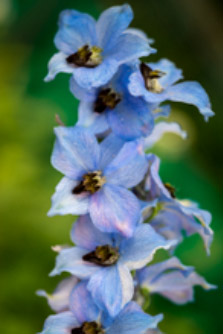
When one looks more closely at the position of the Ranunculaceae in the table, we can assume that the theme of control will be important: the feeling of being controlled, wanting to control something, or an excessive and uncontrollable sexuality. The Ranunculaceae are easily irritable, sensitive and anxious. People who need a remedy from this family desire an ideal world and need a lot of security. They are very naive in their profession. They tend to become confused and may get lost. They are at risk of addiction, tire quickly and get stuck at all transitions in life.
A homeopathic prescription is usually very successful when new methods are combined with tried and tested remedies. One can combine the traditional homeopathic toolkit (Materia Medica, repertory and provings) very effectively with new approaches (synergistic approach).
In the present case confusion is our anchor. It is the rock in the surf: strong, reliable and secure.
The first rubric was:
Mind – Confusion; mental – Identity; in relation to his – Loss of personality: anhcarcfalco-p haloheriniridlsdnelupsil-s staph thuj.
The second important rubric is:
Mind – Suppression of natural inclinations and desires; writing; of the right hand; must with: staph
That very aptly describes the conflict with the mother: “Please don’t tell me to go left when I would rather go right.”
Other rubrics:
Mind – Desire; great – things that are rejected when offered; for: cham KREOS SEC staph
Thus she behaves towards her lovers. She turns away as soon as a serious offer is made.
Mind – Complaints from – abuse; ill‑treatment; does not leave the relationship; wants the: bar‑c staph
Mind – Alcoholism – remove; for drinking habit – sweet alcoholic drinks; for: mag‑c., staph
Mind – Anger – throat area; with constriction of the: staph.
Mind – Seeing blood; cannot see – wounds; cannot: Nux‑v., staph.
Mind – Complaints from – love; disappointed: AUR ign nat‑m ph‑ac staph
Mind – Fear – suicidal tendency: arg‑n AUR bellbuni‑o carc caust chin clem DROS HEP MERC nat‑s NUX‑V plat PULS RHUS‑T staph thuj
Mind – Anorexia nervosa: staph
Mind – Anger – throws objects: STAPH
Prescription: Staphisagria 1M
Follow‑ups:
5 December 2014: The trembling has subsided. She has no craving for cigarettes or alcohol.
She is still confused and anxious and harbours negative thoughts which she says come from the devil. She longs to be able to run away to another world, which she describes as a kind of shock therapy for all who try to control her.
Prescription: Staphisagria 1M, single dose
15 January 2015: The trembling has reduced further and her thoughts have stabilised.
She still has the feeling of not really existing. She cannot make a decision in her favour because it might hurt other people.
Prescription: Staphisagria 10M, single dose
25 March 2015: The thyroid hormones have stabilised. She can make decisions without fear of hurting someone. For the first time she has the feeling of really existing.
Plan: Sac‑lac.
15 June 2015: She had acute digestive complaints accompanied by cravings for alcohol and cigarettes. The trigger was a conflict at work.
Prescription: Staph. 10M, single dose
20 July 2015: The digestive complaints have gone. The craving for alcohol has reduced, but she still wants to smoke.
Plan: Sac‑lac.
17 August 2015: M. is now a self‑confident woman. She is taken seriously at work. She can express her opinion more clearly and has gained self‑confidence. She reports that she has put her relationship problems on hold for a while. She wants to do something to gain more respect.
Plan: Sac‑lac.
10 October 2015: She has fever and a sore throat. The complaints were triggered by an argument with her husband. She wants a divorce.
Prescription: Staphisagria 10M, single dose
10 November 2015: She says she has left the shadows of the past behind. She is autonomous and has taken her life into her own hands. She has become a self‑confident woman who leads a fulfilled and self‑determined life. She is in a good relationship and working again. She has also become more creative and expresses her ideas clearly.
Case 2

December 2014: M.’s autistic son Y. is ten years old. His diagnosis is autism, hyperactivity, attention deficit and delayed speech development. He is hyperactive and showed no interest in his environment until the age of five. He responded to music but not to words.
At school he could not assert himself and was bullied. He himself is also aggressive, has sudden temper tantrums and cannot wait for his turn. Because he hit his classmates he had to leave his former school. He usually regrets his tantrums immediately, but cannot accept a “no”.
Y. is very stubborn and loses himself in his own world. He laughs and talks to himself about comics. He tends to masturbation and touches his genitals openly and often. He kisses directly on the lips to show his affection; otherwise he cannot express his feelings.
He likes to watch romantic films. In his favourite film a famous Bollywood actor plays the main role. “I want to be famous too.” Y. particularly likes to sing a song in which a man and woman become intimate.
He is addicted to chocolate and video games. The games have a calming effect on him.
I notice that Y. cannot make eye contact. He is hyperactive and can only be kept under control by his mother. He cannot bear it when she is sad; then he becomes panicky. He puts his arm around her and says: “Why are you sad? Are you angry with me?”
He only sat quietly on a chair when prompted to do so. Nevertheless he could not sit still for a minute. He was rude to the staff and snapped at them, as if it were his office. He had to examine and touch everything; he could not be controlled.
M. had difficulty becoming pregnant for a long time. Her tests were unremarkable, but her husband produced too little sperm. They were told she could not have healthy children. The pregnancy came as a surprise and was a shock. She was convinced she would give birth to a sick child and wondered whether she should carry the child to term. She had typhoid and lost a lot of weight during the pregnancy.
Analysis
The following rubrics were included:
Mind – Autism: AGRA aspart bar‑c bos‑s brachy‑s bufo cact kali‑br LYC staph tarent thuj tub
Mind – Anger – at children, in: abrot ACON ANAC ANT‑T arn bacbell BRY calc CAPS carb‑v carc CHAM cic cina cupr dros hep hoch ip kali‑c kali‑s kreos LYC medop PHOS placplut‑n sanic scorp sil staph stram syph TER TUB tub‑k
Mind – Regret – weeping; with: cygn‑c‑b lach latex staph thul‑c
Mind – Anarchist: abrotabsin ARG‑N CAUST eur‑p kali‑c MERC sep staph thuj
Mind – Contradiction – cannot tolerate contradiction – rules, cannot tolerate rigid – children; in: CAPS caust chin dysp erb fl‑ac gado‑n hep lyc MED nux‑v phos PLB sam‑s staph sulph TARENT tub
Mind – Authority – does not recognise authority: CAPS carc CAUST chin cina dysp erb erb‑c erb‑p erb‑s excr‑canfl‑ac gado‑n hep kali‑c lac‑d lac‑drom lac‑eq lach lyc MED neod‑n nux‑v phos PLB pras‑f pras‑o promsac‑alb sam‑m sam‑s staph sulph syph TARENT thuj tub ytteytte‑o
Mind – Tantrums: acon aml‑n anac ANT‑T astac AUR aur‑m‑n BAR‑C bar‑s bell bor bufo calc calcul‑b canth carccarn‑g caust cere‑s cham chel cic cich cina cocc coli cupr cupr‑acet dpt elaps gado‑n germ glon heli hep holm‑m hyos lac‑drom lach lant‑c LON‑P luna lyc lyss mag‑c mag‑m melal‑l mez morg mosch nat‑c NAT‑M NUX‑V olnd PETR PHOS plat plut‑n prot psor puls sac‑alb sanic scorp SENEG sepser‑ang sil STANN STAPH stram STRONT‑C sulph syc‑co syph tarent tell TER terb‑o THUJ thul THYR TUB
Mind – Ambition – increased, augmented, very ambitious – fame, wants to be famous, for: alum aur‑s blatta con graph LACH NUX‑V staph
Mind – Society – aversion to – desire for solitude – to pursue fantasies, to pursue their – sexual fantasies: BUFO dios STAPH thuj ust
These rubrics point very nicely and precisely to Staphisagria as the simillimum. The mother’s themes are mirrored in the early phase of individuation during the pregnancy with Y.
Prescription: Staphisagria C200, single dose
02 January 2015: The remedy had a calming effect that lasted for a day.
Prescription: Staphisagria 1M, single dose
15 January 2015: The remedy helped Y. to be calmer for a week. His childminder was glad that he finally listened to her and was less aggressive. He began to express affectionate feelings and was not so restless anymore. He began to form friendships, but still cannot concentrate.
Prescription: Staphisagria 10M, single dose
05 June 2015: The child appears more grounded. To express himself he made a drawing. At school he has made friends and has his aggression under control. He has become more patient. He can now make eye contact and answer my questions. He even wished me good morning.
Plan: Sac‑lac.
18 August 2015: Y. came to the clinic with an acute tonsillitis. He cried and demanded the mobile phone to play. He tried to switch on the camera and behaved badly when his mother denied him his wish.
Prescription: Staphisagria 10M, single dose
19 August 2015: The infection was better, but the pain was still present.
Prescription: Staphisagria 10M, to be repeated
05 October 2015: Y. shook my hand and looked me in the eye. He is now interested in his environment. He enjoys going to school, can concentrate and generally copes better. His compulsive fixation on romantic films has lessened. He can show affection without always needing to give lip kisses. His mother reports that he now asks very intelligent questions. He talks about his fears regarding his parents’ separation and asks with whom he will live. He asks his mother why his friends are so strong. He now likes going out and observing his surroundings.
Plan: Sac‑lac.
15 November 2015: Y. has grown and looks more mature. He sits in the consulting room and talks about school and his friends. He is curious about how the camera works.
He even waits in the waiting room for his mother to finish her treatment. He communicates with me. His gaming addiction has also reduced, but has not yet disappeared completely. I will continue to accompany him.
Summary
The particular feature (and thus the genius) in both cases is the inability of mother and son to express their feelings, which leads to excessive sexuality.
On looking back at the family history I later learned that the grandmother had been married to a violent man and had to endure her suffering quietly. The grandmother could be repertorised with the following rubrics:
Mind – Complaints from – abuse; ill‑treatment; does not leave the relationship; wants the: bar‑c staph
The grandmother repeatedly advised her granddaughter to end her extramarital affairs because they bring shame upon her:
Mind – Delusions – dishonoured, in shame – she is: kali‑s mag‑s nat‑s nux‑v plat rob staph sulph.
It is quite possible that the grandmother was also in a Staphisagria state.
These two cases nicely show the different aspects of the remedy. In Y. the typical Staphisagria state (aggressions, inability to express feelings and an excessive and precocious sexuality) was very clearly recognisable.
The mother’s state could only be worked out through the various stages of individuation. The energetic pattern stretches across three generations: a weak, naive and confused ego almost attracts abuse in relationships. This leads to disharmony that permeates several generations and is best dissolved with a suitable homeopathic remedy. After these two cases I repeatedly asked myself whether autistic children might perhaps be helped more often if transgenerational patterns were given greater consideration?
Photos: Shutterstock
Adult and child hands; paulaphoto
Blue Delphinium; Elena 11
Little boy playing video games; Camilla$$
Category: Cases
Keywords: Depression, blackmail, domestic violence, urinary tract infection, control, lack of self‑confidence, autism, hyperactivity.
Remedy: Staphisagria

