
|
by Enna Stellinga |
|
|
|
 |
|
|
|
|
The patient is a 5-year-old girl who has had frequent colds since birth; the colds develop into bronchitis with shortness of breath and a wet cough if she does not take Flixotide. She also has headaches and eye pain. Since she was 8 months old she has been prone to worm infestations, which often cause abdominal pain. Her mother says she has an abnormal craving for sweets. At the end of a school day she is sullen and her mood only improves when she eats a sandwich with a sweet filling. She wears glasses and is under the care of an ophthalmologist. At school she suffers from severe concentration problems. |
|
| Pregnancy | |
|
Urinary tract infections and often a tense abdomen. Labour was induced at 40 weeks because the baby's growth had stagnated. The baby was in a face presentation. Fortunately she had a small head; her birth weight was 3000 grams. Her mother felt an immediate bond with her. The pregnancy had been delayed because the child's maternal grandmother was very ill; she died shortly before the pregnancy; a few months after her death the mother became pregnant with this child; it was her second child. |
|
|
General |
|
|
Food: lack of appetite; she only starts to eat when given bread with chocolate. |
|
| Mind and emotions | |
| She is very sensitive. Sometimes she is childish, and she is the smallest in her class. When her mother is tense she copies her facial expressions, and the mother can see how she empathises with her. She is slow and needs time to process and act on information. She enjoys learning. | |
|
When there is a conflict between her brother and her parents she panics. She is inconsolable if she is criticised even slightly, as if she had done something terrible. She is very sensitive to pain. When her brother is injured she cares for him; she loves putting on bandages and finds it interesting. She is affectionate and gentle and very sensitive to noises and loud sounds. |
|
| Her mother notices that she is interested in her own cleanliness and that she loves new clothes. She is creative. She has a strong will. At school it is a real drama when demands are placed on her; she becomes angry and wants to do things at her own pace. | |
| Medical history | |
| Oral thrush from 3 weeks to 18 months. At 11 months: atypical febrile convulsions; she was unconscious for 45 minutes and had blue lips. Afterwards she did not speak for a year, although she already knew a few words. At 2 years: pneumonia, 41° C fever, critically ill. |
|
| Observations | |
| During the entire consultation she sat playing with the dollhouse and said not a word, even when spoken to. She has a very delicate build and is small for her age. She is dressed in pink and purple and wears a headband with butterflies on it. Asked about her daughter's hobbies, the mother replies: "Butterflies, flowers and rainbows!" She likes pink and purple and loves anything that shines. | |
|
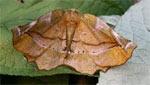
Prescription: Apeira syringaria (Lilac beauty). |
|
|
This butterfly is surrounded by a hint of violet scent. Lilac is also purple. Apeira syringaria is a moth and feeds on the nectar of lilac, honeysuckle, elder (and privet). The Apeira themes are described in Jean Pierre Jansen's lovely case: |
|
|
- beautiful-looking woman |
|
|
Mind and emotion symptoms: |
|
|
Mistakes when speaking |
|
|
Themes from Müller's proving: |
|
|
Butterfly themes in this case: |
|
| Follow-up | |
|
She is full of energy. Her teacher approached her mother and said, "She has changed so much. She understands everything much better now and is less prone to illness." She behaves less childishly and no longer bursts into tears so easily. |
|
|
She has less craving for sweets and now sometimes asks for cheese. She is more motivated at school and dares to speak with strangers. She has become very talkative, even in the consultation. The bedwetting has stopped. She enjoys going to school, and after school she pursues her own interests. From time to time she still has abdominal pain; then she has worms. After a year she is doing very well and is no longer ill. She no longer focusses so much on her appearance and has become much more resilient. |
|
|
|
Case 2: Inachis io - Peacock butterfly (European Peacock) |
|
The patient is a youthful-looking, slim 49-year-old woman. She arrived half an hour late for the appointment; she had "lost her way", although she lives nearby and knows the route. She has lost the balance between over-activity and inactivity; she only relaxes when she has worked hard. She does not sleep well - her head is too busy. She is very committed to her work (teaching), but now has difficulty listening: "I have to feign interest." |
|
| Acute physical complaints | |
|
acid reflux |
|
|
She begins making hand gestures relatively early in the consultation, and I suggest we proceed with the sensation method. The following words and gestures emerged: |
|
|
Feeling trapped |
|
| Mind and emotions | |
|
busy, stressed, fanatical; has already had a nervous breakdown |
|
| General | |
|
Food cravings: dairy products, chocolate, liqueur, fruit +++, raw food |
|
| Medical history: | |
|
At 14 years: cysts in the breast that came and went spontaneously, immediately operated on |
|
|
Prescription: Inachis io (Peacock butterfly) |
|
|
Overwinters in its mature form. Lives on nettles and Buddleia (butterfly bush). Nettles grow everywhere, so this butterfly is not dependent on a particular environment. The eye spots, which give the impression of a dangerous animal, are only displayed when threatened by a predator, e.g. a bird. |
|
| Follow-up | |
|
The response to the remedy is remarkable: initially there was a strong reaction with profound tiredness and headaches. Since then she no longer needs painkillers - all physical pains have disappeared. She sleeps better. She feels emotionally better, more balanced, can follow her own needs more easily and is less prone to overloading herself. |
|
|
She has concluded that as a child she did not receive the necessary support or guidance she needed. She can concentrate much better and feels more stable. Things no longer touch her so deeply or throw her off balance. She is clearer and takes less responsibility for others. Her outstanding skill at work she describes as the ability to "rise above everyday things." She had a turbulent time at work, but she says: "I am finding my way." |
|
| Inachis io - themes according to Patricia Le Roux | |
|
Loss of direction leads to a feeling of abandonment |
|
| Case from Patricia Le Roux | |
|
Six-year-old boy with concentration problems, very active; no discipline within the family; he does what he wants, likes to dress up, especially with two-faced masks; lacks authority; craving for sweets, aversion to meat +++ |
|
| Symptoms of Inachis io in this case | |
| ‘Lost’ feeling Difficulty concentrating Headaches starting from the neck Sinusitis marked difference between right and left, polarity (Bombay remedy proving), two-faced mask (Le Roux proving) |
|
| RADAR | |
|
Anger alternating with calm |
|
|
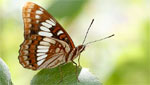
Case 3: Limenitis bredowii California |
 |
|
The patient is an 18-year-old young woman who arrives dressed entirely in black. She comes because of anger which she sometimes suppresses and sometimes vents on her boyfriend: "I am only defending myself!" She prefers to live with her boyfriend rather than at home because her father always shouts at her. She feels his negative energy. Her boyfriend's home, by contrast, seems to her like a temple of calm and silence. |
|
| Current physical complaints | |
|
She is always nauseous in the morning and cannot eat. Sometimes she vomits. During menses she suffers heavy blood loss; before menstruation she is low and emotionally unstable. |
|
| Medical history | |
|
1-4 years: developmental delay, extremely dependent (suspected deafness) Attendance at a special school |
|
| Observation | |
|
Delicate body build |
|
| Mind and emotions | |
|
Sensitive and creative. She expresses her feelings through drawings. She loves horror films and thrillers. She is terrified of losing her boyfriend. She feels small, like a slave: "I am devastated!" She feels compelled to do the housework. She has a poor relationship with her sister, who is good at school and so perfect she is regarded as a prodigy. This pains her deeply. Sometimes she has nightmares of accidents where she is injured or a piece of her face is missing or she is paralysed. Or she dreams of accidents where she loses her way. "I don't do what I want, I need help. I ask too often if I'm doing it right." She loves dark clothing. At school she was bullied, "because I was different from the others." |
|
|
General |
|
| thirsty: "I need fluids more urgently than food." Worse from: olives, fruit. Averse to coffee. Menses: heavy blood loss + +, anaemia, low before menstruation, emotionally unstable; diarrhoea during menstruation. Very cold +++ Sweats easily +++ Sleep disturbances, difficulty falling asleep. Sleeps on her stomach. Nickel allergy |
|
| Bombay method: | |
|
I am stuck in a box with loud knives, I am going crazy from the pain. Slaughtered. Angry and full of fear. |
|
| Prescription: Limenitis bredowii | |
|
A brown-yellow butterfly that is almost invisible on oak bark. The alkaloids of the oaks eaten by the larvae are toxic to birds. |
|
|
Symptoms from the proving by Nancy Herrick: |
|
|
Children feel unprotected by adults. Unprotected adolescents. The butterfly's eggs are laid in the open and are not covered, hence unprotected. |
|
| Symptoms from the case of Catherine Javelle, SSC No. 2, 2011 - Dutch Homeopathic Physicians' Journal | |
|
Nightmares, sleepwalking |
|
| Follow-up | |
|
She became very ill with influenza. Many emotions surfaced; afterwards she slept better and was calmer during the day. She says that as a child she always fluttered her hands. She worries less about her school performance and no longer becomes angry so easily. She found that she no longer reacts as strongly to her father. She was able to tell him what bothered her about him; he became angry in response, but she was able to ignore his outburst. |
|
|
Her body is functioning better: she is not so cold and sweats much less. She feels supple and slim and no longer bruises so easily. She eats fewer sweets. |
|
|
Emotionally she has made enormous progress. She has largely overcome her fears and can let go much better. "The relationship between my sister and me has improved a lot." She takes the initiative; she was the first in her class to get an apprenticeship. She has discarded her dark clothing and is happy. "I am now where I want to be." |
|
| Butterfly themes in these 3 cases: | |
|
Sensitive, very delicate. "Antennas". |
|
|
Strong sense of responsibility; wants others to feel safe. Tries to lead others. |
|
| Summary | |
|
Apeira syringaria: caring, beauty |
|
|
Peacock butterfly: lost, overactive |
|
|
Limenitis bredowii: unprotected, relationship |
|
|
Mutations in butterflies after the tsunami in Japan, Fukushima 2011 exposed to radioactivity: smaller wings, "eye" damage. The larvae in this area were in hibernation during the catastrophe. |
|
| ************************************************************************** | |
| Bibliography | |
|
Le Roux, Patricia, Butterflies in Homeopathy, 13 Butterflies and their Provings, Essences and Cases, Narayana Verlag, 2009 |
|
|
Photos: |
|
|
Wikimedia Commons |
|
|
Category: Cases |
|