
The Synergistic Approach in Homeopathic Practice
By Rajan Sankaran, Sneha Thakkar, Rishi Vyas
Over the past 30 years we have observed a contemporary development in homeopathy that is referred to as synergy. This method has proven highly successful not only in theory but also in everyday practice. In the synergistic method the classical homeopathic tools such as Materia Medica, repertory and Organon retain their firm place and are enriched by innovative approaches, for example the sensation method, the understanding of the kingdoms, the theory of miasms and source homeopathy.
As a result, a unique system has crystallised which is being learned, taught, practised and multiplied with great success by students and practitioners worldwide. Using this system old and new approaches in homeopathy have been united and a universal platform created on which the most diverse approaches are not only welcome but contribute to providing our patients with the best possible treatment.
The following diagram is intended to illustrate the synergistic concept in homeopathy:
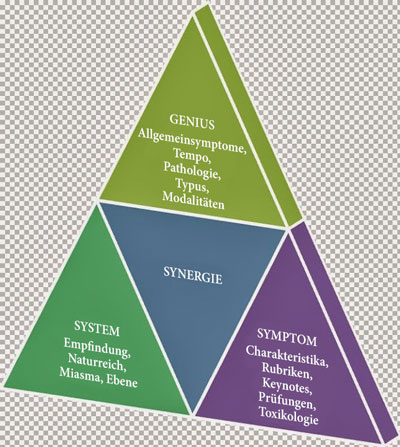
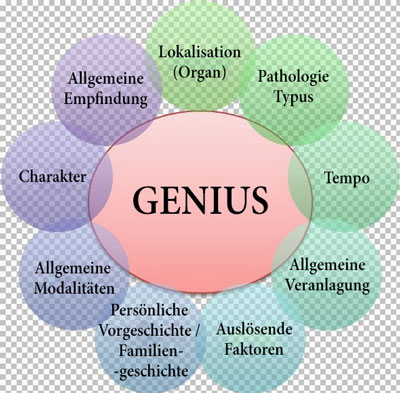
The apex of the triangle represents the Genius. In this sense the Genius describes the unmistakable essence or distinctive characteristic of something – whether it is a patient or a remedy. The term Genius was coined by C.M. Boger. In the foreword to Boger’s 'Synoptic Key' he formulates the Genius of a remedy as "the red thread running through each pathogenic symptom complex". In the 'Synoptic Key' Boger succeeds in describing the Genius of each remedy accurately and comprehensively in the first lines. These special qualities that characterise a patient or a remedy have been referred to by various homeopathic authors as essence, keynote, soul, red thread or "Grand Generals".
Genius
The two sides of the triangle, Symptoms and System, complement each other. We achieve the best results when these two are applied together. The term 'Symptoms' encompasses the use of rubrics, systematic repertorisation, keynote symptoms, drug provings, characteristics and clinical symptoms. The concept of the System includes the division of the kingdoms, the sensation method and the theory of miasms.
When we work within the System and apply it synergistically and in accordance with traditional methods of remedy selection, our understanding of our cases and our Materia Medica will expand significantly. In this way we come to a deeper knowledge of what needs to be healed in an illness and how a particular remedy can act.
The "anchor" serves as a useful tool that can be used in addition to the synergistic triangle and emphasises the application of complete symptoms (location, sensation, modality, concomitants) in conjunction with very characteristic, firm symptoms. This enables a thorough and reliable form of repertorisation that is not influenced by interpretations or the therapist's personal bias.
If one wants to work with the concept of synergy, all three sides of the triangle (Genius, Symptom and System) and the anchor must flow into the prescription. Ultimately, each of the four areas taken alone will also lead to the same conclusion and thus to the appropriate remedy for the patient.
Below we will examine each side of the synergy triangle and other tools useful for our work in detail and discuss them with illustrative graphics.
When we work with the Genius of a remedy, we must always view it in connection with the Genius of the patient. Only then will we be able to successfully bring the two together. Here are some examples:
-
Baryta carbonica – slow development, sluggish, dwarfism, premature dementia, scrofulous, vascular softening, tendency to colds, slow, clumsy and backward.
-
Stannum – extreme weakness, paralysing heaviness, abundant mucus production.
-
Cuprum – intermittent, cramps, spasms, twitching, violent, forceful, the nerves are affected.
-
Ignatia – capricious, moody, spasmodic phenomena, twitching, jerking, hysteria, oversensitive.
-
Helleborus – dark, gloomy remedy, dark facial colour, nostrils sootily coloured, lips, hands etc. darkly stained.
-
Plumbum – slow, creeping processes, with violent concomitants, often changeable or incoherent, affecting single parts of the body.
-
Stramonium – remedy for violent, intense states but with diminished sensitivity to pain, with suppressed discharges, may be unable to pass urine or stool; fear of the dark, of shining objects; full of anxieties, seeks company or wants to flee. If we look more closely at the fears and nightmares of Stramonium, we can find them in each of the three components – in the System, in the Symptoms and in the Genius. Fear forms the core of all three areas.
System
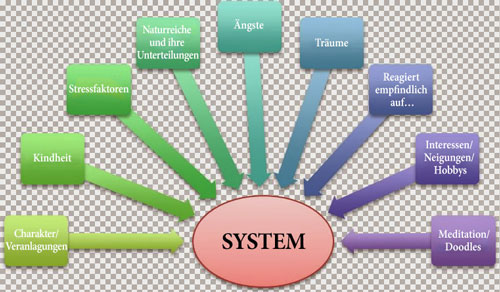
On the side of the triangle corresponding to the concept of the 'System' we find many aspects that have a clear connection to the patient. A patient's system can lead us to the kingdoms, the sensation, the miasm or to the source.
When we deal with a patient's system in case-taking or case analysis, our right hemisphere is stimulated. Our artistic disposition, our creativity, holism, concepts and perception are processed here.
Symptom
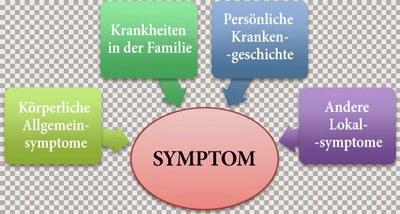
On the 'Symptoms' side of the triangle we deal with the rubrics, structured repertorisation, Materia Medica, keynote symptoms, provings, characteristics and clinical symptoms. These play a central role in prescribing.
The analysis of symptoms takes place in the left hemisphere. This is where a person's scientific, analytical, logical, mathematical and grammatical abilities reside.
|
General physical symptoms |
History/ Family history/ Pre-existing conditions |
Other local symptoms |
Cravings
|
Cancer, cardiovascular diseases, recurrent illnesses such as tonsillitis, tuberculosis etc. |
|
The key to success lies in the therapist's flexibility and good powers of observation. With every patient we may come across clearly defined symptoms and rubrics. Sometimes in a case the System or the sensation is clearly recognisable – the homeopath must be able in each case to separate the individual areas clearly from one another in order to then bring them together into a coherent conclusion. This is what we understand by the art of case-taking. During the case-taking it must become clear that, regardless of the area in which it begins, all other areas (Genius, Symptoms or System) must also be covered.
The Anchor
By anchor we mean what first strikes us about a patient, something that stands out very clearly – it is the concrete, definitive and certain aspect of the case. Even more important is the extent to which this symptom is shown unreservedly in a patient – the more individual the symptom presents, the more reliable it is. An anchor is a solid and dependable characteristic that goes far beyond a possible interpretation. The anchor can be found in all aspects of a case, as illustrated in the graphic below.
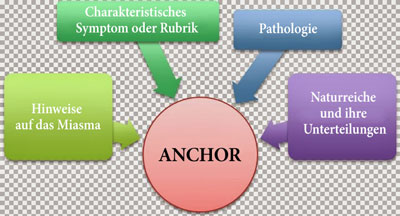
If we want to grasp the essence of a patient, we must succeed in developing a deep understanding of the obvious, the apparent aspects of the case. The apparent can be found in the Genius, in the symptoms, in the system or in the anchor. If we follow this clearly defined thread, the other areas of the case will also reveal themselves. It is important to note that there are cases in which the symptoms are particularly evident, or the Genius or the System stands out clearly. For a truly successful prescription, however, all aspects of the case must be reconstructed and worked on in the same way.
Conclusion
I believe that the majority of our cases – about 90% – can be worked through within 15–20 minutes. For the remaining 10% it takes only slightly longer. For a successful prescription you should grasp and elaborate the central aspect of a case. Once you have found this you do not need to keep searching. If you have to keep searching again and again in a case, then you have missed the essential, the focus!
In every case you should connect the old with the new, i.e. use Symptom and System equally. The System will lead you to the core and the symptoms provide the hard facts, the solid data for repertorisation. Suppose you have found the remedy for your patient using rubrics and repertorisation, then you must ensure that the patient's sensation and experience match what you have worked out.
I advise everyone – and here I am addressing especially homeopaths who are still at the beginning of their art – to learn slowly and thoroughly, because only then will you be able to benefit from your knowledge. In the following case example one must think a little to grasp the central aspect – by now we know that the red thread of the case, what recurs again and again, was found in the patient's anxiety.
The synergistic approach in homeopathic case-taking enables the urgent need to bring together and integrate the old classical school with innovative thinking. The advantages of this new approach lie in the fact that it is easy to follow and reproduce. This in turn allows us homeopaths to regain confidence in our clinical work.
Case Example of the Synergistic Approach
A patient with Meige syndrome.
This case concerns an older man who came to me with the diagnosis of Meige syndrome. The patient was accompanied by his daughter because he could only speak indistinctly due to his condition. From a purely conventional medical perspective this disease involves spasmodic contractions of the facial muscles (predominantly around the eyes and mouth) and is usually treated with Botox injections.
In this patient the left side of the face was particularly affected – contractions around the left eye, the jaw area and the tongue contract spasmodically, he cannot speak and has to bite his teeth together compulsively.
The patient belongs to the highest social circles and is known in the entertainment industry as a successful and prominent personality. He is regarded as an excellent public speaker.
During the case-taking we notice that the patient cannot keep his feet still and has to keep moving them.
Doctor: Please tell me about your complaints.
Patient: Because of my Meige syndrome I cannot speak. My main problem is that I can neither eat nor speak. My eyes close spasmodically, especially when I speak or even otherwise. I have a serious speech problem; speaking is a great effort for me. My muscles become stiff. It is as if I must speak but cannot; I can literally feel the stiffness. Because of this I cannot sleep properly. Also my mouth feels totally dry.
Doctor: So, one issue is the spasmodic closing of your eyes which troubles you and then there is the stiffness around the mouth preventing you from articulating your words properly?
Patient: Eating is also difficult. I have to chew but I cannot. I cannot control the movements of my face. At present it is not constant but initially it was continuous. It always happens between 12:00 and 15:00 and then again after 18:00, around 21:00 to 22:00.
Doctor: At these times of day the complaints get worse?
Patient: Yes, it is especially bad then. But it can occur at any time.
Doctor: Can you tell me more about your complaints? Can you describe them in more detail?
Patient: I often have cramps at the side of my left eye. Suddenly my eye closes and I cannot see anything. I also cannot speak properly and that bothers me the most. My jaw and tongue cramp and I have to keep biting my teeth together.
Comment: So far we know the diagnosis and pathology. In the repertory we can look up the patient's symptoms and peculiarities. The corresponding rubrics are found in the chapter 'Eye' under 'spasmodic closing' and 'involuntary closing'. We should also look up under the chapter 'Mouth' for 'cramps'. These symptoms serve as anchors, because they are concrete, certain, 100% reliable and not open to interpretation.
Doctor: Do you have any other symptoms or complaints?
Patient: Only colds and coughs. I cannot stay in air-conditioned rooms or sit near a fan. My complaints get worse with the slightest draught; I feel very unwell then.
Doctor: Please tell me more about your colds and your cough.
Patient: When it is cold I become very mucousy and then my nose runs.
Daughter: He catches a cold every month and then has this runny nose with thick secretions. He even gets fever. He cannot go anywhere cold; he immediately falls ill.
The patient has problems when eating; food rises into his nose. The man is known for his excellent rhetoric, but since he became ill his power of speech has greatly diminished. Sometimes he has to hold his face when speaking and we have to make an effort to understand what he is saying.
Comment: At this point clear, very concrete modalities appear: aggravation from cold; aggravation from draughts; inability to draw breath.
Doctor: So his speech is very unclear?
Daughter: Yes. He also cannot eat properly. It embarrasses him a lot.
Doctor: You say he is a very well-known rhetorician?
Daughter: Yes, he trained as an actor and was an excellent rhetorician. He was even awarded for it.
Patient: I used to work as a consultant, but I cannot do that anymore. I am very frustrated. This illness keeps me from working; I cannot earn a living. Speaking is my only source of income.
Doctor: What exactly do you do professionally?
Patient: I work with actors and directors, try to recruit them for projects. I do casting, appear as a speaker at public events, host. Sometimes I also design an entire show.
Doctor: Which qualities are particularly important in your work?
Patient: You must know the entertainment industry very well. Talent, creativity, marketing. You must know the market and how to position a product. Market research and assertiveness are important. You definitely need talent. You need excellent contacts and must know people. You must be able to think outside the box and plan. For me every day is new; there is no one-size-fits-all for my work. Every project is tailor-made. You must also be able to articulate yourself and at the moment I lack that. Although I have expertise, I cannot use it; I cannot present anything. It upsets me a lot now. At present I am somewhat confident, but I notice that it affects me deeply. My daughter is the best actress in all of Gujarat. She takes after her father, which means she has become really famous. Does big things. I always liked it when people complimented my rhetoric. I spoke publicly to many people and received recognition for it. Everyone liked me. I naturally felt somewhat special. Now everything is slipping through my hands.
Doctor: Do you dream?
Patient: No. I sleep deeply and soundly.
Doctor: Before you became ill – did you have stage fright before your performances?
Patient: Well, I was naturally excited, but I had a lot of self-confidence, a great deal of self-confidence! I can deliver a speech off the cuff. On every occasion I could improvise – and very well. I was unique and an inspiration to many in my field. Now I face this new challenge.
Comment: At this point we gain insight into the System side of the triangle. We have a patient before us who believes he is special. He is not average. He places great value on the opinion of others; his whole professional life has been spent performing and speaking in public. He describes his profession vividly and explains that a lot of creativity is demanded of him. He has to research and be able to plan his own success. He is visibly proud of his talent (public speaking), but now risks losing it all.
All these themes we can assign to the mineral kingdom – the patient has achieved so much but now fears losing his abilities, which are increasingly failing him. The patient belongs to the fifth series of the periodic table. Keywords for the corresponding themes are creativity, talent, show, performance, challenge, uniqueness, admiration, ambition, voice and inspiration.
Doctor: Do you have any other physical complaints?
Daughter: He has had a heart block three times and has been on medication for it for 20 years. I can well imagine that the medications are responsible for his condition.
Doctor: Do you like to sing?
Patient: No, I do not like that. I also do not like to dance or go to parties. I prefer to be at home.
Doctor: How do you feel about order?
Patient: I am very orderly and disciplined. I like to plan ahead and I want things to be done accordingly. I am a very punctual person. I am known for my discipline.
Daughter: He used to be very quick-tempered, but that has settled. He is a very calm, gentle person, very eloquent. Since he has problems with his eyes he no longer likes to go out at night. He also does not want to drive anymore.
Doctor: Your complaints come and go?
Patient: Yes, they come in attacks.
Doctor: What do you like to eat and drink?
Patient: I eat everything, vegetarian and meat. I like fish, but only occasionally because my whole family is vegetarian. When I eat out I usually order fish.
Doctor: Do you have a sweet tooth?
Patient: Oh yes, I love sweets. I used to eat sweets every day. Because of my health complaints my wife does not give me any now. I also like spicy food, but I have clearly reduced it.
Comment: Personal preferences regarding food and drink have high importance in case-taking. These preferences can confirm our ideas about the correct remedy. In the present case we have a particularly strong craving for sweets; the patient craved them daily.
Doctor: Your feet are very restless?
Patient: Yes, they are.
Doctor: Do you have problems with your voice? Do you sometimes become hoarse?
Patient: Yes. I am often hoarse and my voice becomes rough. Because of these complaints I am gradually losing my voice.
Doctor: How did he speak before?
Daughter: He had a wonderful voice, very clear and distinct. He no longer speaks with his original voice. When he spoke, his words were like pearls, beautiful. Everyone could understand him immediately and all could recognise him by his voice. He loved to speak. He was famous for his voice and his rhetoric. I know many people in the entertainment industry who still rave about his voice today. People say I inherited his voice and many appreciate it. He has performed all over India – on radio, in television and film; he has interviewed many actors.
Comment: The theme revolves around speaking, show and stage appearances. His voice stands out; it is unique and distinct. Because of his illness he can no longer display his talent.
Doctor: Did your complaints begin suddenly or slowly?
Patient: It came suddenly; one day it was suddenly there. I knew exactly that it would be a big problem. One day I suddenly could not open my eyes.
Doctor: All right, we will find a remedy for you.
Final Comment and Case Analysis
This brief case example illustrates the synergistic method well. It is clear that the patient believes he is special; he stands out from the crowd. He is very creative, loves to perform publicly and show his talent. He longs for recognition from his peer group. The main theme is the disease that robs him of the ability to create and perform artistically. Here we have the patient's System.
Regarding the patient's physical complaints, the peculiarities of the pathological processes (spasms) are the focus and the significance of this for his voice and public performances. The patient is in the process of losing his abilities but strives to maintain his position.
Rubrics:
-
GENERAL; COLD; agg.
-
EYE; CLOSING OF EYE; involuntary
-
EYE; CLOSING OF EYE; spasmodic closing
-
EYE; EYE COMPLAINTS; left eye
-
EYE; OPENING OF EYE, THE PALPEBRAL FISSURE; impossible
-
NOSE; DISCHARGE; thick
-
NOSE; DISCHARGE; mucoid
-
NOSE; DISCHARGE; abundant
-
LARYNX AND TRACHEA; VOICE; hoarse
-
MOUTH; CRAMPS
-
MOUTH; CRAMPS; tongue
-
MOUTH; SPEECH; difficult
-
MIND; ANXIETY; anticipatory tension, from
-
MIND; SHYNESS, TIMIDITY; public; when appearing in
Prescription: Argentum metallicum C200
The decision for Argentum metallicum was not difficult; the symptoms were clear. Both the 'System' side of the triangle and the symptoms were clearly confirmed.
To choose the correct column in the periodic table we must understand how much and especially what kind of stress the patient is under. This patient has stress – not because he believes he has lost his social standing, but because he views the spasms as a challenge. He questions himself – am I up to the situation, i.e. the illness? He wants to maintain his position. He still sees himself at the top but increasingly wonders whether he will be able to remain there. Language is a critical and very important aspect of the remedy Argentum, which is in group 11 of the periodic table. The main themes of this group revolve around preservation and maintenance of one's position.
One can also see the Genius of the remedy very clearly here. The main sphere of action of the remedy is the larynx. In patients who need this remedy we often find a loss of power or dwindling strength.
Argentum (silver) is placed in the second row of the metals, between copper and gold. Like all metals, Argentum sees its chance of survival in performance and defence. For the metals of the second row it is about presentation, showing oneself. Silver is a rather flashy, shiny metal, a showpiece of human society. In English a rhetorically gifted person is referred to as having a "silver tongue". We all know the proverb "Speech is silver, silence is golden". Argentum people do not have aristocratic traits; instead they want to show themselves too much and tend to boast. In Argentum metallicum the intellectual component is strongly emphasised. Kent writes that the remedy primarily addresses the intellectual sphere and shows little effect on the emotional level. The situation of Argentum metallicum is that of a person who must perform great intellectual tasks in speech and writing (speaking, singing, writing). His whole personality is defined by intellectual abilities, particularly in the domain of language and writing.
Among the most important symptoms of Argentum metallicum is worsening from use of the voice, i.e. speaking, singing and mental exertion. Argentum patients master the art of argument and debate; they can negotiate and fight at length and with emphasis – not only for themselves but also for others. They radiate conviction and can win over opponents thanks to pronounced intellectual abilities. The Argentum person is a born salesperson or lawyer.
Physical symptoms include contractures, convulsions and cramps.
Follow-ups
4 weeks later
Doctor: Please tell me how you are.
Patient: I am well. Overall I felt about 25% better. Initially I also felt very well mentally and was very confident because the spasms improved markedly. They no longer occurred so often and when a spasm did occur it was not so severe. Now I have the impression that it is getting worse again.
Comment: Here we have a good example that the choice of the correct potency can be decisive for a successful homeopathic prescription. We know the remedy has worked because the patient was 25% better, but the effect was not lasting. From this we can conclude that the patient needs a lower potency given continuously. I prescribed C30 to the patient to take twice daily for a month.
Three months later
Doctor: Tell me, how have you been since your last visit?
Patient: To be honest, doctor, I am much better. I can literally hear my voice steadily improving. Many people say it sounds much clearer. Overall I am about 50% better.
Comment: After we found the correct dosage for the patient we can observe a sustained improvement in health. Argentum metallicum was given again.
This case example was originally published on http://theothersong.wordpress.com/ in the newsletter 'Voice'.
Category: Cases
Keywords: Synergy, Genius, Anchor, System, Meige syndrome, contractures, loss of voice, performance
Remedy: Argentum metallicum

