Valuable Proven Indications The Homeopathic Simile |
|
What is the difference between a simile and a specific? In allopathy insulin is a specific for diabetes. In homeopathy we give a diabetic Nux vomica; to another patient we prescribe the same remedy for constipation; in another patient Nux vomica is indicated for jaundice. In other words, unlike in allopathy, there are no 'specifics' in homeopathy in that sense. Instead we use another term: the 'simile' (and not the 'specific'). We wish to clarify the meaning of the term 'simile' here once more.
|
|
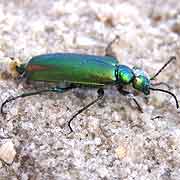
Cantharis vesicatoria |
1. The remedy Cantharis is 'the simile' for superficial burns and scalds. (The careful reader will again note that we do not speak of the 'specific', but rather of the 'most similar remedy'.) 2. The remedy Crotalus horridus D 1000 is the simile for septicaemia, leukaemia, infectious hepatitis, haemophilia and leptospirosis. (Give one dose daily for three days.) |
(a) In more than ninety-five percent of all cases the victims of burns and scalds are very restless; they constantly take up some activity but achieve nothing. They show violent anger with screaming and fury, pronounced over-excitation and hypersensitivity, together with severe irritability and burning wound pains. This symptom group is found without exception in all victims of burns and scalds. A single dose of Cantharis C 30 cures the patient immediately. You can treat hundreds of burn victims with Cantharis; yet you will hardly encounter a case in which Cantharis shows no effect. (However, this should not lead to the hasty conclusion that Cantharis should be given in very high potencies.) If Cantharis were to cure all victims of burns and scalds without exception, we could certainly say that Cantharis is the specific for burns. We have found that in burns in more than 95% of cases there is anger, irritability, burning, restlessness, fury, etc.In one case of scalding with boiling water (which had been sprayed from a car radiator) the entire right half of the victim's upper body was scalded; Cantharis did not help. But the patient said he would not wish these terrible pains even on his worst enemy. The rubric for this is deepest despair. A single dose of Arsenicum album cured him. Therefore we say that Cantharis is indeed a simile, but not the similimum for burns. |
|
Crotalus horridus |
(b) The leading symptom for the use of Crotalus horridus is: "life‑threatening blood diseases". The most common cases are haemophilia, blood cancer, septicaemia, infectious hepatitis, leptospirosis, etc. Ninety‑nine out of one hundred disease cases were completely cured by us with a single dose of Crotalus horridus C 1000. In the remaining one percent of cases we worked the case and found different remedies as the similimum. |
When we say that a particular remedy "is a simile" for a disease, we will use that remedy first for that disease, and only if it does not work (which can occur in one in a hundred cases) do we continue to look for the 'similimum', the 'totality of symptoms', etc. We will now consider some remedies that can be called 'simile' for certain diseases or under certain conditions. |
|
Chikungunya vector: Aedes albopictus |
During the chikungunya epidemic that prevailed in parts of South and East India from 2007 to 2009, more than one million cases were completely and permanently cured by us and our students with a single dose of Polyporus pinicola D 1000. The success rate was ninety‑seven percent. We therefore refer to this remedy as the 'simile' for chikungunya. How did we find this remedy? Chikungunya begins with fever, chills and joint pains. Many patients had to crawl to the toilet because of the crippling pains.
|
| Their faces appeared "dejected". (See Repertory by Calvin B. Knerr - MIND, EMOTIONS and MOOD - dejected, in intermittent fever: Poly.). Although chikungunya is not the same as intermittent fever, this is the closest rubric we have for the appearance of the faces of chikungunya victims. (Intermittent fever: malaria or another disease in which fever and chills occur). |
|
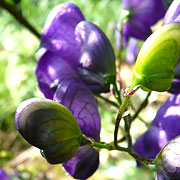
Aconite |
1) Aconite for foreign bodies in the eye. When inflammation sets in, we give Sulphur. 3) Before rectal operations we give Collinsonia. (See Boericke's Materia Medica) 4) Postoperative painful bloating, no relief from passing wind: China. (Boericke) |
5) Pain and other lower abdominal complaints after surgical procedures in the lower abdomen: Staphysagria. 6) Urinary complaints in newly married women: Staphysagria. 7) Superficial burns: Cantharis. Acidum carbolicum (carbolic acid) is suitable for extensive burns when deeper tissues are affected (see Knerr's REPERTORY, p. 1148, Injuries, burns, extensive, Acidum Carbol.). 8) Accidents? Every homeopath would give Arnica, and with that his knowledge of trauma remedies is exhausted. A man fell from a height of 15 metres from a coconut tree. He was admitted to hospital. His bone fractures healed. But he could not get up and walk. After a month he was discharged bedridden, and the doctors said they could do nothing more for him. Arnica etc. had already been tried in vain. A layman (who had read my books) gave the patient a single dose of a remedy, and the next day he began to walk and move about. Can you as the reader guess the remedy? Look in Boericke's Materia Medica: it is Millefolium: "severe sequelae after a fall from a great height". 9) A fractured shinbone in most cases gives trouble and heals poorly. A single dose of Anthracinum has cured most of these cases. (See Knerr's Repertory, p. 1148 - Injuries, fractures… of the shinbone, Anthracinum).
|
|
© Domino / PIXELIO |
Some symptoms cannot be found under any rubric in the Repertory. Therefore it is best to remember these remedies so as to always have them at hand when needed. CASE 1: A patient consulted me about his allergic rash on both upper extremities and on the chest. He said: "Doctor, for three years I have been seeing allopaths, Ayurveda therapists, homeopaths, etc. |
They have treated me for weeks and months and achieved only about a five percent improvement. As soon as I eat unhulled cooked rice or any form of processed wheat flour I get terrible bloating; that same evening the rash begins; at night, when I can pass wind or have a bowel movement, the rash disappears again." CASE 2: A twelve‑year‑old schoolboy was brought by his parents. The mother opened the conversation: "Doctor, he has to leave the house at 9:30 in the morning to go to school. He gets up at 6:00am. Around 7:30 he begins to get restless; he jumps about, shouts etc. This lasts about half an hour. Then the restlessness disappears; instead he has 3–4 bowel motions. After that he is fine again and goes to school." For the two cases described above the symptoms we should note are given below:
|
|
Poppy field |
CASE 3: A patient consulted me about his constipation. Laxatives had produced no result. He went on to report that he had been taking anticonvulsants daily for his epilepsy for several years; if he stopped taking them he would get convulsions. The following passages regarding Opium (in Wilkinson's Materia Medica) correspond with this case: |
"…increasing irritability and activity of the voluntary muscles, accompanied by a decrease in the activity of the involuntary muscles …" CASE 4: A patient showed his right leg, which had an ulcer. He had injured himself a few months earlier, but until now the wound had not healed despite the best medical care. After a pause the patient continued: "Doctor, since the accident I have had numbness in my right upper arm and cannot move it freely. Has the delayed healing of the wound on my leg anything to do with the numbness in my arm? But my arm was not injured in the accident." We say that homeopathy is a medical system in which the patient tells us the remedy or indicates it to us in some other way. In Wilkinson's Materia Medica the following sentence for the remedy Pulsatilla corresponds with this case:… "decline of vital power on one side and increased irritability on the other …" A single dose of Pulsatilla C 1000 cured both the leg ulcer and the numbness in the arm. |
|
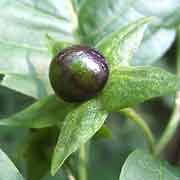
Belladonna |
CASE 5: A significant symptom of Belladonna (found in Wilkinson's Materia Medica) shows what is meant by the term 'unusual symptom'; moreover it illustrates the uniqueness and superiority of Wilkinson's Materia Medica. A patient came with pain in the upper urethra and back pain which worsened when cycling.
|
He has complaints in the kidney and ureter and complains of pain in the upper urethra and low back pain. This is a rare, striking and characteristic symptom. Both painful spots are at the same distance from the affected kidney. CASE 6: Two years after the case described above (No. 5) a lady with cervical spondylosis came to me. These patients usually have pain in the neck which radiates into the head or into an arm.
|
|
Belladonna |
Strangely, this patient complained of unbearable pain in both shoulder blades. (Both shoulder blades are equidistant from the cervical spine). A single dose of Belladonna C 1000 cured him. The following two cases were cured by one and the same remedy. Which homeopath can work it out? |
CASE 7: A lady, the mother‑in‑law of a cancer patient in the fourth stage, came to me to ask for a remedy for cancer. When I asked her to bring the patient to me, she said he did not want to come. I asked her to tell me verbatim what he had said. She replied: "He says nothing." Sometimes we really receive valuable symptoms through reports from third parties! - Aversion to company. - Homesick To work up the case Kent's Repertory was consulted. Aversion to company [aversion = intense dislike, antipathy], (does not want to speak): Homesickness:
|
|
Aurum metallicum |
Two remedies, namely Aurum metallicum and Belladonna, fit both of the symptoms mentioned above. To choose between the two remedies the remedy pictures in 'HOMOEOPATHIC THERAPEUTICS' (by Dr Samuel Lilienthal) were consulted in the chapter "Carcinomas". |
Furthermore, in the chapter 'Insanity' under Aurum metallicum we find the following sentence: "With his quiet behaviour and his taciturnity he pursues his suicide in a refined and persistent manner." ............................................................................................................................................... Autor: Dr. V. Krishnamurthy. Raman House, Old No. 21, Kuppiah Street, West Mambalam, Chennai (Madras) - 600 033. India
|
|
.jpg)