
by Vladimir Petroci

The 45‑year‑old patient, a funeral director, attends the clinic because of a pollen allergy. From April to September he suffers from the symptoms of his hay fever: itchy eyes with tearing, itchy nose with watery discharge and a sensation of tightness in the throat. He is often hoarse. In spring and summer he cannot leave the house without tissues. In addition to grasses, the patient cannot tolerate dairy products.
Five years earlier the man had set up as an independent funeral director. For financial reasons he initially lived in his office, the business did not yet provide enough money for his own flat. It was a difficult time, especially the large amount of dust in the company affected him. At that time he developed pneumonia, which he never properly recovered from because he could not afford time off work. The symptoms of the pneumonia were tightness and a choking sensation in the throat and nosebleeds. Afterwards allergic rhinitis and asthma developed. At present the patient coughs and feels nauseous as soon as he comes into contact with dust. When he has to exert himself physically at work he becomes short of breath. He has to take high‑dose antihistamines, which significantly relieve his symptoms. As soon as he stops the antihistamines, the symptoms return so severely that it takes three days for restarting the antihistamine to take effect.
The patient's mother was an alcoholic. She died of a cerebral haemorrhage caused by a fall while intoxicated. Because of his mother the patient harbours a deep aversion to alcohol. As a child the patient was regularly beaten up by other boys. When his mother heard about it she thrashed her son mercilessly because he had allowed it to happen. He often had to take blows because as a child he was thin, frail and underweight. At the age of 11 he weighed only 15 kg, at 18 he weighed 60 kg. At that age he was once so severely provoked by another boy that he had to defend himself violently and injured the other boy in the process. For that he received a suspended sentence and had to pay compensation to the boy. Since childhood the man has been an outsider and inclined to criminality. At 15 he began to ride a motorcycle despite not having a driving licence. He engaged in pursuits with the police but was never caught. He hid the motorcycle in the flat. After two years his mother reported him to the police and he was mistreated by the officers during his arrest.
As a youth he attended vocational school and received 90 krones (about €13) pocket money a month. Most of it was taken from him by his father. His father was a good‑for‑nothing who never cared for his family. The family was terribly poor; there was not enough to eat and no money for food or clothing. The patient and his brothers were forced to steal the neighbours' shoes so they would not have to go barefoot.
Once the father broke his son's nose because he suspected him of stealing 2 krones (30 cents), although one of his brothers had taken the money. The brother died some time later of an embolism that developed following multiple fractures: the mafia had broken both his legs so that he would not testify against them in court. A second brother maintained an incestuous relationship with his own daughter and the third brother fell from a roof and has been paraplegic ever since. There is no contact with the siblings.
For a time the patient worked in a factory, where he contracted a severe dermatophytosis of the feet. From time to time he has ringworm‑type mycoses on his body.
At 18 the patient was sentenced to two years' imprisonment for theft after stealing a toolbox at work.  Because of his previous conviction (assault) he had to begin his prison sentence immediately. Actually he should have been imprisoned for three years, but his father intervened and the sentence was reduced. It was the first time his father had stood up for him. His father's brother was a senior military officer and put in a good word for his nephew. In the course of his arrest the patient was, however, severely beaten and left critically injured in a detention cell. Against all expectations he survived this incident, although his hair fell out due to the extreme stress.
During the sentence several prison officers tried to pin the suicide of a 'Gypsy' on him. On his release the man weighed 90 kg – he had trained hard in prison. The money he earned from work in prison he sent home to his family.
He fared little better during his military service: during an exercise his Achilles tendon ruptured, yet the officer ordered him to keep marching. The injured tendon could only be stitched in the evening. After the makeshift treatment of the injury he had to return immediately to duty and do painting work. He threw his crutch at the on‑duty officer and tried to escape through a window. In doing so he suffered further severe injuries: glass shards cut his arm and tore his abdominal wall so that his intestines protruded. As if that were not enough, the ambulance that was to take him to hospital was involved in an accident and the patient, along with the stretcher, was flung out of the vehicle during transport. He suffered a broken jaw. A civilian ambulance finally took him to hospital. Due to his injuries he could not eat and was accused by a nurse of deliberately refusing food. Consequently he was admitted to psychiatry and treated with strong psychotropic drugs. Because of the heavy medication the patient began wetting himself, for which intent was again alleged. Only when he was able to confide in a senior duty doctor, tell his story and describe his numerous accidents, could he leave the psychiatric ward.
When he was finally discharged from the army he began an apprenticeship as a printer, but soon lost the job when the company ran into financial difficulties. After that he was unemployed for a long time until the employment office finally found him a job as an undertaker. He did his work well and was able to work his way up in the firm. He began an affair with his female boss and wanted to restructure the company according to his ideas. When he could not implement his ideas he left his lover and her company and founded his own funeral business. He now works in competition with his old company and offers prettier and cheaper funerals. Regarding his work he describes himself as a companion of the deceased on their way into another world.
The patient has become very successful with his funeral business, which at times has made life even harder for him than before. Once he was pursued in a car by two men and shot at. Luckily he was uninjured, though the windows and frame of his car were shattered. Because he would not be intimidated and kept expanding his business, he received increasing threats; among other incidents he was attacked and beaten by masked men on his company premises. He has now become very cautious and weighs carefully whom he gets involved with.
The patient enjoys eating and basically eats anything. He likes rich and fatty meals, e.g. pork knuckle with cabbage. After eating he feels sluggish and bloated. He digests only slowly. He feels heavy, as if he had a stone in his stomach. Because he eats so much he tends to be overweight; it is a kind of compensatory behaviour for his hard childhood when he never had enough to eat. His overweight also earns him respect. Previously he constantly felt humiliated.
The patient cannot tolerate milk. He gets diarrhoea from pasteurised milk, whereas he tolerates raw milk well. He likes rice, goulash and sausage. As a child he once refused to eat tomato soup because the colour reminded him of blood. His mother was very angry and threw a knife at the father, but the knife missed him. It struck the patient on the forehead; the scar is still visible today.
Despite all the accidents and bodily injuries his greatest fear is poverty. Although he has become a more balanced driver, the greatest change has been psychological. His experiences have made him cautious and he abhors violence. As a young man he had been hot‑tempered and explosive, often erupting over trifles. He was almost routinely mistreated and beaten. "Today I would let myself be beaten without resistance, just to avoid going to prison."
He would like to study law and become a lawyer. He has a law book at home which he reads regularly and enjoys. The patient is convinced that prison made a man out of him.
After the failure of his first marriage the man went through a depressive phase with suicidal thoughts. At that time his funeral business was also not doing well.
He is very happy with his second wife. She is 14 years younger than him and treats him well. Through her influence he has become calmer and more balanced.
The patient also suffers from advanced osteoarthritis of the hip with gnawing pain in the hip joint that worsens with exertion. He catches colds easily – even the short walk to the rubbish bin is enough to bring on a cold. His numerous scars and old injuries react very sensitively to changes in the weather. He sweats a lot, mainly on the head, neck and shoulders. Sometimes he experiences hot flushes that run through his whole body.
Analysis
My first impression of the patient was that he could potentially be dangerous and that I should approach him with great caution. At the same time he was self‑confident, cheerful and masculine. He was very communicative, told interesting stories and knew how to hold the attention of his listener. One could empathise with his accounts. The man is of medium height, strongly built and has a slight abdominal paunch. He wears his hair short and arrived at the appointment with a three‑day beard.
For me it was from the outset a clear Melilotus case. The remedy fits both the specific context and the characteristic symptoms. I always strive to cover these two aspects and have had great success with this approach in my practice. If I find that either context or symptoms do not fit the picture, then the remedy is not the right one. By context I mean the themes of the case and the position of the remedy or remedy group in the larger scheme (mineral, plant or animal kingdom).
In the family Leguminosae I repeatedly encounter the theme of the failed entrepreneur who, despite great efforts, must live in poverty. In the present case the patient has indeed managed to run a successful business, but the theme of poverty hangs over him like a dark cloud. The slow digestion, the heaviness and the bloating after meals confirm this remedy group.
Another remedy that repeatedly came to mind during the case taking was Nitricum acidum. In a Nitrogenium case where poverty plays a role one should think either of Nitricum acidum or of the Leguminosae. The remedies differ in their reaction to poverty. Nitricum acidum becomes angry and curses those who have robbed him of his wealth, whereas the Leguminosae are gentler by disposition and repeatedly strive to overcome adverse circumstances. A good self‑esteem, cheerfulness, social competence and the ability to make contact are typical of the nitrogen compounds. These nitrogen themes are most clearly expressed in the family of the legumes.
During repertorisation the specific remedy was confirmed:
NOSE; nosebleed, Typhus abdominalis, during (or NOSE, nosebleed, fever, during, agg.)
GENERALITIES; weather, weather change, agg.
Melilotus is represented in both rubrics. The remedy is known for a tendency to bleeding that arises when coumarin glycosides are converted to dicoumarol. This process can be triggered by various fungi. Coumarin has a characteristic sweet smell reminiscent of freshly mown hay. The glycoside is probably used by the plant to defend against pests.
In the history of our patient these themes can be clearly recognised. As I worked out the corresponding rubrics for Melilotus the connections became clear:
MIND; anger, violent
MIND; delusions; to be arrested, he should be
MIND; fear; of being arrested
MIND; delusions; to be persecuted; would be persecuted
MIND; fear; danger, of impending
MIND; fear; of poverty
MIND; suspicious, mistrustful
Treatment course
After I had elaborated this information I had no further doubts about the choice of remedy and gave the patient Melilotus C30, one globule to be taken three times at one‑hour intervals. The remedy was administered on 17 April 2012.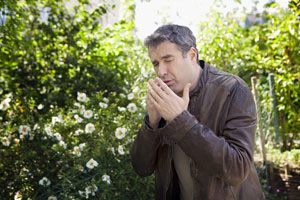 The patient immediately stopped all medications. On the 4th and 5th day after taking the remedy he experienced severe hay fever symptoms. By the following Monday his symptoms had, however, markedly improved and eventually disappeared completely.
Two weeks later he had a relapse, but Melilotus C30 did not really help him. I gave him the highest potency I had in stock, Melilotus 1M.
After this dose the patient only had one acute hay fever episode when he was near a freshly mown meadow in the summer. He no longer took conventional medication, without which he had previously not coped. Every time he had tried to stop his medication he suffered from itchy eyes, tearing and a runny nose. The patient's allergist did not believe his reports until he offered to mow her lawn.
On 17 September 2012 he reported to me that the last summer had been the best for five years. During the whole summer he only had hay fever symptoms three times, which each time disappeared quickly after a single dose of Melilotus 1M. He did not experience shortness of breath.
In May 2013 he received another dose of Melilotus 1M for itchy eyes. Up to our last contact in March 2014 the patient was completely free of complaints.
Note: Such occurrences were rare even in the times of socialism. The history of this patient is indeed extraordinary. Please do not hesitate to visit us here in Slovakia!
*****************************************
Photos: Shutterstock:
Man with umbrella © Marco Antonio
Full length of a depressed criminal sitting behind bars © bikeriderlondon
upset boy against a wall © Mikael Damkier
Allergy, man © Image Point Fr
Category: Cases
Keywords: pollen allergy, physical abuse, psychological abuse, imprisonment, mafia, fear of poverty, suicidal tendency

