
.jpg)
I'm not sure whether the complications after the operation were due to the summer heat or the operation itself. I only know that my little bull – Arnica Montana, or Monti for short – was on the verge of developing a serious infection.
Before that we had tried to sell Monti as a breeding bull to a neighbouring farm, but nobody showed any interest in his "assets". In the end we had to throw in the towel on selling and decided to have him castrated so we could slaughter him later.
Usually castrations proceed completely without complications and most vets do not prescribe antibiotic prophylaxis afterwards.
After the procedure – which was performed on our farm – I treated Monti homeopathically with remedies from my home pharmacy (I had taken a course with Joette). But a week after the testicles were removed, things did not look good for Monti.
He began to limp. The affected area was extremely swollen and hard. Here are photos taken at that time:
Note: To anyone who finds these pictures awful, I want to say: "Welcome to the farm".
.jpg)
I had no idea what a bull's scrotum should look like after a castration, but it seemed like a good idea to take his temperature every morning (in cattle always rectal, people!). Soon he had a fever of 40°C. The normal morning temperature for a cow is 38.5°C.
I began treating him homeopathically according to one of the Banerji protocols, as I'd learned from Joette. I gave Hypericum C200 in combination with Arsenicum C200. I dissolved a few globules in a 50 ml glass bottle of water and sprayed Monti with it on his nose and lower belly.
Despite the homeopathic treatment, Monti got worse and it was time to ask the vet for advice.
I really wanted to avoid the trip to the vet at all costs.
Wondering why?
We are hobby farmers and – here is my confession – we don't have a trailer. BUT we are proud owners of a Toyota estate car.
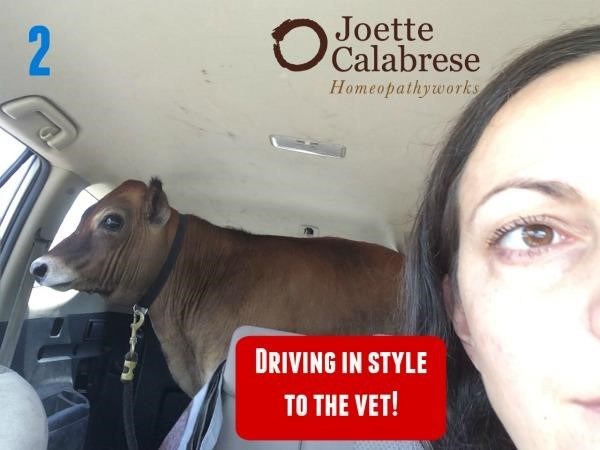
Amazing what you can fit into a Toyota estate!
My husband and I had to tug and haul a bit until Monti finally climbed the makeshift ramp voluntarily (an old door had to serve for this) and I was able to drive him to the vet.
Arriving at the vet, our little companion looked rather pathetic next to all the big pick-up trucks. Every time Monti moved, everything creaked and squeaked. When our vet, who specialises in large animals and never leaves the house without his cowboy hat, saw Monti pulled up, he could barely contain his laughter.
He explained to me that the incision had probably "sealed" because of the great heat and so the exudate could not drain properly. Apparently after such a procedure it is very important that the fluid does not accumulate. If it can drain, no infection develops.
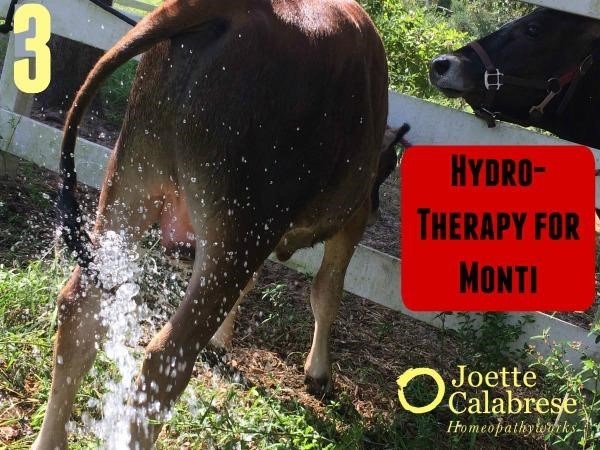
He gave Monti pain relief and opened the wound to disinfect it. He discharged us with the recommendation to flush the wound twice daily (hydrotherapy with the hose). That would promote healing and improve blood flow to the tissue. He also wanted to give an antibiotic.
We drove home hoping that everything would now be fine.
Far from it.
I tried other homeopathic remedies such as Pyrogenium, but after two days the wound was still infected. The area seemed to keep swelling. I checked again and found that the wound had sealed over once more!
Hmm.
I didn't want to make a laughing stock of myself in front of the vet again and decided to open the wound myself – with the help of my nine-year-old son and a dose of Gelsemium to stop him trembling.
First we had to secure Monti safely with three ropes. By the time we were ready, Monti looked pretty miserable. He stood as if nailed to the spot, stretching a hind leg back and looking like a somewhat clumsy ballerina.
I put on gloves and faced the challenge.
To delay things a bit, I repeatedly washed the wound so the tissue would soften a little. After an hour I knew it was time and I pulled off the scab.
Monti cried. I cried. Then poor Monti began bawling. In the background my son was crying and my hands were trembling…
I couldn't help thinking: "Why are you doing this? You're sitting there in the searing heat pulling on a bull's scrotum?!"
After what felt like ten hours – in reality about 20 minutes had passed – the scab was finally completely off. It looked like a bloodbath. Blood and seminal fluid everywhere.
This time I took great care to keep the wound moist. I had bought a pink disinfectant from the feed supplier and dabbed the wound twice daily with it. Monti flinched nearly to death each time.
A few days later the wound still did not look any better.
It had even got worse. Monti and I were at the end of our tether. By now Monti had stopped eating, though he was still suckling from the mother cow. I feared that something even worse was imminent.
In the end I had to give in and got penicillin. I was devastated. I could hardly believe I was willing to give an antibiotic on my own farm. If you know what antibiotics do to ruminants, it can only be disheartening. No wonder dairy cows in large industrial units live only about three years. Animals in hobby farms, by contrast, live 15 years or more. I don't want Monti to die!
At the last minute my wonderful husband encouraged me to try homeopathy once more. At that point it became clear to me that I should have tried our good old Hepar sulph C200 right from the start. It's one of the wonderful remedies for infections we learned about with Joette. Joette has written a lot about this remedy.
So that afternoon I gave Monti Hepar sulph three times at intervals of several hours.
The next morning I could hardly believe my eyes! The swelling had reduced by 50% and after another 24 hours it had decreased significantly again. My mood changed instantly: from total despair to top rockstar!
That Sunday I kept praising myself on the way to church. I was practically floating on my miraculous healing skills.
After the service I visited Monti out on the pasture, still in my Sunday dress and straw hat, just to pat myself on the back once more. What I then saw left me speechless (and that hardly ever happens).
Monti was in the process of giving birth.
We all know bulls don't give birth…
What on earth was that supposed to be?
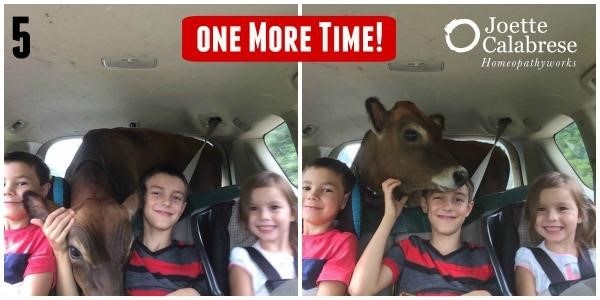
On Monday morning at 5 am my friendly neighbour and I loaded Monti into our estate car again. This time I had all the children in tow. I wish you could have seen the faces of the people we met:
"Hello, you've got a particularly funny dog in your boot!"
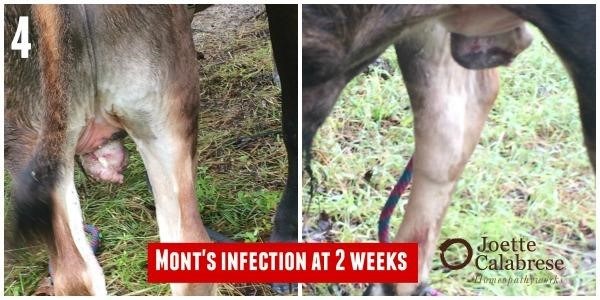
Interestingly, Monti no longer had a fever. The vet told us: "This lump of tissue is inflamed, there is an infection. But the scrotum itself and the wound inside are not inflamed. It's as if the body is trying to push out the infection. How interesting!"
Yes, VERY interesting.
The swelling was vascularised and the vet put a special rubber band on it.
Within three days the strange growth had fallen off and a week later everything was, well, unbelievably fine…
All that remains of the ordeal is an unopened bottle of penicillin in the fridge. This time my joy at the success was somewhat more modest. But the feeling of relief and the pleasure at having achieved something was overwhelming.
THIS is what I love about homeopathy. Thanks to Joette and her good advice I had a choice and could act myself. If you too like to "grab the bull by the horns", then homeopathy is just the thing for you. With a little courage and spit you can accomplish a lot.
Paola

